Andrew Sullivan Is Wrong About the Supreme Court and Guns
via Hit & Run by Damon W. Root on 11/9/11In a long post titled "The Tea Party's Fatal Delusion," Daily Beast blogger Andrew Sullivan takes aim at the "spasm of ideological abstraction and purism" which he says has gripped the American right since 2008 and manifested itself in all sorts of regrettable ways, from "draconian anti-illegal-immigration initiatives" to "the total denial of climate change." I agree with some of Sullivan's criticisms of the modern conservative agenda and disagree with others, but when it comes to his take on the Supreme Court and the Second Amendment he couldn't be more wrong. According to Sullivan, the right's current "spasm" has included "a Supreme Court happy to find radical new interpretations of the Constitution" such as "turning the Second Amendment into something more radical than anything previously contemplated."
Sullivan refers here to District of Columbia v. Heller, the 2008 decision where the Court held that the Second Amendment protects an individual right—not a collective one—to keep and bear arms. For an allegedly radical piece of conservatism, the individual rights interpretation of the Second Amendment has a curiously distinguished list of liberal admirers. Among them are Harvard law professor Laurence Tribe, a longtime friend and adviser to Barack Obama, whose influential legal textbook American Constitutional Law was revised back in 2000 to endorse the individual rights interpretation of the Second Amendment. The two previous editions, published in 1978 and 1988, respectively, had argued that the Second Amendment protected only a collective right, but subsequent legal scholarship prompted Tribe to change his mind. "My conclusion came as something of a surprise to me, and an unwelcome surprise," Tribe later admitted to The New York Times. "I have always supported as a matter of policy very comprehensive gun control." Not exactly the words of a deranged Tea Party extremist.
Other liberal supporters of the "radical" individual rights interpretation include Yale law professor Akhil Reed Amar, one of the most respected progressive legal historians at work today, who has argued that the Second Amendment secures a "core right to self-protection," and University of Texas law professor Sanford Levinson, whose pioneering 1989 Yale Law Journal article "The Embarrassing Second Amendment" argued that it was time for liberals to take the entire Bill of Rights seriously.
In other words, several decades worth of legal scholarship and activism by players of all political stripes helped create the intellectual consensus that culminated in the Heller decision. It was no right-wing "spasm."
Finally, in regards to Sullivan's dubious assertion that Heller turned "the Second Amendment into something more radical than anything previously contemplated," I submit these decidedly non-radical words from Justice Antonin Scalia's opinion for the Heller majority:
Although we do not undertake an exhaustive historical analysis today of the full scope of the Second Amendment, nothing in our opinion should be taken to cast doubt on longstanding prohibitions on the possession of firearms by felons and the mentally ill, or laws forbidding the carrying of firearms in sensitive places such as schools and government buildings, or laws imposing conditions and qualifications on the commercial sale of arms.
Saturday, November 12, 2011
Andrew Sullivan Is Wrong About the Supreme Court and Guns


Occupier Devolution
Occupier Devolution
via Power Line by John Hinderaker on 11/10/11(John Hinderaker)
If you have ever wondered what would happen in a society consisting entirely of liberals, the Occupier movement is providing the answer: devolution. It is almost impossible to keep up with the downward spiral, but here are some of the highlights of the last 24 hours:
* In Portland, an Occupier was arrested for throwing a Molotov cocktail down the stairwell of a building.
* In London, employees of St. Paul's Cathedral have had to clean up human waste left by Occupiers inside the cathedral. (What is it with the Occupiers and toilet issues?)
* In Portland, another drug overdose.
* In Vermont, a man was shot to death at the Occupy Burlington encampment.
* At Occupy San Diego, a citizen journalist was violently assaulted.
* In Atlanta, tuberculosis has broken out among the Occupiers.
* In Salt Lake City, four were arrested after a melee broke out in the Occupy encampment.
* In San Francisco, police expressed concern about escalating violence among the Occupiers, following incidents including gun possession, assault on a city worker and trespassing on the new holiday ice rink.
And this is just a smattering of today's headlines! The Occupiers are conducting a sort of experiment in the viability of left-wing ideas, and the results aren't pretty.
Complex Systems, Part II
Complex Systems, Part II
via John Goodman's Health Policy Blog by John Goodman on 11/9/11In a previous Health Alert, I identified some characteristics of complex systems. Among those were: (1) complex systems are too complicated for any single individual to completely comprehend; (2) simplified models can help, but they are always imperfect; (3) in health care, we don't even have an imperfect model to rely on; and (4) changing the parameters of a complex system always produces unintended consequences that may make matters worse than they were before the change.
In this Health Alert, we want to consider some policy implications.
Complex Systems Cannot Be Managed from the Top, Down. Precisely because knowledge about the system is limited, even the best models are highly imperfect and interventions always produce unintended consequences, top-down management of a complex system never works. The best you can do is to remove perverse incentives faced by those at the bottom — leaving people free to cooperate and solve problems from the bottom-up.
Consider a notorious violation of this principle. At one point, leaders in the Soviet Union thought they could understand enough about their country's entire economy that they could manage the whole thing from a central command post. Today, even the Russians admit they were wrong.
What is true of markets generally, however, is even more true of the health care sector.
The Core Components of Complex Systems Cannot Be Copied. Time and again, Barack Obama has told us how he views health reform. "Let's find out what works," the president says, "and then go copy it." Yet this is precisely what you cannot do with a complex system. The core components cannot be copied, duplicated or replicated.
In the field of education, we have been trying this approach without any success whatsoever, and education is far less complicated than health care. After the publication of "A Nation at Risk" about a quarter of a century ago, alarmed reformers decided to study the best schools to determine what they do that works and to use various carrots and sticks to try to get all other schools to do the same. This is what I call the "demand-side approach" to education reform. How well has this approach worked? Miserably.
Inner-city schools are about as bad as they ever were. So what are we doing about it today? We are continuing with the very same reforms that have failed for 25 years!
Meanwhile, developments in health care are like a parallel universe. On the supply side, we have the islands of excellence (Mayo, Intermountain Healthcare, Cleveland Clinic, etc.). On the demand side, we have a whole slew of experiments with pay-for-performance and other pilot programs designed to see whether demand-side reforms can provoke supply-side behavioral improvements. And never the twain shall meet.
We cannot find a single institution providing high-quality, low-cost care that was created by any demand-sided buyer of care. Not the Centers for Medicare and Medicaid Services. Not Medicare. Not BlueCross. Not any employer. Not any payer, anytime, anywhere. As for the pilot programs, their performance has been lackluster and disappointing.
What about other demand-side reforms: forcing/inducing/coaxing providers to adopt electronic medical records, to coordinate care, to integrate care, to manage care, to emphasize preventive care, to adopt evidence-based medicine, etc.? The Congressional Budget Office (CBO) has reviewed the evidence on all these reforms and concluded that the savings will be meager, if they materialize at all.
One reason why the demand side approach to excellence doesn't work is that there is nothing to be copied. Scholars associated with the Brookings Institution identified 10 of the best hospital regions in the country and then tried to identify common characteristics that could be replicated. There were almost none. Some regions had doctors on staff. Others paid fee-for-service. Some had electronic medical records. Others did not.
A separate study of physicians' practices found much the same thing. There were simply not enough objective characteristics that the practices had in common to allow an independent party to set up a successful practice by copycat alone.
In a recent Health Alert, I invited readers to consider applying the copycat approach to becoming as rich as Bill Gates, Warren Buffett or Sam Walton. If we could discover what they did right, and everyone copied their behavior, then we could all become billionaires. Right? Well, not quite.
Here's the problem: In order for each of us to be a billionaire, we have to each be doing something that produces a billion dollars' worth of goods and services. But if all we're doing is copying action items out of a book, then we are not doing anything special. And if we're not doing anything special, we are definitely not producing a billion dollars of value added.
Although there are some habits of highly successful people that can be identified and copied, there are not enough of them for each of us to become highly successful ourselves through copycat behavior alone.
Choosing Public Policies for Complex Systems. Most people in health policy do not understand complex systems. They really don't understand social science models either. As a result, when they advocate or enact public policies, they are almost always oblivious to the inevitability of unintended consequences. The idea that a policy based on good intentions could actually make things worse is beyond their comprehension.
This problem is not unique to health care. I think it is fair to say that virtually everything we do to try to help low-income families meet essential needs is deeply flawed. In general, the middle class tends to have access to the benefits of capitalism. The poor must rely on government. The middle class exercises choice. The poor have no alternative to what they are offered. The middle class gets the benefits of competition. The poor are left with public sector monopoly. If a middle-class patient is unsatisfied with a doctor or a facility, she can take her dollars and patronize another. The poor tend to be left with whatever doctor or facility is given them.
In general, no one ever planned for the poor to have services that were inferior, bureaucratic and unresponsive. These outcomes are the unintended consequences of policies that were often designed to help them!
Public Policy Lessons. When dealing with a complex system for which there is no reliable predictive model, the first lesson is to show humility. Don't restrict people's behavior when you don't know what you are doing. Restrictions on behavior limit people's ability to meet their own needs and the needs of others. In the absence of better information, we should want people to freely exercise their intelligence, their creativity and their entrepreneurial abilities to solve problems.
A second lesson is that we should eliminate restrictions on behavior unless there is overwhelming evidence that they do more good than harm. This means, for example, allowing low-income families on Medicaid greater access to services whose prices are determined in the marketplace. Let Medicaid enrollees add to Medicaid's fee with out of pocket money and pay the market price at walk-in clinics, surgi-centers and free standing emergency care clinics. Also, we should make it easier for nurses, physicians' assistants and other non-doctor providers to deliver care to low-income patients by relaxing occupational licensing restrictions.
A third lesson is to avoid trying to administer and regulate the system from the top. If we are dealing with a complex system and we don't have a reliable model to predict how it will respond to simple parameter changes, it is more important than ever to avoid trying to solve problems with top down commands. Instead, we need to begin the process of liberation by working from the bottom up.
Disappointing a Reporter
Disappointing a Reporter
via John Goodman's Health Policy Blog by Greg Scandlen on 11/10/11A reporter who is new to the health care wars contacted me the other day. She already had a pretty good idea of the liberal point of view — expand government — and wanted the conservative viewpoint. She assumed that meant "privatization." She asked several questions, such as:
What do you think privatization of the entire health care system would do to fix it? Why does this work better than the opposite, a universal system run by the government?I'm afraid I disappointed her by responding with this:
Calling what I have been advocating "privatization" is too simplistic. That is not descriptive at all. Let me explain.My contention is that the core problem in health care is third-party payment — having other people pay the bills on our behalf. It matters some (but not much) if that third-party payer (TPP) is public or private. In fact virtually all the "public" payers contract out to private insurers for the administration of the programs.TPPs may be private insurers, employers, or government agencies. They all have the same insidious effects: (1.) They add administrative costs that take away from patient care. (2.) They substitute their judgment for ours even though they don't know us and really don't much care about OUR needs, values, priorities, resources, family structure, or emotional condition.This is doubly ironic since every penny they spend on our healthcare comes from us. There is simply no other source. It is our money in the form of premiums, taxes, or lost wages. It is supposed to be spent for our benefit.We have been trying to get this system of third-party payment to work for 50 years. Sometimes the government is dominant, other times, employers, other times private insurers. Many billions of dollars have been spent trying to tweak it — rate setting, managed care, contract negotiations, DRGs, universal health programs, Medicaid expansion, and on and on and on. None of it has worked. We have instead a system that is inefficient, bureaucratic, inconvenient, unaccountable, and waaaay too expensive.The Affordable Care Act is just more of the same — maybe this time if we have this requirement and that mandate and these regulations we'll be able to get everything to work out just right. It is a fantasy. Replacing HMOs with ACOs will do nothing to fix the system. Mandating that people must buy lousy insurance does not improve anything.We need real reform. We now have an inkling of what WILL work in the form of "consumer driven health care." HSAs are just a baby step in the right direction, but so far the evidence is overwhelming that putting the money in the hands of the consumer/patient creates the change we need. People get the services they want at a price they think provides value.But the so-called "policy community" hates this idea because it disempowers them. Allowing people to control their own money means that policy makers lose control.Hope this helps.YIKES! She said, "This is an interesting option that I haven't really heard!" And asked some follow-up questions centered around the idea that health insurance would be banished. She asked whether the government would be involved at all, how such an idea would hold down costs, and how the poor would fare.
I replied:
Well, not quite that, either.Insurance is different than third-party payment. Insurance is a two-party contract, like your auto insurance. You pay the premium, and the insurer pays you when something bad happens. That is fine, but different people will choose different levels of coverage, again depending on their own circumstances. It would be there for the kinds of high cost conditions you cite.Of course the government should be involved. It needs to regulate the insurance companies to make sure they will pay the promised benefits.Government is also involved in setting tax policy. Current tax law gives an unlimited tax break to employer-sponsored plans, but none at all to people who buy their own coverage. This should be equalized.Lower income people can be subsidized with vouchers. I would suggest a sliding scale voucher based on income. This would be another role for government.On cost containment, consumer driven plans (like HSAs) are the only approach that has been proven to hold down costs. Researchers at the Rand Corporation found they lower costs by 30%.But, yes, as much as possible there should be direct payment of services. This completely eliminates administrative waste for both payers and providers.And, btw, Medicare should also be reformed to include HSAs. The Feds could continue to provide the back-up insurance, but Parts A and B would be merged into a single program with an across the board deductible with 100% coverage after that. The deductible would be set wherever the actuaries say is appropriate to keep in revenue neutral — probably in the $2,000 to $3,000 range. People would not have to buy Medigap coverage any longer.Oy gavalt! It's so confusing. Methinks she won't have any more questions, at least not for me.
Tuesday, November 08, 2011
132 Economists Support Republican Job Creation Plan
132 Economists Support Republican Job Creation Plan
via The Weekly Standard Blog by Daniel Halper on 11/8/11
A press release from Speaker of the House John Boehner's office announces "a list of 132 American economists who believe the job creation strategy used in the House GOP Plan for America's Job Creators will do more to boost private-sector job growth in America in both the near-term and long-term than the "stimulus" spending approach favored by President Obama."
The list is in response to Boehner's question to economists: "which do you believe is more likely to provide a boost for private-sector job growth in America in both the near- and long-term: a plan focused on billions of dollars in additional "stimulus" spending by government – or a plan focused on halting excessive government regulations and fixing the tax code to help private-sector job creators? A total of 132 economists indicated they clearly favor the latter strategy. The list of 132 economists includes experts from Stanford University's Hoover Institution, Carnegie Mellon University, and Harvard University; economists from the American Enterprise Institute (AEI), the Manhattan Institute, and the American Action Forum; and many others."
Here are the 132 economists who support the Republican job creation plan:
Douglas K. Adie
Ohio University
Tim Bastion
Creighton University
Walter E. Block
Loyola University New Orleans
Scott Bradford
Brigham Young University
Alex Brill
American Enterprise Institute
Edgar K. Browning
Texas A&M University
Phillip J. Bryson
Brigham Young University
William N. Butos
Trinity College
Victor A. Canto
La Jolla Economics
Kenneth W. Chilton
Lindenwood University
John F. Cogan
Hoover Institution
Peter F. Colwell
University of Illinois
Clyde Wayne Crews, Jr.
Competitive Enterprise Institute
Coldwell Daniel III
University of Memphis
William P. Albrecht
University of Iowa
Christopher Baum
Boston College
Michael J. Boskin
Hoover Institution
Judith Staley Brenneke
John Carroll University
Wayne T. Brough
FreedomWorks
Lawrence Brunner
Central Michigan University
James L. Butkiewicz
University of Delaware
Charles W. Calomiris
Columbia University
Don Chance
Louisiana State University
R. Morris Coats
Nicholls State University
Robert Collinge
University of Texas at San Antonio
Mike Cosgrove
University of Dallas
Robert M. Dammon
Carnegie Mellon University
Lawrence S. Davidson
Indiana University
Antony Davies
Duquesne University
Clarence R. Deitsch
Ball State University
Allan DeSerpa
Arizona State University
John Eckalbar
California State University, Chico
John B. Egger
Towson University
Frank Falero
California State University
Dorsey D. Farr
French Wolf & Farr
Fred Foldvary
Santa Clara University
Peter Frank
Wingate University
Diana E. Furchtgott-Roth
Manhattan Institute for Policy Research
Otis W. Gilley
Louisiana Tech University
Richard Gordon
Pennsylvania State University
Scott F. Grannis
Calafia Beach Pundit
John D. Grether
Northwood University
Dennis Halcoussis
California State University, Northwood
John P. Hoehn
Michigan State University
C. Thomas Howard
University of Denver
Ronnie H. Davis
Florida Institute of Technology
Joseph S. DeSalvo
University of South Florida, Tampa
Floyd H. Duncan
Virginia Military Institute
Francis J. Egan
Trinity College
Dorla A. Evans
University of Alabama, Huntsville
Eugene F. Fama
University of Chicago
W. Ken Farr
Georgia College & State University
William Ford
Middle Tennessee State University
Douglas C. Frechtling
George Washington University
James Garven
Baylor University
Micha Gisser
University of New Mexico
Ernest P. Goss
Creighton University
Paul Gregory
University of Houston
Earl L. Grinols
Baylor University
Kevin Hassett
American Enterprise Institute
Douglas Holtz-Eakin
American Action Forum
Forrest E. Huffman
Temple University
Steve Jackstadt
University of Alaska Anchorage
Joseph M. Jadlow
Oklahoma State University
Adrienne A. Kearney
University of Maine
Arnold Kling
Cato Institute
Kishore G. Kulkarni
Metropolitan State College of Denver
Dwight R. Lee
Southern Methodist University
Tom Lehman
Indiana Wesleyan University
Tony Lima
California State University, East Bay
William A. Luksetich
St. Cloud State University
Glenn MacDonald
Washington University in St. Louis
Michael W. Marlow
California Polytechnic University
W. Douglas McMillin
Louisiana State University
Allan Meltzer
Carnegie Mellon University
Jeffrey Miron
Harvard University
Frank Navratil
John Carroll University
Farrokh Nourzad
Marquette University
James B. O'Neill
University of Delaware
Brian Jacobsen
Wisconsin Lutheran College
Jason Scott Johnson
University of Virginia
Barry Keating
University of Notre Dame
Meir G. Kohn
Dartmouth College
Arthur B. Laffer
Laffer Associates
Don R. Leet
California State University, Fresno
Stan Liebowitz
University of Texas-Dallas
Alan Lockard
St. Lawrence University
R. Ashley Lyman
University of Idaho
Yuri N. Maltsev
Carthage College
Timothy Mathews
Kennesaw State University
Roger Meiners
University of Texas-Arlington
John D. Merrifield
University of Texas at San Antonio
Ed Miseta
Penn State Erie, The Behrend College
Jinlan Ni
University of Nebraska at Omaha
Lee Ohanian
University of California Los Angeles
Randall Parker
East Carolina University
Judd W. Patton
Bellevue University
G. Michael Phillips
California State University, Northridge
Ronald L. Promboin
University of Maryland University College
Paul Rubin
Emory University
Raymond Sauer
Clemson University
John Seater
North Carolina State University
Vlad Signorelli
Bretton Woods Research, LLC
James F. Smith
EconForecaster
Dean Stansel
Florida Gulf Coast University
Derek Stimel
Menlo College
Alan Sykes
Stanford University
Daniel Talley
Dakota State University
Henry Thompson
Auburn University
William N. Trumbull
West Virginia University
Richard Vedder
Ohio University
Richard E. Wagner
George Mason University
Christopher Westley
Jacksonville State University
Mark J. Perry
University of Michigan-Flint
Barry W. Poulson
University of Colorado
Mario J. Rizzo
New York University
John Rutledge
Claremont Graduate University
Mike Schuyler
Institute for Research on the Economics of Taxation
George P. Shultz
Hoover Institution
Marc W. Simpson
Northern Illinois University
Lawrence Southwick
University at Buffalo
Jeffrey Steagall
Weber State University
Brian Strow
Western Kentucky University
Daniel Talley
Dakota State University
Robert Tamura
Clemson University
Steven A. Tolbert Jr.
Montgomery County Community College (PA)
David Tufte
Southern Utah University
George J. Viksnins
Georgetown University
Brian Westbury
First Trust Advisors
Gary Wolfram
Hillsdale College
Qi Zhang
Old Dominion University
Joseph Zoric
Franciscan University of Steubenville
Benjamin Zycher
American Enterprise Institute and Pacific Research Institute
Myths of the Great Depression
Old myths never die; they just keep showing up in college economics and political science textbooks. Students today are frequently taught that unfettered free enterprise collapsed of its own weight in 1929, paving the way for a decade-long economic depression full of hardship and misery. President Herbert Hoover is presented as an advocate of “hands-off,” or laissez-faire, economic policy, while his successor, Franklin Roosevelt, is the economic savior whose policies brought us recovery. This popular account of the Depression belongs in a book of fairy tales and not in a serious discussion of economic history, as a review of the facts demonstrates.....To properly understand the events of the time, it is appropriate to view the Great Depression as not one, but four consecutive depressions rolled into one. Professor Hans Sennholz has labeled these four “phases” as follows: the business cycle; the disintegration of the world economy; the New Deal; and the Wagner Act.[1]The first phase explains why the crash of 1929 happened in the first place; the other three show how government intervention kept the economy in a stupor for over a decade.
Phase I: The Business Cycle
The Great Depression was not the country’s first depression, though it proved to be the longest. The common thread woven through the several earlier debacles was disastrous manipulation of the money supply by government. For various reasons, government policies were adopted that ballooned the quantity of money and credit. A boom resulted, followed later by a painful day of reckoning. None of America’s depressions prior to 1929, however, lasted more than four years and most of them were over in two. The Great Depression lasted for a dozen years because the government compounded its monetary errors with a series of harmful interventions.
....
The stock market crash was only a symptom—not the cause—of the Great Depression: the market rose and fell in near synchronization with what the Fed was doing.
Phase II: Disintegration of the World Economy
If this crash had been like previous ones, the subsequent hard times might have ended in a year or two. But unprecedented political bungling instead prolonged the misery for twelve long years.
Unemployment in 1930 averaged a mildly recessionary 8.9 percent, up from 3.2 percent in 1929. It shot up rapidly until peaking out at more than 25 percent in 1933. Until March 1933, these were the years of President Herbert Hoover—the man that anti-capitalists depict as a champion of noninterventionist, laissez-faire economics.
Did Hoover really subscribe to a “hands off the economy,” free-market philosophy? His opponent in the 1932 election, Franklin Roosevelt, didn’t think so. During the campaign, Roosevelt blasted Hoover for spending and taxing too much, boosting the national debt, choking off trade, and putting millions of people on the dole. He accused the president of “reckless and extravagant” spending, of thinking “that we ought to center control of everything in Washington as rapidly as possible,” and of presiding over “the greatest spending administration in peacetime in all of history.” Roosevelt’s running mate, John Nance Garner, charged that Hoover was “leading the country down the path of socialism.”[4] Contrary to the modern myth about Hoover, Roosevelt and Garner were absolutely right.
The crowning folly of the Hoover administration was the Smoot-Hawley Tariff, passed in June 1930. It came on top of the Fordney-McCumber Tariff of 1922, which had already put American agriculture in a tailspin during the preceding decade. The most protectionist legislation in U.S. history, Smoot-Hawley virtually closed the borders to foreign goods and ignited a vicious international trade war. Professor Barry Poulson notes that not only were 887 tariffs sharply increased, but the act broadened the list of dutiable commodities to 3,218 items as well.[5]....To compound the folly of high tariffs and huge subsidies, Congress then passed and Hoover signed the Revenue Act of 1932. It doubled the income tax for most Americans; the top bracket more than doubled, going from 24 percent to 63 percent. Exemptions were lowered; the earned income credit was abolished; corporate and estate taxes were raised; new gift, gasoline, and auto taxes were imposed; and postal rates were sharply hiked.
Can any serious scholar observe the Hoover administration’s massive economic intervention and, with a straight face, pronounce the inevitably deleterious effects as the fault of free markets?
Phase III: The New Deal
Franklin Delano Roosevelt won the 1932 presidential election in a landslide, collecting 472 electoral votes to just 59 for the incumbent Herbert Hoover. The platform of the Democratic Party whose ticket Roosevelt headed declared, “We believe that a party platform is a covenant with the people to be faithfully kept by the party entrusted with power.” It called for a 25 percent reduction in federal spending, a balanced federal budget, a sound gold currency “to be preserved at all hazards,” the removal of government from areas that belonged more appropriately to private enterprise, and an end to the “extravagance” of Hoover’s farm programs. This is what candidate Roosevelt promised, but it bears no resemblance to what President Roosevelt actually delivered.
In the first year of the New Deal, Roosevelt proposed spending $10 billion while revenues were only $3 billion. Between 1933 and 1936, government expenditures rose by more than 83 percent. Federal debt skyrocketed by 73 percent.
....
The American economy was soon relieved of the burden of some of the New Deal’s excesses when the Supreme Court outlawed the NRA in 1935 and the AAA in 1936, earning Roosevelt’s eternal wrath and derision. Recognizing much of what Roosevelt did as unconstitutional, the “nine old men” of the Court also threw out other, more minor acts and programs which hindered recovery.
Freed from the worst of the New Deal, the economy showed some signs of life. Unemployment dropped to 18 percent in 1935, 14 percent in 1936, and even lower in 1937. But by 1938, it was back up to 20 percent as the economy slumped again. The stock market crashed nearly 50 percent between August 1937 and March 1938. The “economic stimulus” of Franklin Roosevelt’s New Deal had achieved a real “first”: a depression within a depression!
Phase IV: The Wagner Act
The stage was set for the 1937–38 collapse with the passage of the National Labor Relations Act in 1935—better known as the Wagner Act and organized labor’s “Magna Carta.” To quote Hans Sennholz again:
This law revolutionized American labor relations. It took labor disputes out of the courts of law and brought them under a newly created Federal agency, the National Labor Relations Board, which became prosecutor, judge, and jury, all in one. Labor union sympathizers on the Board further perverted this law, which already afforded legal immunities and privileges to labor unions. The U.S. thereby abandoned a great achievement of Western civilization, equality under the law.[8]Armed with these sweeping new powers, labor unions went on a militant organizing frenzy. Threats, boycotts, strikes, seizures of plants, and widespread violence pushed productivity down sharply and unemployment up dramatically. Membership in the nation’s labor unions soared; by 1941 there were two and a half times as many Americans in unions as in 1935.
From the White House on the heels of the Wagner Act came a thunderous barrage of insults against business. Businessmen, Roosevelt fumed, were obstacles on the road to recovery. New strictures on the stock market were imposed. A tax on corporate retained earnings, called the “undistributed profits tax,” was levied. “These soak-the-rich efforts,” writes economist Robert Higgs, “left little doubt that the president and his administration intended to push through Congress everything they could to extract wealth from the high-income earners responsible for making the bulk of the nation’s decisions about private investment.”[9]....Whither Free Enterprise?
On the eve of America’s entry into World War II and twelve years after the stock market crash of Black Thursday, ten million Americans were jobless. Roosevelt had pledged in 1932 to end the crisis, but it persisted two presidential terms and countless interventions later.
Along with the horror of World War II came a revival of trade with America’s allies. The war’s destruction of people and resources did not help the U.S. economy, but this renewed trade did. More important, the Truman administration that followed Roosevelt was decidedly less eager to berate and bludgeon private investors, and as a result, those investors came back into the economy to fuel a powerful postwar boom.
The genesis of the Great Depression lay in the inflationary monetary policies of the U.S. government in the 1920s. It was prolonged and exacerbated by a litany of political missteps: trade-crushing tariffs, incentive-sapping taxes, mind-numbing controls on production and competition, senseless destruction of crops and cattle, and coercive labor laws, to recount just a few. It was not the free market that produced twelve years of agony; rather, it was political bungling on a scale as grand as there ever was.
Monday, November 07, 2011
Does it matter that a lot of people are wrong about evolution? | Samizdata.net
Does it matter that a lot of people are wrong about evolution? | Samizdata.net
my concern here is not whether Dawkins is right that evolution has happened and is happening. Of course he is, of course it has and of course it is. No, what interests me is whether the fact that so many people now, still, deny the truth of evolution matters. Dawkins thinks that this rejection of one of the central achievements of science isscandalous and appalling, and that these crackpot creationists must be told the error of their ways, and told and told again, until they return to the straight and narrow. Me? I don’t think I care that much.
To illustrate my point with a contrast, I think it matters a very great deal that so many people have been and continue to be so very, very wrong about the nature of the financial crisis that now afflicts the world. Errors in this matter are not merely erroneous. They are errors with huge and hugely damaging consequences. Millions have already suffered horribly because of these errors. Millions more are about to. But who is suffering because of creationism? Why does it matter to the rest of us what creationists think? Are creationists forcing their nonsense upon others? Maybe to some extent they are. Many potential commenters will know a lot more about the answer to that question than I do. If creationists are doing this, that would be a reason to berate them about all the errors they are making. But, are they?
Another good reason to go after creationists is to demoralise them, because of the other bad things that creationists are doing.
But what other bad political projects are creationists contributing to? Dawkins regards the USA’s aggressive policies in the Middle East as very bad, and thinks that Christian creationists are responsible for these policies in a big way. I agree that occupying foreign countries these days tends to be a mistake, while shorter, in-and-out attacks, with fewer pretensions in the direction of telling the locals how to govern themselves (such as I hope and trust the recent Libyan escapade has been (and fear that it may not be)), are also fraught with peril but seem, on the face of it, somewhat less harmful. But I don’t think that Christian creationists are by any means the only people who support such military operations.
A Lesson on the Laffer Curve for Barack Obama
via Big Government by Dan Mitchell on 11/6/11One of my frustrating missions in life is to educate policy makers on the Laffer Curve.
This means teaching folks on the left that tax policy affects incentives to earn and report taxable income. As such, I try to explain, this means it is wrong to assume a simplistic linear relationship between tax rates and tax revenue. If you double tax rates, for instance, you won't double tax revenue.
But it also means teaching folks on the right that it is wildly wrong to claim that "all tax cuts pay for themselves" or that "tax increases always mean less revenue." Those results occur in rare circumstances, but the real lesson of the Laffer Curve is that some types of tax policy changes will result in changes to taxable income, and those shifts in taxable income will partially offset the impact of changes in tax rates.
However, even though both sides may need some education, it seems that the folks on the left are harder to teach – probably because the Laffer Curve is more of a threat to their core beliefs.
If you explain to a conservative politician that a goofy tax cut (such as a new loophole to help housing) won't boost the economy and that the static revenue estimate from the bureaucrats at the Joint Committee on Taxation is probably right, they usually understand.
But liberal politicians get very agitated if you tell them that higher marginal tax rates on investors, entrepreneurs, and small business owners probably won't generate much tax revenue because of incentives (and ability) to reduce taxable income.
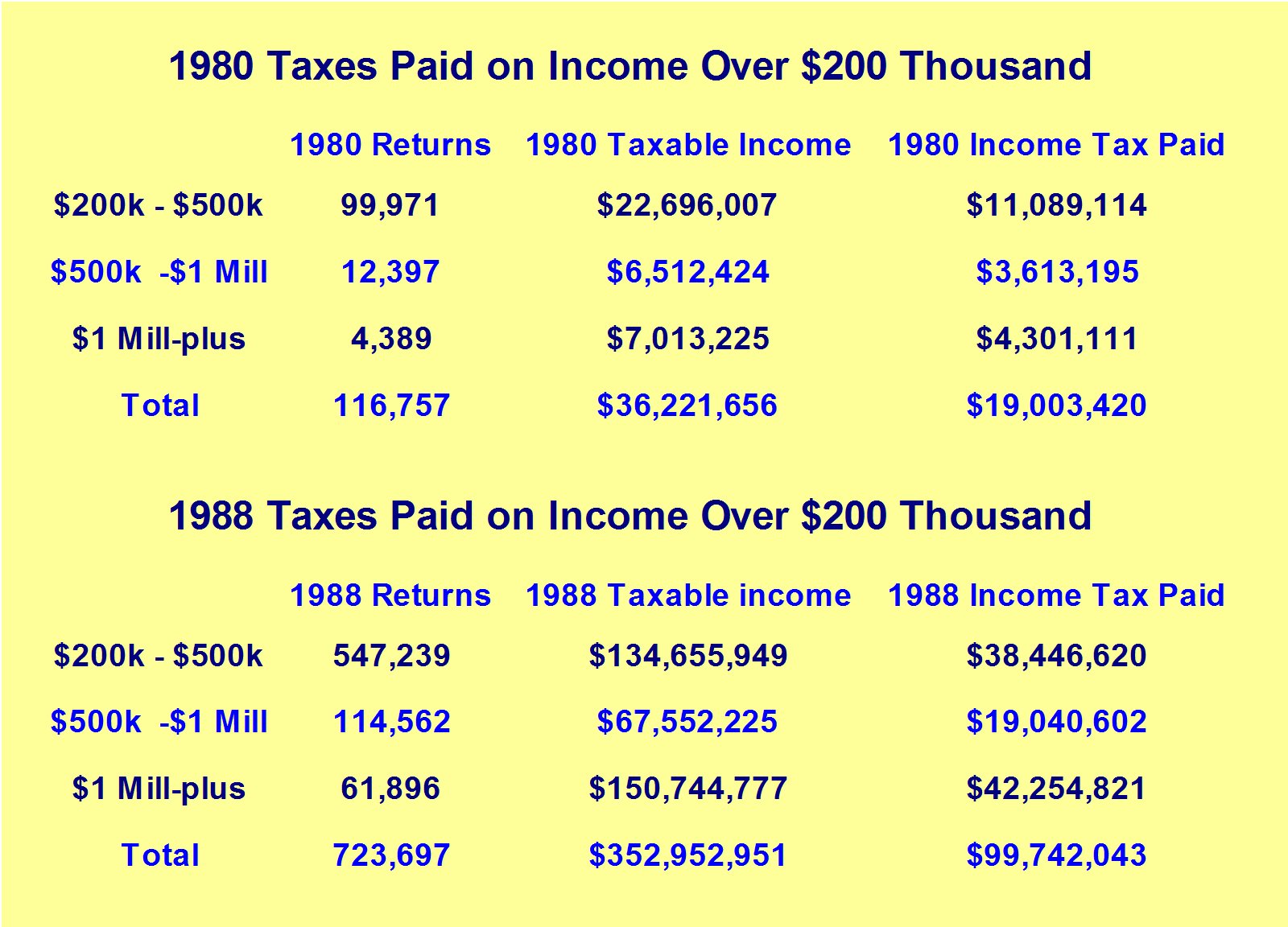
To be fair, though, some folks on the left are open to real-world evidence. And this IRS data from the 1980s is particularly effective at helping them understand the high cost of class-warfare taxation (click to enlarge).
There's lots of data here, but pay close attention to the columns on the right and see how much income tax was collected from the rich in 1980, when the top tax rate was 70 percent, and how much was collected from the rich in 1988, when the top tax rate was 28 percent.
The key takeaway is that the IRS collected fives times as much income tax from the rich when the tax rate was far lower. This isn't just an example of the Laffer Curve. It's the Laffer Curve on steroids and it's one of those rare examples of a tax cut paying for itself.
Folks on the right, however, should be careful about over-interpreting this data. There were lots of factors that presumably helped generate these results, including inflation, population growth, and some of Reagan's other policies. So we don't know whether the lower tax rates on the rich caused revenues to double, triple, or quadruple. Ask five economists and you'll get nine answers.
But we do know that the rich paid much more when the tax rate was much lower.
This is an important lesson because Obama wants to run this experiment in reverse. He hasn't proposed to push the top tax rate up to 70 percent, thank goodness, but the combined effect of his class-warfare policies would mean a substantial increase in marginal tax rates.
We don't know the revenue-maximizing point of the Laffer Curve, but Obama seems determined to push tax rates so high that the government collects less revenue. Not that we should be surprised. During the 2008 campaign, he actually said he would like higher tax rates even if the government collected less revenue.
That's class warfare on steroids, and it definitely belong on the list of the worst things Obama has ever said.
But I don't care about the revenue-maximizing point of the Laffer Curve. Policy makers should set tax rates so we're at the growth-maximizing level instead.
To broaden the understanding of the Laffer Curve, share these three videos with your friends and colleagues.
This first video explains the theory of the Laffer Curve.
This second video reviews some of the real-world evidence.
And this video exposes the biased an inaccurate "static scoring" of the Joint Committee on Taxation.
And once we educate everybody about the Laffer Curve, we can then concentrate on teaching them about the equivalent relationship on the spending side of the fiscal ledger, the Rahn Curve.



Sunday, November 06, 2011
The Cain Mutiny
Articles: Razing Cain
Based on the track record, the more noise is made about Cain, the more people are tending to discount the charges.
Based on the track record, the more noise is made about Cain, the more people are tending to discount the charges.
Maybe Cain behaved badly. Maybe the women were unhappy in their jobs and took advantage of a legal regime that--especially in the wake of the furor over Anita Hill's unsubstantiated accusations of ribaldry against Clarence Thomas--is highly indulgent of sexual-harassment allegations. Maybe the real story is something in between and involves elements of misunderstanding.
Saturday, November 05, 2011
So, Newt didn’t ask his wife for a divorce on her death-bed?
So, Newt didn’t ask his wife for a divorce on her death-bed?
via GayPatriot by B. Daniel Blatt on 11/2/11If you want to know why so many conservatives were initially skeptical of the allegations leveled against Herman Cain, all you need do is read the latest column by former House Speaker Newt Gingrich's daughter, Jackie Gingrich Cushman. For the longest time, our liberal friends have told us how the Georgia Republican presented his first [...]
More Kwick Kicks...
I love the last sentence.
More Kwick Kicks...
via Big Lizards by Dafydd on 10/28/11
Shocking everyone, Democrats in the Senate have launched a campaign to repeal the Defense of Marriage Act, DOMA; this is the federal law that (section 3) defines marriage for federal purposes as only being between one man and one woman, and (section 2) -- most important -- allows states to refuse to recognize same-sex marriage (SSM), even when the couple is legally married in some other state.
Without section 2, the distinction between states that do and do not recognize SSM would be utterly lost, as any two persons of the same sex could marry in an SSM state, then demand that every other state in the United States recognize the union as the same as traditional marriage. We would lose a huge chunk of Federalism, as states could no longer define marriage as the citizens of that state decide; it would all be decided by Washington D.C.
So you can follow along on your scorecard, here is the complete law; well, the definitional part, that is:
Section 2. Powers reserved to the statesBy seeking to repeal DOMA, Senate Democrats signal the full and complete capitulation to the most radical of gay-"rights" leaders: They would rather destroy legal marriage itself, the very fabric of Western culture, than tolerate traditional marriage in any of the
No State, territory, or possession of the United States, or Indian tribe, shall be required to give effect to any public act, record, or judicial proceeding of any other State, territory, possession, or tribe respecting a relationship between persons of the same sex that is treated as a marriage under the laws of such other State, territory, possession, or tribe, or a right or claim arising from such relationship.
Section 3. Definition of marriage
In determining the meaning of any Act of Congress, or of any ruling, regulation, or interpretation of the various administrative bureaus and agencies of the United States, the word 'marriage' means only a legal union between one man and one woman as husband and wife, and the word 'spouse' refers only to a person of the opposite sex who is a husband or a wife.5750 states.
But that's not what I want to talk about. Yes, you read right; the entire post to this point has been nothing but preamble. Here is the part to which I intend to draw your intention... this quotation from the Washington Times story on the hoped-for death of DOMA:
The issue is bound to face strong opposition from Republicans, who would likely have the votes to filibuster the legislation should it reach the Senate floor. And it's unlikely to make it to the GOP-controlled House at all.I am appalled that even a somewhat more conservative newspaper has been sucked into the fantasy of a "gay movement," as if sexual orientation is a supercategory the gulps up everything even superficially related to homosexuality. But more properly, a veritable Valles Marineris gapes between, on the one hand, the demand for the end of "Don't Ask, Don't Tell" (DADT) and the overturning (by the Supreme Court decision in Lawrence v. Texas) of laws against "sodomy," however defined; and on the other hand, the shrill insistance upon federal legislation accepting and promoting SSM.
But the measure comes at a time when gay and lesbian advocates are on a roll, having won repeal of the military's "don't ask, don't tell" policy in Congress late last year.
It's vital that America discriminate between the two species of demand:
Lawrence should have been based upon the First Amendment's freedom of assembly, rather than the amorphous and ill-defined (but trendy!) "right of privacy"; and the repeal of DADT should have been based upon the unenumerated but self-evident right of every citizen and legal resident to defend his country, society, and culture; it's a simple extension of the fundamental right of self defense.
- Whether you agree or disagree with Lawrence -- which held that anti-sodomy laws violated "privacy rights" -- or with allowing gays to serve openly in the military, these claims are based upon the liberty argument: that people have a fundamental core of individual integrity, which cannot be subdivided, and inside of which governments cannot legislate.
Similarly, a law (federal or state) mandating vegetarianism would be an egregious violation of fundamental individual liberty, as would a law forbidding self defense or defense of one's family (or of any innocent person, for that matter).
It's not that gays want the right to live together, to consider themselves married, or even to be declared married in the eyes of God, according to a particular church; for they already have those rights (and I completely support them). Rather, they demand not merely that you allow them to pursue their own happiness, but that you agree with and support their lifestyle... and that you consent to equate an outré sexual relationship with the traditional Western and American relationship called marriage.
- Contrariwise, a demand for legal recognition of SSM (same-sex marriage) cannot be based upon simple liberty; for it entails not simply the right to be let alone, to be allowed to be oneself, but the demand that the rest of society embrace one's actions and declarations.
(Not merely outré but antithetical to what I consider the main point of traditional, even more axiomatic than the raising of children: the union of the female and male elements of humanity, the yin and yang. Opposite-sex marriage serves to moderate the extremes of both sexes, producing a stable and fruitful (in several senses) society. By contrast, SSM tends to exaggerate the bad tendencies of both sexes, leading to extremism and even fanaticism.)
Enforced SSM sails directly athwart the First Amendment's guarantee of freedom of religion, speech, and association: If we're forced to equate same-sex couples with opposite-sex couples for purposes of marriage -- speaking of them as married, suppressing any religious-based criticism, and compelled to let them live together as if married, even in a room I might rent out within my own house -- then dissent from liberal orthodoxy is criminal, upon penalty of prosecution or administrative punishment.
Thus conservatives (I am not one) fall into grave error when they accept the idea that there is a "gay agenda," defined as the collection of all laws or policies that most homosexuals and many libertine liberals want to enact. Discrimination in this case is vital, and the real divide is between liberty interests (allowing the individual to live his life as he sees fit) and social reprogramming -- forcing society to transmogrify from the traditional American Borg culture into a limp, squishy, bowl of moral pablum, where all that matters is feeding the maw of every special-interest group temporarily important to the ruling class.
It's easy to draw the line between freedom of association and the right to defend oneself, one's loved ones, and one's society on the one hand, and the peremptory demand that all of us espouse the absurdity that same-sex relationships are identical to opposite-sex relationships.
It's like legally declaring cows to be vegetables, just so that everyone can be called a vegetarian.
Friday, November 04, 2011
Rebutting the “Gingrich abandons cancer-stricken wife” canard
Rebutting the “Gingrich abandons cancer-stricken wife” canard
via Bookworm Room by Bookworm on 11/3/11Why, oh, why, oh, why do we believe anything the media says about conservatives? I wrote yesterday that Gingrich is a principled conservative with an unprincipled private life (thinking mostly about his abandoning his cancer-stricken wife), while Romney is an unprincipled conservative with a principled private life.
Not only does it turn out that Romney is an even less principled conservative than we thought, it also turns out that much of what you thought you knew about Gingrich's private life is a lie. His daughter is now setting the record straight:
For years, I have thought about trying to correct the untrue accounts of this hospital visit. After all, I was at the hospital with them, and saw and heard what happened. But I have always hesitated, as it was a private family matter and my mother is a very private person. In addition, for the four people involved, it was one of a million interactions and was not considered a defining event by any of us.Please read the rest here. (Hat tip: Earl Aagaard)
My mother and I have both recently run into quite a few people who hold an inaccurate understanding of this hospital visit. Many think my mother is dead.
So, to correct the record, here is what happened: My mother, Jackie Battley Gingrich, is very much alive, and often spends time with my family. I am lucky to have such a "Miracle Mom," as I titled her in a column this week.
As for my parents' divorce, I can remember when they told me.
It was the spring of 1980.
I was 13 years old, and we were about to leave Fairfax, Va., and drive to Carrollton, Ga., for the summer. My parents told my sister and me that they were getting a divorce as our family of four sat around the kitchen table of our ranch home.
Soon afterward, my mom, sister and I got into our light-blue Chevrolet Impala and drove back to Carrollton.
Later that summer, Mom went to Emory University Hospital in Atlanta for surgery to remove a tumor. While she was there, Dad took my sister and me to see her.
It is this visit that has turned into the infamous hospital visit about which many untruths have been told. I won't repeat them. You can look them up online if you are interested in untruths. But here's what happened:
My mother and father were already in the process of getting a divorce, which she requested.
Dad took my sister and me to the hospital to see our mother.
She had undergone surgery the day before to remove a tumor.
The tumor was benign.
I am leaning more and more to Gingrich, the tortoise in this race, if for no other reason than the pleasure I would get seeing him eviscerate the "articulate" Obama during head-on debates.
Even if you're not a Gingrich fan, I urge you to pass on this post (or the original Jackie Gingrich Cushman post), so that Newt can fight his political battle on true, not false, grounds.

Thursday, November 03, 2011
The Old Astronomer
The Old Astronomer to His Pupil
Reach me down my Tycho Brahe, I would know him when we meet,
When I share my later science, sitting humbly at his feet;
He may know the law of all things, yet be ignorant of how
We are working to completion, working on from then to now.
Pray remember that I leave you all my theory complete,
Lacking only certain data for your adding, as is meet,
And remember men will scorn it, 'tis original and true,
And the obloquy of newness may fall bitterly on you.
But, my pupil, as my pupil you have learned the worth of scorn,
You have laughed with me at pity, we have joyed to be forlorn,
What for us are all distractions of men's fellowship and smiles;
What for us the Goddess Pleasure with her meretricious smiles!
You may tell that German College that their honor comes too late,
But they must not waste repentance on the grizzly savant's fate.
Though my soul may set in darkness, it will rise in perfect light;
I have loved the stars too fondly to be fearful of the night.
Sarah Williams
(from _Best Loved Poems of the American People_, Hazel Felleman, ed.
Garden City Publishing Co., Garden City NY: 1936, pp. 613-614)
Wednesday, November 02, 2011
If I were the mayor, I wouldn’t move the Occupy protesters one inch
via Bookworm Room by BookwormThe City of Oakland suffered a black eye when its attempt to rout the Occupy Oakland not only failed to move the protest, it managed to create the first martyr, an antisemitic ex-Marine who hates the Marines with an abiding passion. I'm sorry that Oakland made the effort. If I were in charge, I would let the Occupy people stay as long as possible. The benefits of their continued presence in any given City are twofold.
First, in one of those great ironies, the occupiers are learning that their principles work well in theory, but fail completely in fact. My personal favorite story in this genre involves the food situation at OWS:
The Occupy Wall Street volunteer kitchen staff launched a "counter" revolution yesterday — because they're angry about working 18-hour days to provide food for "professional homeless" people and ex-cons masquerading as protesters.Two of my favorite writers commented on the lessons that those youngsters enthralled with the Leftist world of unicorns and fairies are learning from this little run-in with reality. First, James Taranto:
In truth, the Obamavillians are learning why Obama is wrong–why socialism doesn't work. A society that makes a virtue of dependency ultimately encourages freeloading and grifting. The instinct to prevent it is a healthy one. A lot has been written about the similarities and differences between Obamaville and the Tea Party, and here is one: Whereas the latter arose out of the instinct to reward self-reliance and discourage dependency, the former is having it awakened by an encounter with the real world.Ace has his own take on the lessons the OWS crowd is learning.
Lessons of social evolution, part 8: Sharing of resources only works within a small group with some natural connection (such as familial bond) or other emotional/personal fondness for each other. Sharing of resources generally only works for a brief period of time — the natural resentment towards Takers can only be briefly suppressed — and usually during special occasions (such as communal feasts).Or, to put both more simply the conclusions that Taranto and Ace draw: a conservative is a liberal who is mugged by reality or, in this case, has to share food with grifters. The longer the encampments exist, the more the denizens will see that their Socialist dream is just that — a dream.
Being expected to share with individuals outside of one's kin group quickly produces resentment, and soon after, a codification of the principle of private property, which is, of course, the right to exclude others from the use of one's property as one deems fit.
The encampment's continued existence might also help make non-resident sympathizers realize that these protesters aren't romantic heroes. If you want to protest in America, you use the ballot box. The protests are for show, not for real political effect. As it is, having people defecate on doorsteps seems to be making OWS's neighbors — all of whom claim to support OWS — a bit hostile to the movement.
The growing and instinctive revulsion against the movement probably holds true for the San Franciscans, most of whom are ordinary working stiffs, who have to walk by overflowing PortaPotties near the Embarcadero. It turns out that the protesters were able to rouse themselves sufficiently to order PortaPotties, but hadn't figured out that they needed to be emptied. I'm sure that the random piles of vomit, feces, and used tampons surrounding the protest area aren't so exciting either.
As for the public health issues,, it's important to remember that the people at these protest sites are there voluntarily. If the filth, vermin and discomfort become too much, they can leave. This is true even if infectious diseases start spreading within the confines of these Obamavilles. Unlike concentration camp inmates, or the people trapped by war in refugee camps, nothing stops these residents from moving on.
Filth and potential disease risks notwithstanding, I have too admit that I don't feel that bad (at least not yet) for the nearby residents, because they've embraced social and financial policies that provided the perfect breeding ground for these anarchist protests. Chicago? San Francisco? New York? All relentlessly blue politically. As I noted above, even the Zuccotti Park homeowners have, so far, been paying lip service to the protesters' virtues. Now, these seem voters/taxpayers/tuition payers are getting to see the real world effect of their ideology. Whatsoever a man soweth, that shall he also reap, right?
If you think I'm overstating the effects of revulsion and disenchantment on any but the truest of true believers, think about the effect a visit to Haight Ashbury during the summer of love had on George Harrison. Remember that the Beatles, with the best will in the world, supported and advanced the whole hippie movement, which they thought was a step in the ultimate fulfillment of human kind. The Beatles were therefore very excited about visiting Haight, which they thought would be the apex of the hippie movement, filled with peace, love and harmony. What Harrison saw, instead, were "bums." There wasn't any flower power. There were just pathetic addicts wallowing in filth:
I went there expecting it to be a brilliant place, with groovy gypsy people making works of art and paintings and carvings in little workshops. But it was full of horrible spotty drop-out kids on drugs, and it turned me right off the whole scene. I could only describe it as being like the Bowery: a lot of bums and drop-outs; many of them very young kids who'd dropped acid and come from all over America to this mecca of LSD.Harrison gave up LSD after seeing the Haight:
[snip]
It certainly showed me what was really happening in the drug culture. It wasn't what I'd thought – spiritual awakenings and being artistic – it was like alcoholism, like any addiction. The kids at Haight-Ashbury had left school and dossed out there, and instead of drinking alcohol they were on all kinds of drugs.
That was the turning-point for me – that's when I went right off the whole drug cult and stopped taking the dreaded lysergic acid. I had some in a little bottle (it was liquid). I put it under a microscope, and it looked like bits of old rope. I thought that I couldn't put that into my brain any more.I, who grew up fairly near the Haight, never took drugs for precisely the same reason. These people weren't romantic, they were disgusting.
Perhaps many of today's play-acting radicals will give up Socialism after spending some time in their Occupy [pick a city] socialist paradise. After all, if news reports are true, these People's Parks aren't just figuratively mugging liberals with reality, they're really mugging them, and raping them too* (not to mention the masturbation that keeps people warm on a cold morning). So let's keep these Occupies going as long as we can. They're the liberal petri dish we've been waiting for.
__________________________________
*Don't give up on that link, which may well return a denial of service or some other dead page. Because it is a pithy, easy-to-read summation of the ugly side of OWS, it's been under constant attack from liberal hackers. If you find yourself completely unable to get through, go to Gateway Pundit, which has been consistently document the complete societal breakdown in the Obamavilles.
Slouching into slavery
via Bookworm Room by Danny Lemieux on 10/30/11
What the Occupy Wall Street (OWS) protestors don't realize (yet) is that they have been suckered into becoming the agents of their own enslavement.
Orwell had it so right in defining the Left because he was a man of the Left. The term "Orwellian" now refers to the Left's use of terms to mean the direct opposite of the intention of an idea or act ("war is peace", for example). Orwell also noted the need for the State to invent enemies as a means of deflecting attention away from its own actions. It's all about deflection away from true agendas.
Let me explain. Granted that the OWS movement is defined by many grievances, one underlying theme of the OWS protests is the onerous debt assumed by students. I have sympathy for this because, as many commentators have already pointed out, these students were sold a bill of goods. The idea was that, whether qualified or motivated or not, kids could simply participate in the university experience, supported with "generous" (i.e., taxpayer-funded) government aid, and exit with a paper degree and guaranteed, high-paying job bereft of drudgery. This is the siren song that led to the inevitable crash upon the rocks of debt slavery.
Universities, those bastions of entitlement, have made out like bandits, taking the students money in exchange for worthless promises and worthless degrees. The government financed this process using "free" taxpayers' monies and, in the end, developed a class of dependents that will spend the rest of their lives working their way out of indentured servitude at the behest their government masters (the Golden Rule is those that own the gold, rule!). For, as these students are slowly realizing, government debt and dependency is forever…there is no escaping their obligations.
It used to be that students could tap loans from private lending institutions that assumed the risk of a student borrower's success or failure. If the student went bankrupt, the bank suffered. That is how capitalism and free markets should work. Not so with Liberal government. When the Obama administration took over these lending services, it took away failure as an option. Today, neither students nor their parents can escape their student debt obligations and the total student debt outstanding has been estimated to approach $1.0 trillion.
Many of these OWS students are now answerable to their government masters for the foreseeable future and during their most formative years… a period when they should be free to work toward satisfying careers, saving to purchase their own homes, preparing to raise families and, eventually, achieving financial independence. Instead, as long as the government holds their debt, it can now dictate how these students will lead their lives in service to their government's regime goals (as in, "we will forgive x-amount of your debt if you "agree" to work in only certain prescribed professions or government-approved public works programs under certain given conditions dictated by us, your master) Or, let's try the Chicago Way: "as long as we hold your debt, you will only believe certain things, work for certain causes, and vote in certain ways" . Their indentured servitude has taken away their freedom to think, to act and to build their own futures. Even more sadly, for many of these students, their expensive college educations amounted to little more than indoctrination whereby to accept these circumstances as a good thing: witness the large number whose goal in life is simply to work for "non-profits".
The especially egregious aspect of this is that it is poorer students that have so been hooked into government dependency. But then, that has pretty much been par for the course for Liberal government, hasn't it? Government did this before, with poor blacks and the War on Poverty. Government programs enslave the poor through indentured dependency. Rich or talented kids don't have to worry about this: they have parents, scholarships or trust funds to ensure that they never become indentured government debt pawns. The especially pathetic part of these events is that these indebted students and graduates have been led to believe, through Orwellian deflection, that the agents of their servitude are banks, conservatism, political and economic liberty, and capitalism – the very agents that could yet free them – rather than the government and academia that shackled them.
I suspect that, deep down in their hearts, many of the OWS protestors are slowly coming to realize their predicament. They've been had. Eventually, I expect, they will come to learn the truth about their servitude. I hope that they will still have the strength to resist.
I think that it is safe to say that slavery, not democracy, has been a defining condition for the great majority of human history. This may not be a point stressed in the Orwellian halls of academia that groomed this new government slave class at these students' own expense, but it is a historical truism, none the less. It would truly be sad if what we are observing at the various OWS rallies around the country and world is simply an age-old historical evil reasserting itself in modern drag. What we are now seeing as the product of the college experience is the emergence of two classes: a wealthy, highly educated ruling class and a subservient, dependent, servant class that got suckered into paying the Liberal/Left ruling class to deprive it of intellectual and economic choices under the Orwellian guise of "freedom". The Liberal/Left has done a bang-up job of severely crippling a generation of our children. I would be hard-pressed to conceive of a more gross corruption of the American ideal.
I hope that I am wrong. What do you think?
Tuesday, November 01, 2011
Political Calculations: The Real Story Behind "Rising" U.S. Income Inequality
Political Calculations: The Real Story Behind "Rising" U.S. Income Inequality
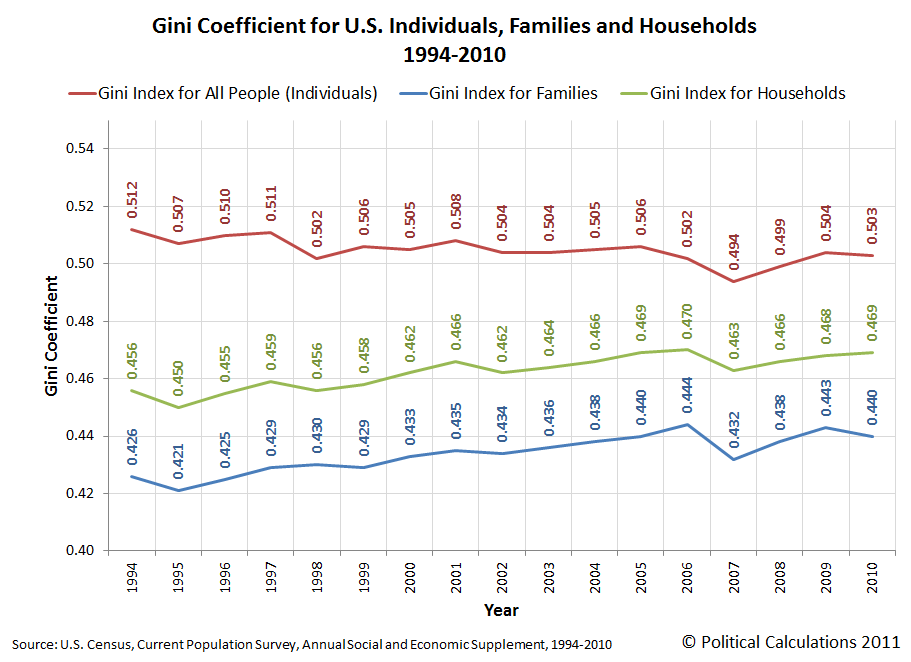
Why is income inequality rising for U.S. families and households, but not for individual Americans?
Having now shown that there has been absolutely no significant change in the level of inequality among U.S. individual income earners from 1994 through 2010, we thought we'd take a step back and look at the data for U.S. families and for households to examine those trends over time.
The chart below shows what we find for each grouping of Americans according to their Gini Coefficient, where a value of 0 indicates perfect equality (everyone has the same income) and a value of 1 indicates perfect inequality (one person has all the income, while everyone else has none):
Think about it. The reason that the income inequality levels recorded for families and households are lower than those for individuals are because most families and households may have one high income earner, who is balanced out by individuals within the families or households who have low or no incomes.
But, if people with very high income earning potential join together to form families and households, and increasingly do so over time, perhaps because such people might have things in common that make forming themselves into families and households an attractive proposition, then income inequality among families and households will increase.
The same holds true for the opposite end of the income earning spectrum. If people with really low income earning potential join together to form families and households, or perhaps if they choose to split apart, and increasingly do so over time, then the resulting low income family and household will also make income inequality among families and households rise, even though there has been no real change in the amount of actual income inequality among individuals.
A thought on marriage from Facebook
Greetings!
One of my FB friends posted a photo with the caption:
"Kim Kardashian made 17 million
dollars off her wedding
divorced 72 days later"
"And they're worried about gays
ruining the sanctity of marriage?"
So I asked,
So what are your objections (if any) to a divorce that soon after the wedding?
The answer I got was:
my only objection is that they obviously married too soon, people r quick to get married because divorce is an option... whats the point of getting married if ur just gonna divorce?
So I followed up:
I don't know. What is the point of getting married either way?
The response to that:
ya know im not even sure anymore. it used to mean something....
And I pointed out:
True. Then we started relaxing standards in order to be nice to people, and we wound up with something that really doesn't mean a whole lot.
Nowadays, it's hard to get people to name any point to marriage that justifies all the paperwork.So my point remains, people are hard put to say why marriage is so darn important to them. They know, somewhere in the back of their mind, that it's special, and because of that they want it. But when they look at the results of everything that's been done to make it available to everyone who wants it, they start to realize it's not special any more.
This can be allowed to continue, or society can attempt to turn it around.
And deciding not to decide is a decision.
Income Inequality?
Promoters of the income inequality meme—Occupy Wall Street, the Obama White House, liberal think tanks, "progressive" bloggers—typically point to data showing how "rich" households and families have been getting even richer vs. those in the middle class. But yet there's no evidence of any significant change in income inequality among individuals as this gobsmacking chart from the must-follow Political Calculations blog shows:
An explanation from PC:
The chart [above] shows what we find for each grouping of Americans according to their Gini Coefficient, where a value of 0 indicates perfect equality (everyone has the same income) and a value of 1 indicates perfect inequality (one person has all the income, while everyone else has none). … But here's the thing. We have already confirmed that there has been absolutely no meaningful change in the inequality of individual income earners in the years from 1994 through 2010. If income inequality in the United States was really driven by economic factors, this is where we would see it, because paychecks (or dividend checks, or checks for capital gains, etc.) are made out to individuals, not to families and not to households.
It would seem then that the real complaint of such people isn't about rising income inequality, but rather, how people choose to group themselves together into their families and households.

Subscribe to:
Posts (Atom)