Showing posts with label education. Show all posts

Wednesday, February 08, 2017

The Shameful War on Betsy DeVos

National Review Online | Print

The Shameful War on Betsy DeVos
Betsy DeVos is seeing firsthand that no good deed goes unpunished.
By Rich Lowry — January 18, 2017

Betsy DeVos


Thomas Sowell speaks up to defend Betsy DeVos and to point out that the opposition to her is being generated by teachers unions objecting to her support of charter schools.
....
My daughter works for KIPP schools in Washington, D.C. and the stories of the dedicated work of the teachers and administration to help students who otherwise would be condemned to failing regular public schools is truly inspiring. I work at a charter school for which we regularly have over 1000 applications for about 80 spots in the entering class. Like KIPP, we are a public school, a fact often ignored in the overwrought rhetoric against charters. We have to educate students with the same per-student allotment that the regular public schools get. The difference is that we have to pay all our capital expenses out of that amount as well as teachers' health insurance and pensions. And still our students regularly achieve at the highest level in our state. No wonder the teachers' unions see the threat.

The Real Democratic Party - WSJ

The Real Democratic Party - WSJ

The Senate made history Tuesday when Mike Pence became the first Vice President to cast the deciding vote for a cabinet nominee.

The nominee is now Secretary of Education Betsy DeVos. The vote came after an all-night Senate debate in a futile effort by Democrats to turn the third Republican vote they needed to scuttle the nomination on claims that the long-time education reformer isn’t qualified. Republicans Lisa Murkowski and Susan Collins had already caved, so Mr. Pence had to cast the 51st vote to confirm Mrs. DeVos.

She can now get on with her work, but this episode shouldn’t pass without noting what it says about the modern Democratic Party. Why would the entire party apparatus devote weeks of phone calls, emails and advocacy to defeating an education secretary? This isn’t Treasury or Defense. It’s not even a federal department that controls all that much education money, most of which is spent by states and local school districts. Why is Betsy DeVos the one nominee Democrats go all out to defeat?

The answer is the cold-blooded reality of union power and money. The National Education Association and the American Federation of Teachers are, along with environmentalists, the most powerful forces in today’s Democratic Party. They elect Democrats, who provide them more jobs and money, which they spend to elect more Democrats, and so on. To keep this political machine going, they need to maintain their monopoly control over public education.

Mrs. DeVos isn’t a product of that monopoly system. Instead she looked at this system’s results—its student failures and lives doomed to underachievement—and has tried to change it by offering all parents the choice of charter schools and vouchers. Above all, she has exposed that unions and Democrats don’t really believe in their high-minded rhetoric about equal opportunity. They believe in lifetime tenure and getting paid.

This sorry politics means that no Democrat could dare support Mrs. DeVos, even if it meant a humiliating about-face like the one performed by New Jersey Senator Cory Booker. As the mayor of Newark, Mr. Booker supported more school choice and he even sat on the board of an organization that would become the American Federation for Children (AFC), the school reform outfit chaired by Mrs. DeVos.

As recently as May 2016, Mr. Booker delivered an impassioned speech at the AFC’s annual policy summit in Washington. He boasted about how Newark had been named by the Brookings Institution “the number four city in the country for offering parents real school choice.”

He described the school-choice cause this way: “We are the last generation, fighting the last big battle to make true on that—that a child born anywhere in America, from any parents, a child no matter what their race or religion or socio-economic status should have that pathway, should have that equal opportunity, and there is nothing more fundamental to that than education. That is the great liberation.”

Some liberator. On Tuesday Mr. Booker voted no on Mrs. DeVos.

His calculation is simple. Mr. Booker is angling to run for President in 2020, and to have any chance at the Democratic nomination he needs the unions’ blessing. He knows that a large chunk of both the party’s delegates and campaign funding comes from the teachers unions, and so he had to repent his school-choice apostasy.

The unions can’t even tolerate a debate on the subject lest their monopoly power be threatened. All that chatter about “the children” is so much moral humbug.

Mrs. DeVos is a wealthy woman who could do almost anything with her time and money. She has devoted it to philanthropy for the public good, in particular working to ensure that children born without her advantages can still have an equal shot at the American dream. She knows education should be about learning for children and not jobs for adults.

All you need to know about today’s Democratic Party is that this is precisely the reason the party went to such extraordinary lengths to destroy her. We trust she realizes that her best revenge will be to use every resource of her new job to press the campaign for charter schools and vouchers from coast to coast.

Monday, January 23, 2017

The foolish Democratic crusade against Betsy DeVos

The foolish Democratic crusade against Betsy DeVos

What was most galling about the confirmation charade was the conceit of Murray and her gang that their positions are based on hard evidence and science while DeVos' are simply a reflection of her ideological fanaticism. But the fact of the matter is that there are two education paradigms in this country — the old one that favors public accountability via the political process and the new one that favors parental accountability via the market process. Democrats are wedded to the first one for ideological reasons — despite its 200-year history of failing poor kids — and simply won't give the second a chance. That's why they also declared war on DeVos for shielding Detroit's charter schools from being taken over by politicians. Incidentally, these charters, while far from perfect, have shown much better results than comparable public schools, as three independent studies, including by Stanford's CREDO, have shown.

If the DeVos confirmation hearing exposed anything at all, it is that the Democratic Party is now the Dogmatic Party. And that will not position it to fight the genuine threats to vulnerable minorities that the Trump presidency will almost certainly bring.

Sunday, January 22, 2017

Who’s Afraid of Betsy DeVos? - WSJ

Who’s Afraid of Betsy DeVos? - WSJ


Perhaps Mrs. DeVos’s most important qualification is that she has the courage of her convictions. Progressives are willing to brook billionaires who use their wealth to expand government or augment their political influence. Hyatt heiress Penny Pritzker, whose family is a major Democratic patron, served as President Obama’s Commerce secretary. But a conservative who’s dedicated her private fortune to liberating poor kids trapped in lousy public schools? The horror!

The DeVoses have donated tens of millions of dollars to charity including a children’s hospital in Michigan and an international art competition in Grand Rapids. They’ve also given to Christian organizations, which the left cites as evidence of concealed bigotry. Yet education has been their main philanthropic cause.

During the 1990s, they patronized a private-school scholarship fund for low-income families and championed Michigan’s first charter school law. In 2000 they helped bankroll a voucher initiative, which was defeated by a union blitz. The DeVoses then turned to expanding charters, which have become Exhibit A in the progressive campaign against her. Unions claim Michigan charters are inferior to the state’s public schools and that 80% are run for profit.

These claims are spurious. Detroit charters are low performing—only 19% of students are proficient in English—but they’re better than the alternative. Charter students in Detroit on average score 60% more proficient on state tests than kids attending the city’s traditional public schools. Eighteen of the top 25 schools in Detroit are charters while 23 of the bottom 25 are traditional schools.

Two studies from Stanford’s Center for Research on Education Outcomes (2013, 2015) found that students attending Michigan charters gained on average an additional two months of learning every year over their traditional school counterparts. Charter school students in Detroit gained three months.

Eighty-percent of Michigan charters utilize a private education service provider. Yet only about half are operated by a for-profit entity, and almost all of these are mom-and-pop businesses run by Michigan residents. While unions have fought to keep failing public schools open, Mrs. DeVos backed a 2009 law allowing the state to close public schools—charters included—that scored in the bottom 5% of the state for three consecutive years. Only seven of the 54 schools with two strikes in the past two years were charters.

The real reason unions fear Mrs. DeVos is that she’s a rare reformer who has defeated them politically. Prior to being tapped by Mr. Trump, she chaired the American Federation for Children (AFC), which has helped elect hundreds of legislators across the country who support private school choice. Last year AFC and its affiliate groups spent $5 million on elections compared to the teachers unions’ $138 million. Yet 108 of the 121 candidates AFC supported won their races.

And while we're at it, here's Reason Magazine:

Betsy DeVos, Donald Trump's pick for Secretary of Education, doesn't want to destroy public education. Public educators—and Title IX zealots—want to destroy Betsy DeVos. Passed in 1972, Title IX is the federal statute banning gender-based discrimination in any educational institution that receives federal funding. It effectively covers all public K-12 schools, many private elementary and secondary schools, and effectively all colleges, public or private.

Among DeVos's staunchest critics are so-called victims' rights groups. Know Your IX, an activist organization that works to diminish due process protections for students accused of sexual assault on university campuses, is tweeting under the hashtag #DearBetsy in hopes of pressuring her to continue the Education Department's misguided and legally suspect campaign against fairness and justice in university misconduct hearings.

"Ms. DeVos must fully explain whether she supports the radical view that it should be more difficult for campus sexual assault victims to receive justice," Sen. Bob Casey, a Democrat and member of the committee that will vote on DeVos's confirmation, told Politico.

Title IX supporters portray their critics as radicals who believe that every rapist should go free and that every woman is a liar. Of course, this is not the case. The Education Department's Office for Civil Rights's (OCR) interpretation of Title IX has come under fire precisely because OCR has taken a radical position: It believes that university students accused of sexual misconduct should be left with very little means of proving their innocence before poorly trained bureaucrats. It is OCR's opinion—not Congress' or the Supreme Court's—that federal law requires universities to investigate wrongdoing in accordance with a definition of sexual harassment so broad that it threatens academic freedom and free speech while denying fundamental due process to the accused.

That's why civil liberties organizations including the American Association of University Professors and PEN America have expressed serious concerns about OCR's handling of Title IX under President Obama. These are not radical organizations, and they consist mostly of liberal thinkers who want to protect free speech and due process for all.

All that said, it's unclear whether victims' advocates have anything to worry about—DeVos's opinion on Title IX is not widely known. She has met with Sen. James Lankford, a Republican and major critic of OCR, to discuss the subject, but that's about it.

Devos is a donor to the Foundation for Individual Rights in Education (FIRE), and this fact has activists particularly worried:

The donations are "a red flag," said Lisa Maatz, the top policy adviser at the American Association of University Women, which advocates for strict enforcement of Title IX, the federal law that governs sex discrimination, harassment and sexual assault on college campuses. "In the absence of an actual record … I think these kinds of donations take on even greater importance, because we have to rely on her contributions to inform us on particular issues."

FIRE is primarily a free speech organization, and DeVos might have donated $10,000 to the group for reasons other than a desire to eviscerate Title IX. But even if DeVos shares FIRE's attitude toward Title IX (and I hope that she does), this would not make her a radical about the issue of campus sexual assault. As FIRE explains:

The basic protections for which FIRE argues—the right to the active participation of counsel; the right to see the evidence in one's case and to meaningfully question witnesses; and the right to an impartial tribunal, among others—benefit all parties and do not impede the pursuit of justice. Outside of the campus context, nobody would argue that reducing due process protections, including the burden of proof, is necessary to secure a just outcome.

Public university students who are accused of misconduct deserve a fair hearing and a chance to defend themselves: This is the idea that Title IX loyalists deem radical. If Betsy DeVos wanted to take a second look at OCR's directives, this would not make her an extremist. It would put her in the company of countless civil liberties groups that believe OCR is currently operating outside the law.

But the crusade to portray DeVos as a dangerous ideologue is mulit-faceted. Critics have not been content to hound her for possibly thinking that OCR has overstepped. They also accuse her of wanting to destroy the public education system entirely. Sensing that an education secretary who supports school choice reform is a threat to their political power, teachers unions and their allies are relentlessly insisting that DeVos is some kind of radical anarcho-capitalist or religious fanatic when it comes to private schools.

Randi Weingarten, president of the American Federation of Teachers, had this to say: "In nominating DeVos, Trump makes it loud and clear that his education policy will focus on privatizing, defunding and destroying public education in America. Every American should be concerned that she would impose her reckless and extreme ideology on the nation."

Of course, there's nothing extreme or reckless about DeVos's support for school choice reforms. School choice is broadly popular, well-liked by fair-minded policy experts, and draws support from Democrats as well as Republicans. New Jersey Sen. Cory Booker, a rising leader in the Democratic Party, was a supporter of school choice, at least until recently. He formerly served with DeVos on the board of the Alliance for School Choice, in fact. Here's what Booker had to say about school choice, according to Breitbart News:

I cannot ever stand up and stand against a parent having options because I benefited from my parents having options. And when people tell me they're against school choice, whether it's the Opportunity Scholarship Act or charter schools, I look at them and say, "As soon as you're telling me you're willing to send your kid to a failing school in my city or in Camden or Trenton, then I'll be with you."

Now that it's politically inconvenient for Booker to say anything that would perturb teachers unions—huge power brokers in the Democratic Party—Booker has changed his tune. He claims to have "serious concerns" about DeVos.

It's not just the Democratic Party stumping for the teachers unions. The New York Times, ever the enemy of a well-educated populace, accused DeVos of "damaging" the fabric of public education in her home state of Michigan, where she spent considerable money promoting charter schools:

She has poured money into charter schools advocacy, winning legislative changes that have reduced oversight and accountability. About 80 percent of the charter schools in Michigan are operated by for-profit companies, far higher than anywhere else. She has also argued for shutting down Detroit public schools, with the system turned over to charters or taxpayer money given out as vouchers for private schools. In that city, charter schools often perform no better than traditional schools, and sometimes worse.

That Times editorial relies on reporting from the Times' Kate Zernike, who claims that DeVos is a "believer in a freer market than even some free market economists would endorse" and "pushed back on any regulation as too much regulation."

DeVos did nothing of the sort, as National Review's Ramesh Ponnuru explains:

You might think, then, that DeVos got legislation enacted that, well, reduced oversight of charter schools. The linked article, although biased against DeVos, makes no such claim. Rather, it shows that DeVos intervened to force the modification of legislation about charter schools. She opposed the creation of a commission that would have given traditional public schools a say in which charter-school networks could expand and which charter schools could continue to operate. (More on that dispute here and here.) The legislation that was eventually enacted omitted that provision and instead "allow[ed] the state to close the schools at the bottom of existing state rankings." There was, in other words, no reduction in oversight and accountability.

The Times is also waging war on established facts about charter schools. Studies consistently show that not all charters succeed, but providing kids with more education options leads to better outcomes in many cases. The Times editorial states that charter schools in Detroit "often perform no better than public schools, and sometimes worse." That's a curious misreading of the data, though, according to The Cato Institute's Jason Bedrick:

To claim, as the NYT does, that Detroit "charter schools often perform no better than traditional schools, and sometimes worse" based on these figures is a highly distorted way of presenting the data. It's equally true to say "Detroit charter schools almost always perform as well or better than traditional schools."

The Times has already proven that it has no interest in telling the truth about charter schools Just recently, a University of Michigan education professor was given room in the paper of record to argue that economists are generally skeptical of free market alternatives to public education. But the data she used to make this point was both out of date and misrepresented in the article. According to the most recent survey data, 44 percent of economists thought a voucher system would leave most students better off, 34 percent weren't sure, and just 5 percent thought not. Among economists with an opinion on the subject, the consensus overwhelmingly favored school choice.

That's because school choice is fundamentally un-radical. Education reformers don't want to defund public education and bring back child labor, they want to provide publicly funded alternatives to government-run schools that have failed their students, who are typically the poorest and least-privileged students.

In the policy battle over school choice, it's the teachers unions who are the radicals. They believe that they are entitled to an unbreakable monopoly on providing K-12 education, in defiance of a wealth of evidence suggesting that such a system is marred by bad incentives and serves only to protect public employees at the expense of kids and families. They smear any suggestion that competition could improve the system as an attempt to destroy public schools.

No, Betsy DeVos doesn't want to destroy public schools. Nor is there any reason to believe she wants to turn rapists loose on college campuses. Those who say otherwise are the real extremists.

Monday, January 16, 2017

Campuses buckle under Obama policies: Glenn Reynolds

Campuses buckle under Obama policies: Glenn Reynolds

One of Robert Conquest’s three laws of politics is that “The simplest way to explain the behavior of any bureaucratic organization is to assume that it is controlled by a cabal of its enemies.” Odd as this may sound, it seems to have pretty good predictive power. And President Obama’s Department of Education seems like a good example.

Higher education, after all, is one of the Democratic Party’s biggest sources of support: Financial (according to Open Secrets, 4 of the top 10 organizations furnishing donors to the Obama 2012 campaign were universities: The University of California was #1, ahead of Google, and the others were Harvard, Stanford and Columbia), ideological (faculties lean far-left and the lefty faculty members tend to be much more outspoken, on average, than the conservative or libertarian faculty), and grassroots, with students, faculty and administrators serving as foot-soldiers (sometimes with university funding) for Democratic candidates and causes. And as Case Western University law professor George Dent notes, “Most state colleges and universities now serve as political action committees for the left, and their political spending dwarfs that of all other PACs.”

So you’d expect the Obama Department of Education to be doing whatever it could to nurture, support, and protect colleges and universities. But instead, it seems to be acting almost as if it were controlled by . . . a cabal of its enemies.

For example, in the area of Title IX enforcement Obama’s Department of Education has taken a statute that simply reads: “No person in the United States shall, on the basis of sex, be excluded from participation in, be denied the benefits of, or be subjected to discrimination under any education program or activity receiving federal financial assistance,” and turned it into an Orwellian nightmare of what Harvard law professors Jacob Gersen and Jeannie Suk call "bureaucratic sex creep.”

As a new book by KC Johnson and Stuart Taylor, Jr., The Campus Rape Frenzy, makes clear, the results have been bad for victimized students (almost always male), but they’ve also been bad for colleges and universities, producing horrible publicity, a growing number of expensive lawsuits, and increased trouble recruiting male students for what is increasingly becoming a pink-collar higher education system. This “rape frenzy” wasn’t the product of anti-sex religious fundamentalists, but of hard-core gender-war feminists. And Obama has doubled down by, at the very last minute, appointing a new, hardline head for the Department of Education’s Office of Civil Rights, which oversees this debacle. She can be expected to double down, unless Trump replaces her.

And, in many other ways, the Department of Education’s pro-diversity efforts have — entirely deliberately — fostered a climate of racial balkanization and division on campus. Again, the results have empowered a small number of student “activists” and administrators, but with destructive, and sometimes genuinely disastrous results. That's that case at the University of Missouri which has seen enrollments and donations plummet by astonishing amounts, genuinely disastrous results.

Most recently, the Department of Education struck the Charlotte School of Law off the eligibility list for federal student aid, because of its graduates’ low bar passage rate. That’s pretty much a death blow. But why Charlotte, and why now?

Well, there’s a good argument, as education expert George Leef notes in Forbes, that we have too many law schools and that we should thin the herd. But as another expert I discussed this with noted, there are probably ten or fifteen other law schools that are just as strong candidates for this treatment as Charlotte. Charlotte is a for-profit school, and the Obama administration has been notably hostile to for-profit education in general, but the precedent set here is just as applicable to traditional “nonprofit” schools, many of whom also have lousy records at having their students pass the bar and find gainful employment.

Much of the hoopla about Trump education nominee Betsy DeVos has involved her views on K-12 education, though some critics have, absurdly, complained that her donation to the Foundation for Individual Rights in Education, a civil liberties outfit that has, among other things, opposed the Title IX kangaroo sex courts on many campuses, is somehow disqualifying. The critics fear that she’ll reverse course on Obama’s education program.

But if DeVos is really hostile to higher education, she should probably just double down on these Obama policies. Because that would probably do more damage than anything she has in the works.

Tuesday, October 18, 2016

The Left and the Masses: Part II - Thomas Sowell

The Left and the Masses: Part II - Thomas Sowell


It is never easy to tell what people's motives are. But, when the political left proclaims their devotion to improving the lives of others in general, and of the poor in particular, we can at least get some clues from the way they go about it.

One of the first things the left does is take away the right of other people to make their own choices.

For example, under current California law, Hispanic school children cannot be taught in Spanish if their parents want them taught in English. Like parents in other immigrant groups before them, Hispanic parents tend to want their children to learn English, so that those children will have more opportunities when they become adults in an English-speaking country.

But the left in general, and Hispanic activists in particular, have fought against leaving Hispanic parents with that choice. At the heart of the left's vision of the world -- and of themselves -- is that they know better what is good for other people. This means that the left sees itself as having both a right and a duty to take away other people's options.

This issue was fought out 18 years ago, in a California referendum on so-called "bilingual education," which in practice meant largely teaching Hispanic school children in Spanish. All the forces of political correctness, including the media and the educational establishment, argued in favor of teaching those children in Spanish, even when their parents wanted them taught in English.

Despite a barrage of propaganda from the media and other organs of the left, a majority of California voters sided with Hispanic parents, and passed a law forbidding schools from imposing Spanish on children whose parents wanted them taught in English.

But the left never gives up on their pet notions. This year there is a new proposition on the California ballot -- Proposition 58, very misleadingly phrased -- that would take that choice away from parents, and let schools impose teaching in Spanish to Hispanic children, whether the parents want it or not.

The Spanish language issue in the schools is just one example of the left's vision, which applies to many other issues.

There is the same dogged resistance on the left to allowing black parents to choose to have their children educated in charter schools that are part of the public school system, but are not subject to all the bureaucratic rules that lead to such bad results in other public schools.

Many years ago, in a debate on William F. Buckley's program "Firing Line," I was told by a left-wing lawyer that black parents without a good education themselves could not make wise choices for their children's education.

But hard evidence says otherwise. There are whole chains of charter schools, such as the KIPP (Knowledge Is Power Program) schools and the Success Academy schools, where ghetto kids have academic achievements equal to those of children in affluent suburbs -- and sometimes higher achievements.

Many of these charter schools are located in the very same buildings in ghetto neighborhoods where children in the regular public schools are failing miserably. Black parents who enroll their children in charter schools have apparently made better choices than the know-it-alls on the left.

Meanwhile, black children by the tens of thousands in New York alone are on waiting lists for charter schools because politicians, beholden to teachers' unions for money and votes, fight against the expansion of charter schools. Not all charter schools are successful. But at least unsuccessful charter schools can be shut down, while other failing public schools keep right on failing.

When it comes to crime and violence, the political left, including much of the media, are having a great time demonizing the police. Blacks are the biggest victims of the sharp upturn in murders that has followed. But, yet again, hard evidence carries very little weight when the left is feeling good about themselves, while leaving havoc in their wake.

The absurdity to which this kind of media frenzy about the police can lead is shown by the fact that a black policeman in Charlotte, North Carolina, shooting a black suspect who had a gun, has been blown up into a racial issue across the nation. Have we become so gullible that we are so easily manipulated and stampeded?

Tuesday, October 04, 2016

Dunbar High School After 100 Years - Thomas Sowell

Dunbar High School After 100 Years - Thomas Sowell


One hundred years ago, on October 2, 1916, a new public high school building for black youngsters was opened in Washington, D.C. and named for black poet Paul Laurence Dunbar. Its history is a story inspiring in many ways and appalling in many other ways.

Prior to 1916, the same high school had existed under other names, housed in other buildings -- and with a remarkable academic record.

In 1899, when it was called "the M Street School," a test was given in Washington's four academic public high schools, three white and one black. The black high school scored higher than two of the three white high schools. Today, it would be considered Utopian even to set that as a goal, much less expect to see it happen.

The M Street School had neither of two so-called "prerequisites" for quality education. There was no "diversity." It was an all-black school from its beginning, and on through its life as a high quality institution under the name Dunbar High School.

But its days as a high quality institution ended abruptly in the middle of the 1950s. After that, it became just another failing ghetto school.

The other so-called "prerequisite" that the M Street School lacked was an adequate building. Its student body was 50 percent larger than the building's capacity, a fact that led eventually to the new Dunbar High School building. But its students excelled even in their overcrowded building.

Some students at the M Street School began going to some of the leading colleges in the country in the late 19th century. The first of its graduates to go to Harvard did so in 1903. Over the years from 1892 to 1954, thirty-four of the graduates from the M Street School and Dunbar went on to Amherst.

Of these, 74 percent graduated from Amherst and 28 percent of these graduates were Phi Beta Kappas. Other graduates from M Street High School and Dunbar became Phi Beta Kappas at Harvard, Yale, Dartmouth and other elite institutions.

Graduates of this same high school pioneered as the first black in many places. These included the first black man to graduate from Annapolis, the first black woman to receive a Ph.D. from an American institution, the first black federal judge, the first black general, the first black Cabinet member and, among other notables, a doctor who became internationally renowned for his pioneering work in developing the use of blood plasma.

How could all of this come to an abrupt end in the 1950s? Like many other disasters, it began with good intentions and arbitrary assumptions.

When Chief Justice Earl Warren declared in the landmark 1954 case of "Brown v. Board of Education" that racially separate schools were "inherently unequal," Dunbar High School was a living refutation of that assumption. And it was within walking distance of the Supreme Court.

A higher percentage of Dunbar graduates went on to college than the percentage at any white public high school in Washington. But what do facts matter when there is heady rhetoric and crusading zeal?

There is no question that racially segregated schools in the South provided an inadequate education for blacks. But the assumption that racial "integration" was the answer led to years of racial polarization and turmoil over busing, with little, if any, educational improvement.

For Washington, the end of racial segregation led to a political compromise, in which all schools became neighborhood schools. Dunbar, which had been accepting outstanding black students from anywhere in the city, could now accept only students from the rough ghetto neighborhood in which it was located.

Virtually overnight, Dunbar became a typical ghetto school. As unmotivated, unruly and disruptive students flooded in, Dunbar teachers began moving out and many retired. More than 80 years of academic excellence simply vanished into thin air.

Nobody, black or white, mounted any serious opposition. "Integration" was the cry of the moment, and it drowned out everything else. That is what happens in politics.

Today, there is a new Dunbar High School building, costing more than $100 million. But its graduates go on to college at only about half the rate of Dunbar graduates in earlier and poorer times. Politics can deliver costly "favors," even when it cannot deliver quality education.

Saturday, October 01, 2016

Money And School Performance: Lessons from the Kansas City Desegregation Experiment

Executive Summary

For decades critics of the public schools have been saying, "You can't solve educational problems by throwing money at them." The education establishment and its supporters have replied, "No one's ever tried." In Kansas City they did try. To improve the education of black students and encourage desegregation, a federal judge invited the Kansas City, Missouri, School District to come up with a cost-is-no-object educational plan and ordered local and state taxpayers to find the money to pay for it.

Kansas City spent as much as $11,700 per pupil--more money per pupil, on a cost of living adjusted basis, than any other of the 280 largest districts in the country. The money bought higher teachers' salaries, 15 new schools, and such amenities as an Olympic-sized swimming pool with an underwater viewing room, television and animation studios, a robotics lab, a 25-acre wildlife sanctuary, a zoo, a model United Nations with simultaneous translation capability, and field trips to Mexico and Senegal. The student-teacher ratio was 12 or 13 to 1, the lowest of any major school district in the country.

The results were dismal. Test scores did not rise; the black-white gap did not diminish; and there was less, not greater, integration.

The Kansas City experiment suggests that, indeed, educational problems can't be solved by throwing money at them, that the structural problems of our current educational system are far more important than a lack of material resources, and that the focus on desegregation diverted attention from the real problem, low achievement.

Does Expanding School Choice Increase Segregation? | Brookings Institution

Does Expanding School Choice Increase Segregation? | Brookings Institution

...I provide new evidence on this question based on an analysis of nine years of data from the Common Core of Data, the federal government’s annual census of all public schools. For each of the more than 3,000 counties in the U.S., I calculate an “exposure index” that measures the share of non-minority students at the schools attended by the average under-represented minority student.[2] The average minority student in the U.S. attends a school that is 33 percent non-minority. In other words, the typical minority student attends a majority-minority school. Likewise, the typical student eligible for free or reduced-price lunch (a proxy for economic disadvantage) attends a school where almost two-thirds of students are also eligible for a subsidized lunch.

A naïve examination of the relationship between this measure of (de)segregation and the percentage of students enrolled in charter schools appears to show that the critics are right: more choice is associated with minority students attending less diverse schools. For the 2010-11 school year, a 10-percentage-point increase in charter enrollment is associated with a decline of 16 percentage points in minority students’ exposure to non-minority students. A similar but weaker relationship exists along class lines (as measured by free lunch eligibility).

Of course, this relationship ignores the fact that charters tend to locate in areas that serve large shares of disadvantaged students and members of minority groups. As a result, this simple correlation tells us nothing about whether charters increase segregation or just tend to locate in areas where the schools are already segregated. This is the same methodological flaw that compromised the findings of the UCLA study.

A better approach to the question of whether choice increases segregation is to look at changes over time. Did areas that saw large increases in choice experience larger increases in segregation than areas that saw smaller increases in choice? This kind of analysis does not conclusively measure the causal effect of choice on segregation, but by examining the same locales over time it represents a clear improvement over the cruder approach of comparing different locales at the same point in time. For example, it takes into account any unmeasured factors, such as the degree of residential segregation, to the extent that those factors remain constant over time.

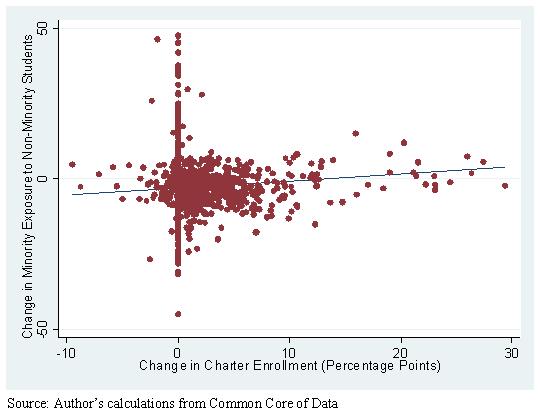
Figure 1 shows the relationship between the change in charter enrollment and the change in minority exposure to non-minority students between 2002-03 and 2010-11.[3] The cloud of points suggests little relationship between these two factors, and a regression analysis confirms that this is the case.[4] There is actually a slight positive (and statistically significant) relationship between choice and diversity, but it is very weak and is not also found in the free-lunch data.

fig1a chingos may15

I also used an alternative measure of segregation called a “dissimilarity index” and obtained similar findings: no consistent relationship between changes in charter enrollment and changes in segregation. Finally, I conducted a more sophisticated panel data analysis that uses all nine years of data to estimate the relationship between charter enrollment and segregation using only the changes within counties over time.[5] Once again, using both the exposure and dissimilarity indices, the results consistently indicated no meaningful relationship between choice and segregation.

The lack of any consistent relationship between charter enrollment and segregation does not eliminate the possibility that such a relationship exists, but suggests that it is unlikely. For there to be a relationship, it would have to be the case that counties where charter enrollment increased experienced an increase in segregation as a result but then adopted policies (or experienced other changes) that counteracted the increase in segregation. In my view, that is not a very plausible explanation for these results.

Tuesday, September 13, 2016

Racial Issues - Thomas Sowell

Racial Issues - Thomas Sowell

Ordinarily, it is not a good idea to base how you vote on just one issue. But if black lives really matter, as they should matter like all other lives, then it is hard to see any racial issue that matters as much as education.

The government could double the amount of money it spends on food stamps or triple the amount it spends on housing subsidies, and it will mean very little if the next generation of young blacks goes out into the world as adults without a decent education.

Many things that are supposed to help blacks actually have a track record of making things worse. Minimum wage laws have had a devastating effect in making black teenage unemployment several times higher than it once was.

In my own life, I was very fortunate when I left home in 1948, at age 17 -- a high school dropout with no skills or experience. At that time, the unemployment rate of black 16- and 17-year-old males was 9.4 percent. For white males the same ages, it was 10.2 percent.

Why were these unemployment rates so much lower than we have become used to seeing in later times -- and with very little difference between blacks and whites?

What was different about those times was that the minimum wage, established in 1938, had been rendered meaningless by a decade of high inflation. It was the same as if there were no minimum wage.

In later years, as the minimum wage was repeatedly raised to keep up with inflation, black teenage unemployment from 1971 through 1994 was never less than 3 times what it was in 1948, and ranged as high as more than 5 times the 1948 level. It also became far higher than the unemployment rate of whites the same age.

The relations between the police and the black community are another issue that has gotten a lot of attention, and produced counterproductive results. After all the rhetoric and all the efforts towards more tightly restraining the police, the net result has been that murder rates have soared in cities where that policy has been followed -- and most of the people killed have been black.

None of the most popular political panaceas for helping black communities has a track record of making things better, and some have made things much worse.

The one bright spot in black ghettos around the country are the schools that parents are free to choose for their own children. Some are Catholic schools, some are secular private schools and some are charter schools financed by public school systems but operating without the suffocating rules that apply to other public schools.

Not all of these kinds of schools are successes. But where there are academic successes in black ghettos, they come disproportionately from schools outside the iron grip of the education establishment and the teachers' unions.

Some of these academic successes have been spectacular -- especially among students in ghetto schools operated by the KIPP (Knowledge IS Power Program) chain of schools and the Success Academy schools.

Despite all the dire social problems in many black ghettos across the country -- problems which are used to excuse widespread academic failures in ghetto schools -- somehow ghetto schools run by KIPP and Success Academy turn out students whose academic performances match or exceed the performances in suburban schools whose kids come from high-income families.

What is even more astonishing is that charter schools are being opposed, not only by teachers' unions who think that schools exist to provide guaranteed jobs for their members, but also by politicians, including black politicians who loudly proclaim that "black lives matter."

Apparently these black children's futures do not matter enough for black politicians -- including the President of the United States -- to stand up to the teachers' unions. The teachers' unions produce big bucks in campaign contributions and big voter turnout on election day.

Any politician, of any race or party, who fights against charter schools that give many black youngsters their one shot at a decent life does not deserve the vote of anybody who really believes that black lives matter.

Saturday, September 10, 2016

Commentary: Black Lives Matter vs. charter schools

Commentary: Black Lives Matter vs. charter schools

The Movement for Black Lives Matter coalition has recently issued education-policy "demands" that demonstrate that not all the lives of black children matter to the group.

In the preamble of the BLM demands, the group uses language that seems drawn straight from teacher-union talking points. BLM talks about "an international education privatization agenda," which sounds very similar to a recent National Education Association tweet claiming, "Privatization is a global threat to public education." And like the NEA, the BLM authors believe that deregulated public charter schools are an instrument of this feared privatization agenda.

Despite the fact that charter schools are government funded and must receive initial and periodic approvals by local school boards, the fact that charters can be operated by private education management organizations causes BLM to froth about "corporate school reformers" who turn schools into "test subjects of experimental, market-based education reforms." BLM thus demands "a moratorium on charter schools."

In a hypocritical twist, The Atlantic reports that a child of Jonathan Stith, one of the authors of the BLM demands, is "enrolled in a charter school." Yet, Stith told the publication that his desire to eliminate charters "comes from a lived experience" - whatever that means.

What empirical research shows is that the lived experience of black children in charter schools has been very positive.

A 2015 study by Stanford University's Center for Research on Education Outcomes found that low-income black students in urban charter schools had higher achievement in math and reading than their peers in traditional public schools.

Looking across all 41 urban regions examined in the study, the Stanford researchers found, "Black students in poverty [in charter schools] receive the equivalent of 59 days of additional learning in math and 44 days of additional learning in reading compared to their peers in [traditional public schools]."

Urban charter schools were also more effective for black students who were not from low-income backgrounds. The Stanford study found that black students not in poverty gained the equivalent of 43 additional days of math learning and 29 additional days of reading learning in urban charter schools compared with similar students in traditional public schools.

Charter schools in cities such as Newark, New Orleans, and Memphis, which have large black populations, had some of the largest impacts on student achievement.

Further, the study found that charter schools in heavily black Detroit, the District of Columbia, and Newark have "small shares of low-performing [charter] schools and a majority of charters outperforming their local traditional public schools."

Yet, despite this overwhelming evidence that charter schools help improve the learning of black students, BLM would cut off this educational lifeline to the very children and parents for whom they purport to speak.

Why would BLM throw black children overboard? It is instructive to note that Hiram Rivera, one of the authors of the BLM document, is executive director of the Philadelphia Student Union, which has received funding from the American Federation of Teachers.

Also, the NEA and the AFT are members of the Alliance to Reclaim Our Schools, which is listed in the BLM document as a resource on education policy.

In addition, the NEA has passed a resolution supporting BLM and the head of the union has said, "The NEA is honored to stand in solidarity with Black Lives Matter." No wonder the BLM document specifically worries about how privatization would "destroy organized labor."

The authors of the Stanford charter-school study concluded: "[T]hese charter sectors clearly refute the idea that some groups of students cannot achieve high levels of academic success. They need only to be given the opportunity."

Black Lives Matter would destroy that opportunity and, along with it, the lives of thousands of black children.

Lance Izumi is Koret is senior fellow in education studies and senior director of the Center for Education at the Pacific Research Institute

Wednesday, December 24, 2014

10 Charts to Brighten Your Century : The Freeman : Foundation for Economic Education

10 Charts to Brighten Your Century : The Freeman : Foundation for Economic Education

Follow link to see charts.
1. There is a rape epidemic caused by rape culture.
...incidents of rape are lower than they have been in 40 years and have been reduced by more than half. It’s not clear what factors brought about such declines, but the declines should be acknowledged.
2. Police work is dangerous, so cops need military gear.
...it just isn't unusually deadly or dangerous — and it’s safer today than ever before. The data do not justify the kinds of armor, weapons, insecurity, and paranoia being displayed by police across the country.
3. Gun ownership increases violent crime.
The most remarkable statistic is that, since gun-related violence peaked in 1993, there has been an appreciable decline in gun violence ever since — all despite (or perhaps because of) significant national increases in gun ownership.
4. Concentrations of CO2 in the atmosphere will lead to catastrophic climate change.
...despite significant increases in carbon dioxide concentrations in the atmosphere, average global temperatures in the lower atmosphere have been virtually unchanged for more than 18 years.
What does this mean? At the very least, it means we should be dampening some of the climate-change hysteria, questioning the models that have predicted greater warming, and embracing a reasoned agnosticism about the issue until it’s better understood.
5. The rich are getting richer and the poor, poorer.
The truth is, the rich are getting richer and the poor are getting richer, too. In fact, globally, the poor are richer than they have ever been in human history.
But what about in the US? As columnist and professor Michael Shermer writes in Scientific American, “The top-fifth income earners in the U.S. increased their share of the national income from 43 percent in 1979 to 48 percent in 2010, and the top 1 percent increased their share of the pie from 8 percent in 1979 to 13 percent in 2010. But note what has not happened: the rest have not gotten poorer. They’ve gotten richer: the income of the other quintiles increased by 49, 37, 36 and 45 percent, respectively.”
6. The air is getting dirtier due to more cars on the road.
In the United States, there are more than twice the vehicles on the road today than in 1980. Yet, the air quality has never been better. Remember pictures of Los Angeles in the 1980s? Smog. L.A. hasn’t seen that kind of filthy pea soup since Magnum PI.
7. We’re nearing  "peak oil."
Ever heard of Julian Simon? He’s the doomslayer who suggested we take any neo-Malthusian predictions of resource depletion with a grain of salt. Indeed, he suggested that because the human mind is the “ultimate resource,” resources would never run out. As long as there is a system of prices, property, and a profit motive, people will have incentives to conserve, innovate, or substitute. So what happened to peak oil? TheShale Revolution happened, just as Simon would have predicted. (Sorry, Professor Krugman.)
8. Our infrastructure is crumbling.
During the worst of the 2008 recession, one popular meme was that the nation’s infrastructure was “crumbling.” We were all to fear falling bridges and the general pothole-ification of America. Governments used such fearmongering to justify Keynesian stimulus policies through more taxpayer-funded investment in roads and bridges. But transportation analyst David Hartgen countered that false narrative right here in the pages of The Freeman.
9. The US health system ranks low among developed countries for health outcomes.
Not so fast. When one factors out deaths due to homicide and auto fatalities, the United States shoots to number one in health outcomes along a number of dimensions. Yes, health care is expensive. Yes, it’s convoluted. Yes, it’s corrupt — and it’s all thanks to political meddling. But the US health care system is still probably among the best in the world.
10.The Public Schools Need More Funding
Each year, the schools get more resources. Another Taj Mahighschool goes up. Another football stadium gets built. Another administrator’s salary goes up. Another union boss enjoys champagne in a hot tub. And what happens to educational outcomes? Forty years on … no change.

Wednesday, August 14, 2013

Education Spending Soars, Test Scores Stagnate | National Review Online

Link: http://www.nationalreview.com/corner/355271/education-spending-soars-test-scores-stagnate-deroy-murdock (via shareaholic.com)

As this chart by the Cato Institute's Andrew J. Coulson irrefutably illustrates, the trouble with U.S. education is not a scarcity of tax dollars thrown in its general direction. The spending curve of government outlays on K–12 education from 1970–2010 is essentially an upward-sloping 45-degree angle. The curves representing reading, math, and science test scores are all 0-degree angles. These commonly are called flat lines.


Saturday, March 02, 2013

Education link


http://www.strike-the-root.com/education-for-individual
In a world without public or State-run education, we could cease speaking of an "educational system." Schools would survive or fail based on the needs of individuals in particular communities, and each individual would be free to pursue his or her own natural calling or vocation. As a result of an absence of one set of educational standards, schools would embrace approaches to education that were the most successful, rather than those dictated from afar. This would ultimately lead to a more pragmatic and less political educational environment.

Thursday, July 05, 2012

Teaching Economics

via The American Spectator and The Spectacle Blog by Thomas Sowell on 7/5/12

Having taught economics at a number of colleges for a number of years, I especially welcomed a feature article in the June 22nd issue of the Chronicle of Higher Education, on how economics courses with the same name can be very different at different colleges. It can also be very different when the course is taught by professors in the same department who have different approaches.
The usefulness of the three approaches described in the article depends on what the introductory course is trying to accomplish.
One professor taught the subject through a steady diet of mathematical models. If the introductory economics course is aimed at those students who are going to major in economics, then that may make some sense. But most students in most introductory economics courses are not going to become economics majors, much less professional economists.
Among those students for whom a one-year introductory course is likely to be their only exposure to economics, mathematical models that they will probably never use in later life, as they try to understand economic activities and policies in the real world, may be of very limited value to them, if any value at all.
If the purpose of the introductory course is to serve as a recruiting source for economics majors, that serves the interest of the economics department, not the students. It may also serve the interests of the professor, because teaching in the fashion familiar in his own research and scholarship is a lot easier than trying to recast economics in terms more accessible to students who are studying the subject for the first time.
Having written two textbooks on introductory economics -- one full of graphs and equations, and the other with neither -- I know from experience that the second way is a lot harder to write, and is more time-consuming. The first book was written in a year; the second took a decade. The first book quickly went out of print. The second book ("Basic Economics") has gone through 4 editions and has been translated into 6 foreign languages.
Both books taught the same principles, but obviously one approach did so more successfully than the other. The same applies in the classroom.
The opposite extreme from teaching economics with mathematical models was described by a professor who uses an approach she characterized as democratizing the classroom, "so that everybody is a co-teacher and co-learner." This has sometimes been called "discovery learning," where the students discover the underlying principles for themselves while groping their way through problems.
Unfortunately, discovery can take a very long time -- much longer than a course lasts. It took the leading classical economists a hundred years of wrestling with different concepts of supply and demand -- often misunderstanding each other -- before finally arriving at mutually understood concepts that can now be taught to students in the first week of introductory economics.
The Chronicle of Higher Education reported that the discovery learning professor sometimes seemed to be the one doing most of the work in the class, "bringing the students' sometimes fumbling answers back to economic principles."
This course's main focus is said to be not on mastering the principles of economics, but being able to "dialog" and discuss "shades of gray." With such mushy goals and criteria, hard evidence is unlikely to rear its ugly head and spoil the pretty vision of discovery learning.
Discovery learning may not serve the interests of the students, but it may well serve the ego of its advocate. Education may be the only field of human endeavor where experiments always seem to succeed -- as judged by their advocates.
By contrast, the third method of teaching introductory economics, in lectures by Professor Donald Boudreaux of George Mason University, tests the students with objective questions -- which means that it is also producing a test of whether this traditional way of teaching actually works. Apparently it does.
The Chronicle of Higher Education also reported on the students. The feckless behavior of today's students in all three courses makes me glad that I left the classroom long ago, and do my teaching today solely through my writings.
COPYRIGHT 2012 CREATORS.COM

Tuesday, May 15, 2012

Generic Iconoclasm vs. Some Sensible Things You Were Taught in School

Ruth Stout, who once wrote a book on the virtues of mulching and composting in her garden, once joked, "when I go to plant seeds, I read the instructions on the back of the packet and then carefully violate every one of them."

Here are nine rules to carefully violate.

Generic Iconoclasm vs. Some Sensible Things You Were Taught in School

via The Volokh Conspiracy by Eugene Volokh on 5/8/12

(Eugene Volokh)
Forbes runs this item:
Nine Dangerous Things You Were Taught In School

Be aware of the insidious and unspoken lessons you learned as a child. To thrive in the world outside the classroom, you're going to have to unlearn them.

Dangerous things you were taught in school:

1. The people in charge have all the answers. That's why they are so wealthy and happy and healthy and powerful — ask any teacher.

2. Learning ends when you leave the classroom. Your fort building, trail forging, frog catching, friend making, game playing, and drawing won't earn you any extra credit. Just watch TV.

3. The best and brightest follow the rules. You will be rewarded for your subordination, just not as much as your superiors, who, of course, have their own rules.

4. What the books say is always true. Now go read your creationism chapter. There will be a test.

5. There is a very clear, single path to success. It's called college. Everyone can join the top 1% if they do well enough in school and ignore the basic math problem inherent in that idea.

6. Behaving yourself is as important as getting good marks. Whistle-blowing, questioning the status quo, and thinking your own thoughts are no-nos. Be quiet and get back on the assembly line.

7. Standardized tests measure your value. By value, I'm talking about future earning potential, not anything else that might have other kinds of value.

8. Days off are always more fun than sitting in the classroom. You are trained from a young age to base your life around dribbles of allocated vacation. Be grateful for them.

9. The purpose of your education is your future career. And so you will be taught to be a good worker. You have to teach yourself how to be something more.

I've always been quite skeptical of this sort of generic iconoclasm, for three related reasons: (1) It debunks categorical assertions that the debunkees actually rarely make in that categorical a way, and that in case are obviously wrong if made so categorically. (2) This debunking is rarely useful, because just as "always" assertions are rarely right where practical matters are involved, "not always" assertions are rarely useful. (3) The things being debunked are actually often pretty good rules of thumb for daily life, which are right more often than not; friendly amendments pointing out the exceptions can be helpful (especially if they are specific rather than generic), but categorical attempts at debunking miss the general wisdom in the rules.

For instance, behaving yourself is often more important than getting good marks. Sometimes even knowing when to question the status quo and when to follow it is important, as is knowing when to at least temporarily follow conventional wisdom (especially in an environment where error can cause a lot of damage) instead of coming up with your own approaches. But beyond that, "behaving yourself" in the sense of learning how to operate productively within an organization of two or more people, in a way that maximizes results while minimizing needless friction with your colleagues, superiors, and subordinates, and needless pushback from people who see you as misbehaving is a tremendously important life skill in a vast range of occupations. Even geniuses need it, and ordinary people who will have to work closely with others and will rarely have the "he's rude and a pain in the neck, but he's brilliant" excuse need it even more.

As to the purpose of education, schools rarely teach that the only purpose of your education is your future career (especially since many literature and history teachers realize that such an argument will go only so far with their students). But throughout your life you'll want access to goods and services, and unless you try to force people to give them to you, you'll need to offer something in return; in our society, many of the things you offer require specialized knowledge, which a good education will help give you. And while college is certainly not a very clear, single path to success, and it won't get you to "the top 1%," for many people it's a pretty important part of the path to careers that are both more financially and intellectually rewarding.

Likewise, the best and brightest follow the rules the great majority of the time, and we take it for granted because it's "just following the rules." They follow rules about how to do good science, how to write well, how to craft effective arguments, how to operate within organizations, how to deal with other people's understandings of what is their property or institutional bailiwick, and so on. Of course, they realize that to succeed in really big and innovative ways they need to do more than follow the rules. "Always follow the rules, and nothing more" would be lousy advice. But "learn the rules well, because they are the repository of important wisdom accumulated through the efforts of many smart people, and then think creatively about how to go beyond the rules or even break some rules" is good advice.

What's true of the rules is also true of the books and of the messages passed along by people in authority. What the books say isn't always true, but they have a lot of truth in them, and 99% of what we need to know we learn from the books (especially if we learn how to find the right books). Similarly, the people in charge often have some pretty important answers — again, answers that are so important and foundational that we take them for granted (once we learned them from people in charge).

That's true of specific knowledge about particular academic subject matters; teachers are hardly perfect, but they know some important information that most students need to learn to succeed. It's also true of "answers" in the sense of character traits that are conducive to success: Answers to questions such as, "Should I work hard?," "Should I invest for the future?," "Should I work well with others?," and so on; and these answers do tend to make people more "wealthy and happy and healthy and powerful," though of course they are not perfectly correlated with success.

Finally, while learning doesn't end when you leave the classroom, standardized tests don't measure your entire value, and days off aren't always more fun than sitting in the classroom, few schools seek to try to teach that, and my sense is that few students actually learn this. Rather, classroom learning — if done right — is an important part of your learning, being able to demonstrate your abilities even in the imperfect way that tests capture is important in a society where employers and universities have to sort through thousands of applications, and classroom learning even at a good institution can involve kinds of work that aren't as fun as what you can do on your own but are still important.

So if the Forbes column is merely saying "remember that the practical rules for life that you're taught in school are true only most of the time, and always think about whether some occasion is an exception to the rule," then it's correct but banal to the point of uselessness. And if it's trying to say that those rules really are things that you have to outright "unlearn," to the point of actually rejecting them much of the time, then it seems to me to be generally wrong.

Tuesday, May 08, 2012

Glenn Reynolds On Online College Educations

via Advice Goddess Blog on 5/8/12

Glenn Reynolds On Online College Educations
Reynolds writes at washingtonexaminer.com:
Another opportunity exists in alternative methods of certifying knowledge. A college diploma serves as a basic signifier of its holder's basic competence, but with costs running well into the six figures, it's an awfully expensive credential.
MIT/Harvard will start certifying online students, and that may be just the beginning. The Cato Institute's Andrew Coulson suggests that people should accumulate knowledge in life, then build a portfolio that will directly demonstrate their knowledge to future employers. He calls it savoir faire: (Literally: "know how to do.")
I think that's a really nice idea but find that people are often unable to assess for themselves whether another person is qualified and like to fall back on credentialism.

Thursday, April 19, 2012

The horrors of a Leftist English teacher


The horrors of a Leftist English teacher


via Bookworm Room by Bookworm on 4/13/12


The other day, Zombie put up a post that resonated with me on more levels than you can imagine.  It turns out that Zombie deciding to drop in on a lecture at UC Berkeley (my alma mater) to hear a lecture by an English as a Second Language, or ESL, professor (my father's job), which was given in execrable English (my complaint about my children's English teachers), and had as its point the moral necessity of using education to advance Leftist causes (my bête noire as a parent, a Berkeley grad, and a conservative in America).
You have to read Zombie's post to believe it and, even after reading it, you might find it hard to believe. I'll just say that my father, who worshiped the beauty of the English language and who believed that his job was to have his students speaking English, is probably rolling in his grave right about now.

Tuesday, April 10, 2012

Khan Academy for iPad Puts World-Class Educational Lectures in Your Hand


via Lifehacker by Adam Pash on 3/12/12

iPad: The Khan Academy provides over 3,000 free educational videos, exercises, and lectures covering the span of everything from math, physics, finance, and history. It's one of our favorite places to get a free education online, and now its complete library is available on-the-go on your iPad.