Showing posts with label religion. Show all posts

Wednesday, February 08, 2017

The Shameful War on Betsy DeVos

National Review Online | Print

The Shameful War on Betsy DeVos
Betsy DeVos is seeing firsthand that no good deed goes unpunished.
By Rich Lowry — January 18, 2017

Thursday, December 03, 2015

In God we trust « Hot Air

In God we trust « Hot Air

While the Daily News only chose to profile Republicans who offered their thoughts and prayers to the victims of the San Bernardino shooting it would be wise to remember that prayer unites us and doesn’t divide us.  Prayer isn’t a partisan thing, in fact prayer has no denomination and no political affiliation.
Now is the time where it would be important to note that our currency still has printed on it, “In God We Trust.”  Our nation’s history is rich and is deeply rooted in a faith in a higher power, recognizing our human limitations.  Secretary of the Treasury, Salmon P. Chase instructed the Director of the Mint to prepare a motto for our currency back in 1861 that read:
Clearly, our government has no issue putting its trust in a higher power and supreme being so why should we shame policymakers who offer comfort through prayer during a tragedy?  Our nation is rooted in the fact that no nation can be strong except in the strength of God.  Isn’t it only natural that we as humans turn to God, the one whom we trust, during a time of shock and despair?

Sunday, October 04, 2015

The Facts About Pope’s Meeting With Kim Davis - Matt Barber - Page full

The Facts About Pope’s Meeting With Kim Davis - Matt Barber - Page full


On Wednesday the Vatican confirmed what a handful of us knew days before. Pope Francis secretly (and privately) met with Kim Davis at Washington’s Vatican Embassy to personally offer his broad support for her bold stand against that insidious and “intrinsically disordered” counterfeit called “gay marriage.”


Does Pope Francis really support Kim Davis?


While specifics of Davis’ legal case were not discussed during the private meeting, days later Pope Francis publicly affirmed Kim’s “human right” as a “conscientious objector” to refuse to sign her name to “gay marriage” licenses – even in her official capacity as an elected official. This human right, incidentally, is an unalienable right protected by the First Amendment. “Stay strong,” the pope told Kim after the two embraced during the tearful meeting. He thanked her for her courage and asked her to pray for him. She likewise asked him to pray for her. These facts are not in dispute.


On Friday the Vatican issued another statement to clarify what was, or, better still, was not, discussed during the meeting: “The pope did not enter into the details of the situation of Mrs. Davis, and his meeting with her should not be considered a form of support of her position in all of its particular and complex aspects,” said Vatican spokesman Rev. Federico Lombardi.


As Austin Ruse of Breitbart.com notes, “The Vatican spokesman chose his words carefully. By stating that the meeting should not be considered support for her position ‘in all of its particular and complex aspects,’ Lombardi is allowing the notion that the meeting can be understood as general support for Davis’ cause, but not necessarily papal support for every detailed aspect of the legal case.”


Indeed, neither Kim Davis nor anyone on her legal team ever suggested that the pope supports, or is even aware of, “her position in all of its particular and complex aspects.” Still, based upon his own words and the official position of the Catholic Church, we can know, for sure, of at least three “positions” on which the pope does support Kim Davis. They are: 1) Homosexual behavior is sin; 2) Marriage is exclusively between one man and one woman; and 3) No “human person,” whether a government official or not, should be forced to violate his or her conscience by affirming sin-based “gay marriage.”


Who asked for the meeting?


There has likewise been much speculation and liberal wishful thinking as to how this meeting came about, with some pundits desperately clinging to hopes that the pontiff was “actually swindled into meeting Kim Davis.”


Let’s end the speculation.


Vatican officials reached out, unsolicited, to Davis through her attorney, Mat Staver, and arranged the meeting out of the blue before Pope Francis even arrived in the U.S. for his whirlwind tour. The Davis team was led to believe that the request came from the pope himself. Not only did Pope Francis know who Kim Davis was when he told reporters on the plane ride home that conscientious objectors have a “human right” to decline participation in sodomy-based “marriage,” he had personally met Kim privately, and embraced her both physically and ideologically, before he did so.


The meeting was temporarily kept “secret” during the pope’s visit so as to avoid the predictable media circus that would, and later did, ensue. Both Davis’ representatives and the Vatican agreed that news of the meeting would be released upon the pope’s departure. He wasn’t “embarrassed” by the meeting, as some have suggested, but, rather, held it discreetly for logistical reasons alone.


What does the pope believe about homosexuality and “gay marriage”?


While protestant Christians obviously don’t agree with Pope Francis and the Catholic Church on everything, all faithful Christians, both protestant and Catholic alike, are nonetheless indebted to him for validating Kim’s courageous obedience to God. By extension, the pope has likewise validated every other Christian who refuses to be forced to participate in, or otherwise affirm, this sinful pagan rite. “Gay marriage” is an affront to Christ, the Church and God’s natural order. No faithful believer who wishes to remain in obedience to God can have anything to do with it.


But why? Why is “gay marriage” an affront to God? Why must Christians oppose it?


While the reasons are manifold, it seems most wish to avoid the primary issue surrounding any discussion on “same-sex marriage.” That is, the fundamental wrongness of homosexual behavior itself. If homosexual behavior is not wrong, as it goes, then what justification is there for refusing to redefine marriage around it?


But it is wrong. It’s always, and in every way, wrong.


So says the pope.


So says the Bible.


And, most importantly, so says the very Creator of marriage itself.


On the question of homosexual sin, the Catechism of the Catholic Church offers a clear and biblically sound summation: “Basing itself on Sacred Scripture, which presents homosexual acts as acts of grave depravity, tradition has always declared that ‘homosexual acts are intrinsically disordered.’ They are contrary to the natural law. They close the sexual act to the gift of life. They do not proceed from a genuine affective and sexual complementarity. Under no circumstances can they be approved.”


And so Kim Davis refuses to approve them.

Sunday, July 12, 2015

Homosexuality and Christian apologetics

Homosexuality and Christian apologetics

Argument from the first century environment

One argument I see is that homosexuality is condemned only about three times in the New Testament so they cannot really have meant it seriously. If it really was a serious concern it would have been mentioned more often. And Christ himself did not mention it at all. Allied to that is an argument that Christ and the apostles lived in a Greco-Roman world where homosexuality was normal, common and unquestioned so it cannot have been seen as very wrong or it would have been condemned out of hand.

That is the sort of argument you might get from the U.S. Supreme Court -- one that completely ignores what the documents actually say -- and it seems to me to be an argument of desperation. But let me point out the simple and major flaw in it anyway.

Christ and the early Christians lived in an environment that was overwhelmingly Jewish. And Jews had always stood out in their rejection of homosexuality (Leviticus 18:22 etc.). They did indeed live in a Greco-Roman world and pedophilia had been routinely practiced by the Greeks for centuries -- something that the unfortunate Chris Brand got fired for after he pointed that out once too often.

But Israel was not Greece then any more than it is today. Regardless of what other subjects of the Roman empire might say or do, Jews lived in a society where homosexuals risked being stoned to death. Rejection of homosexuality could be taken as read in that environment so needed only incidental mention. And when the apostle Paul did in fact comment directly on Roman civilization, he absolutely ranted and raved in his condemnation of it.

Paul started travelling very early on and so came into much more contract with Greco-Roman civilization than one would have done in Israel. Most of his missions were at least initially to congregations of the Jewish diaspora so he still lived in something of a Jewish bubble. But when it came to Rome itself he could not restrain himself. He condemned just about everything Roman.

Read what he says about Roman practices in his epistle to the Christians in Rome, chapter 1, from verse 21 onwards. Being a good theologian, Paul puts his condemnation in the context of what Jewish backsliders in the past had done but there is no ambiguity about the general applicability of what he says. And he is clearly motivated by what he has observed of Roman civilization, which is why he felt the need say it when writing to the congregation in Rome. So on occasions when it was needful to condemn homosexuality, the Bible writers did just that. I quote from verse 27:

"And likewise also the men, leaving the natural use of the woman, burned in their lust one toward another; men with men working that which is unseemly, and receiving in themselves that recompence of their error which was meet".

And in the final verse of the chapter Paul moves into the present tense, indicating that it is the malign influence of then-current Roman civilization on Christians that he has particularly in mind:

"Who knowing the judgment of God, that they which commit such things are worthy of death, not only do the same, but have pleasure in them that do them"

What did Christ say?

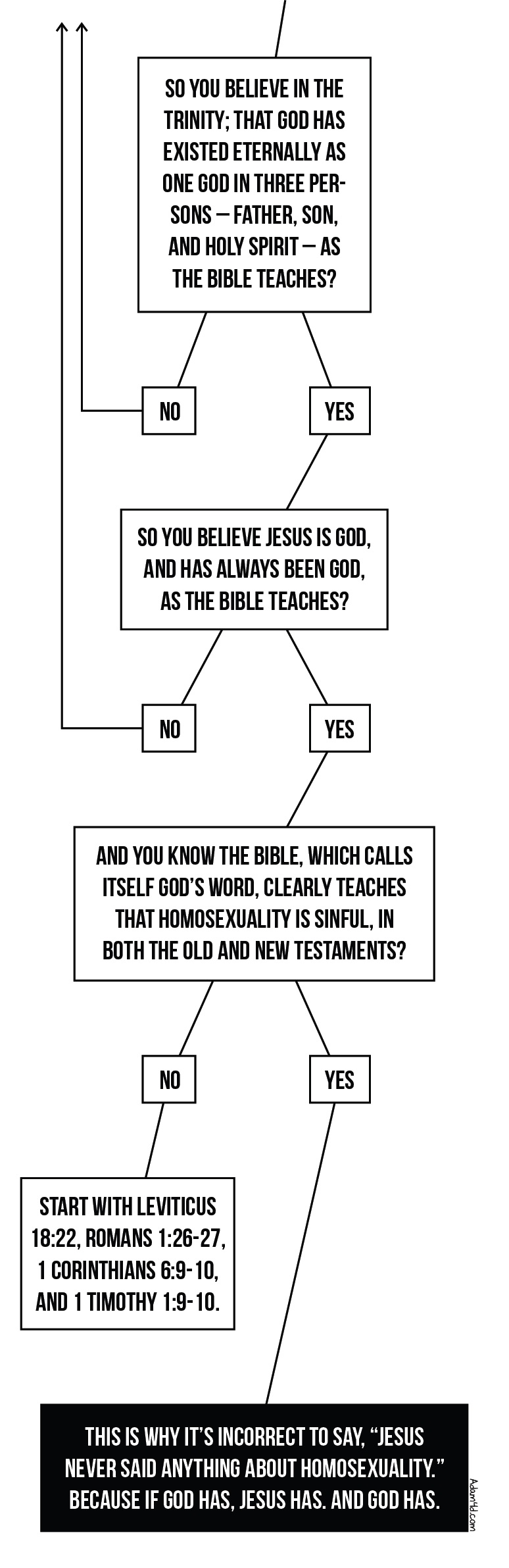
A related argument is that Christ never mentioned homosexuality so it was only that old puritan Paul who thought it was a bad thing. Since Paul's writings form a large part of the New Testament, that is simply a repudiation of the Bible and is, if anything, an anti-Christian argument and reveals those who put it forward for what they are: Disciples of Satan maybe but certainly not disciples of Christ.

But, that aside, context again is explanatory. Because Christ was a devout Jew in a Jewish society, the question never arose. It was not an issue. The Jewish law still unquestionably applied. Let me quote the only thing that Christ said about marriage -- in Matthew 19. He specifically put his teaching in the context of a debate about Jewish law:

"Some Pharisees came to him to test him. They asked, “Is it lawful for a man to divorce his wife for any and every reason?”

“Haven’t you read,” he replied, “that at the beginning the Creator ‘made them male and female,’ and said, ‘For this reason a man will leave his father and mother and be united to his wife, and the two will become one flesh'. So they are no longer two, but one flesh. Therefore what God has joined together, let no one separate.”


Clearly, for him, marriage was between a man and a woman and it was only they who could become "one flesh". And his authority for that was what was found in the Jewish scriptures. So there is no doubt whatever about his view of sexual relationships. Only male/female marriage was on his horizons.

Universal salvation?

A remaining argument from the pseudo Christians is that God is a God of love so therefore he must love homosexuals too. That is also an amazing argument. The Bible repeatedly makes clear that God loves his children but, like any parent, he also has rules for his children. And just as children can be disinherited, so God can sentence unrighteous people to everlasting "kolasin" (cutting off). Let me quote Matthew 25.

"When the Son of man shall come in his glory, and all the holy angels with him, then shall he sit upon the throne of his glory: And before him shall be gathered all nations: and he shall separate them one from another, as a shepherd divideth his sheep from the goats: And he shall set the sheep on his right hand, but the goats on the left. Then shall the King say unto them on his right hand, Come, ye blessed of my Father, inherit the kingdom prepared for you from the foundation of the world ...

Then shall he say also unto them on the left hand, Depart from me, ye cursed, into everlasting fire, prepared for the devil and his angels. And these shall go away into everlasting punishment: but the righteous into life eternal"


The word translated as "punishment" above is in Greek "kolasin" and it simply means "cutting off". It is the word a Greek gardener might use to describe the pruning of a tree. So it would be a proper translation to say that the goatish ones will be cut off and thrown away like the unwanted branch of a tree.

So the argument that the love of God is unconditional is utter rubbish. You have to do your best to obey his rules if you want salvation from death. There is no universal salvation.

So those are the arguments that the pseudo-Christians use. They are so weak that you could only accept them out of desperation. You could only accept them if you wanted to use Christianity as a false front. They are arguments that mock the Bible, not arguments from the Bible -- JR.

Thursday, July 02, 2015

About those Gay Marriage Flow Charts… | Shameless Popery

About those Gay Marriage Flow Charts…

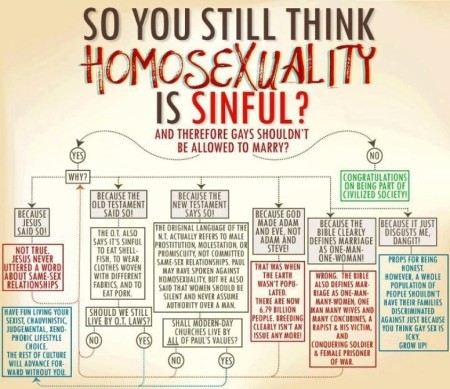
One of those memes that propagates on Facebook...

typical same-sex marriage flowchart

Deconstructed here.

Like every other flowchart I’ve seen on this question, it conflates three things found in the Book of Leviticus: (1) expressions of the moral law (like the Ten Commandments, or the prohibition against homosexuality and other forms of sexual immorality); (2) temporal punishments; and (3) the so-called ceremonial law (like the laws on keeping kosher).

The moral law, as an expression of what is good and evil, is timeless. Good doesn’t suddenly become evil, or vice versa, because it’s Tuesday, instead of Monday, or because it’s 2015 A.D. and not 2015 B.C. 

But the particular statutory punishments *weren’t* timeless: they were quite explicitly the law books of the nation of Israel. These laws can be illuminating, in that they show the severity of certain sins, but the Church never considered Israel’s statutory punishments to be binding on Christians. 
And the ceremonial laws were a way of setting apart the Jewish people to signal them as chosen and to prepare them for Christ.

....

The idea that Paul doesn’t really condemn homosexual behavior is based on a selective interpretative of two Greek words that he uses in 1 Corinthians 6:9: pornos (πόρνος) and malakos (μαλακός). Pornos means:
  1. a man who prostitutes his body to another’s lust for hire
  2. a male prostitute
  3. a man who indulges in unlawful sexual intercourse, a fornicator
  1. soft, soft to the touch
  2. metaph. in a bad sense
    1. effeminate
      1. of a catamite
      2. of a boy kept for homosexual relations with a man
      3. of a male who submits his body to unnatural lewdness
      4. of a male prostitute

So the Greek terms used in Paul’s day weren’t specific to only adult male-male sexual behavior (since a great deal of it was man-boy), but they certainly included those behaviors. But besides this, Paul and several other parts of the New (and Old) Testament condemn fornication. That’s broader still, but it shows that non-marital sex is sinful… regardless of who the parties are. (This raises the question: what sort of sexual unions are marriage-material? And we’ll get to that shortly).

....


But there’s a second problem with this claim. It assumes that the Bible is essentially a rule book full of Thou Shalt Not’s. But it’s missing that both Jesus and St. Paul present a positive view of marriage. That is, Scripture shows us what marriage is, which is why we can also say what itisn’t.
This is important, because as we saw from the attempts to work around St. Paul’s prohibitions, the same-sex marriage side is essentially arguing: “but here’s an arrangement nobody had thought of back then!” With a positive view of what marriage is, we can easily establish whether some new sexual variation is compatible with marriage or not.

Friday, April 17, 2015

Scalias Worst Opinion

Scalias Worst Opinion
Smith is the well-known “Peyote Case,” in which Scalia, for a 5-4 majority, adopted the most narrow possible reading of the Free Exercise Clause of the Constitution, concluding that the First Amendment’s ban on laws “prohibiting” the “free exercise” of religion stated a non-discrimination rule only. Government could not target specific religious practices for prohibition, and could not prohibit conduct because it is engaged in for religious reasons. But if a “neutral” and “generally applicable” rule had the effect of banning religious practice or religiously motivated conduct, that was not a law prohibiting the free exercise of religion.

Scalia’s reading of the Free Exercise Clause was not entirely implausible: There is at least a colorable argument from the text (and history) that the Free Exercise Clause states a rule about the formal content of government’s rules — that government may not adopt a law that, by its terms, prohibits religious exercise. But the better conclusion (as I argue in today’s piece, and at greater length in my academic writing on the topic) is that the Free Exercise Clause confers an affirmative substantive right to the free exercise of religion, unimpaired by government’s laws, and that this sometimes may indeed confer an immunity, specifically for religious conduct, from government’s usual rules. (What was less plausible was Scalia’s manipulation in Smith of the Court’s prior Free Exercise Clause precedents, which Scalia refashioned into rather unprincipled, incoherent exceptions to his refashioned rule.)

I argue that Smith is a positively perverse reading of the Free Exercise Clause: As the sphere of government expands, the sphere of religious liberty contracts. And it has proved unqualifiedly pernicious in its consequences.

Thursday, April 02, 2015

Why The Atlantic Is Wrong about Indiana's Religious Freedom Law | The Weekly Standard

Why The Atlantic Is Wrong about Indiana's Religious Freedom Law | The Weekly Standard
Garrett Epps writes at The Atlantic that I am wrong to say there aren't "significant" differences between the federal Religious Freedom Restoration Act (RFRA) and Indiana's RFRA.

According to Epps, who teaches creative writing and constitutional law at the University of Baltimore, there are two major differences between the Indiana law and the federal law. "First, the Indiana law explicitly allows any for-profit business to assert a right to 'the free exercise of religion.' The federal RFRA doesn’t contain such language," writes Epps. "Second, the Indiana statute explicitly makes a business’s 'free exercise' right a defense against a private lawsuit by another person, rather than simply against actions brought by government."

"I am not sure what McCormack was thinking," writes Epps, referring to my claim that there aren't any "significant" differences between Indiana's RFRA and the federal RFRA.

If Epps could have continued reading just a bit longer, he would have discovered that I back up this claim by directing readers to the writings of University of Virgina law professor Douglas Laycock, Stanford University law professor Michael McConnell (a former federal judge on the Tenth Circuit Court of Appeals), and South Texas law professor Josh Blackman: "Indiana's RFRA makes it explicit that the law applies to persons engaged in business as well as citizens in private lawsuits, but until quite recently it had always been understood that federal RFRA covered businesses and private lawsuits. (See this post by law professor Josh Blackman for more on these matters.)"

In an email to THE WEEKLY STANDARD, University of Virginia law professor Douglas Laycock explains why the Indiana RFRA's inclusion of corporations isn't really different from federal RFRA:
On corporations: The United States has what is commonly known as “The Dictionary Act.” At the very beginning of the United States Code (Title 1, section 1) is a series of definitions. As used in this Code, unless the context otherwise requires, these words have the following meaning. The federal RFRA protects every “person,” and the Dictionary Act defines “person” to include corporations. Most states have the same sort of Dictionary Act, and the same definition. In Indiana, they put it directly into the RFRA, presumably because of the litigation culminating in Hobby Lobby. That’s not really a difference.
Epps wrote that a "lot of legal thinkers thought that idea was outlandish until last year’s decision in Burwell v. Hobby Lobby Stores, in which the Court’s five conservatives interpreted the federal RFRA to give some corporate employers a religious veto over their employees’ statutory right to contraceptive coverage." What Epps doesn't acknowledge is that only two of the nine Supreme Court justices (Sonia Sotomayor and Ruth Bader Ginsburg) dissented from the majority opinion's holding that closely-held coporations may defend themselves under federal RFRA (Kagan and Breyer didn't take a position).

As for Epps's claim that the Indiana RFRA differs from the federal RFRA in allowing people to defend themselves in private lawsuits, Josh Blackman points out that there hasn't been unanimous agreement, but "four federal courts of appeal and the Obama Justice Department have all taken the position that [federal] RFRA can be used as a defense in private suits."

So I stand by my original claim that these two features of the Indiana law cited by Epps are not significantly different from the federal law.

But does Indiana's RFRA differ from other state RFRAs?

Epps points out that the New Mexico Supreme Court did not allow a RFRA defense in a private lawsuit, and he suggests that Texas is the only state besides Indiana that allows such a defense. But Stanford's Michael McConnell has argued persuasively that other state RFRAs cover private lawsuits: "The New Mexico RFRA specifically covers action by 'a government agency.' The Arizona RFRA applies to all action by 'government' and extends to 'all state and local laws and ordinances and the implementation of those laws and ordinances.' Courts are not agencies, but they are an arm of government. 'All' law includes common law; civil suits are a means of implementing and enforcing law."

It is worth noting that the Illinois RFRA--which Barack Obama voted for as a state senator--also applies to all state and local laws: "This Act applies to all State and local (including home rule unit) laws, ordinances, policies, procedures, practices, and governmental actions and their implementation, whether statutory or otherwise and whether adopted before or after the effective date of this Act."*

So how did the confusion arise as to whether or not RFRA applied in private lawsuits in New Mexico? In his email to TWS, Douglas Laycock explains:
On private lawsuits, the federal RFRA was clearly intended to provide a possible defense (subject, as always, to the compelling interest test) when a religious organization or believer is sued, whether by a government or a private citizen. The statute specifically mentioned relief against a government, because of concerns about sovereign immunity (the rule that you usually can’t sue a state). And that created an ambiguity; did it mean only against a government?

Most states copied the federal language, and copied the ambiguity. And the New Mexico Supreme Court took advantage of that, and said no RFRA defense in a suit by a private citizen. So the Indiana bill addresses that ambiguity. If your church is feeding the homeless, and the neighbors don’t like it, it really doesn’t matter whether you get sued by the neighbors or by the city.

The New Mexico court was clearly hostile to the religious claim, rejecting every argument she made; if it had not had the ambiguity about private lawsuits, it would have just found a compelling government interest, which is what the state trial court in Washington did in the florist case. And what the Minnesota Supreme Court did thirty years ago in the only reported case of a business claiming a religious justification for discriminating against gays just because they are gay.
It's unfortunate that Epps didn't make any effort to respond to the arguments made by McConnell, Laycock, or Blackman. Perhaps a public debate is in order. Isn't that what C-SPAN is here for?

*Update (11:40a.m.): Here's Michael McConnell's analysis of the Illinois statute:
Here is the relevant part [of the statute]:
If a person's exercise of religion has been burdened in violation of this Act, that person may assert that violation as a claim or defense in a judicial proceeding and may obtain appropriate relief against a government. A party who prevails in an action to enforce this Act against a government is entitled to recover attorney's fees and costs incurred in maintaining the claim or defense.
It allows the person to assert RFRA as a claim or defense in any judicial proceeding, but seems to authorize appropriate relief only against a government. That seems to suggest RFRA can be asserted as a defense in a lawsuit brought by a private person, but not to allow suits by RFRA claimants against other private parties -- or at least, not to get relief. Perhaps a RFRA plaintiff could get a declaratory judgment that a particular act violates RFRA.

This does not make much sense. What it really might mean is that RFRA plaintiffs cannot obtain affirmative relief such as damages against private parties, but only protective relief like an injunction. In any event, the hypothetical cases people have been raising involve RFRA claimants being sued by other persons who want to compel them to take actions contrary to their religion.

The second sentence reinforces the idea that RFRA applies to lawsuits between private parties, because if it did not, there would be no need to restrict attorneys fees to those cases involving government.

Wednesday, April 01, 2015

The New Intolerance - WSJ

The New Intolerance - WSJ
In the increasingly bitter battle between religious liberty and the liberal political agenda, religion is losing. Witness the media and political wrath raining down upon Indiana because the state dared to pass an allegedly anti-gay Religious Freedom Restoration Act. The question fair-minded Americans should ask before casting the first stone is who is really being intolerant.

The Indiana law is a version of the federal Religious Freedom Restoration Act (RFRA) that passed 97-3 in the Senate and that Bill Clinton signed in 1993. Both the federal and Indiana laws require courts to administer a balancing test when reviewing cases that implicate the free exercise of religion.

To wit: Individuals must show that their religious liberty has been “substantially burdened,” and the government must demonstrate its actions represent the least restrictive means to achieve a “compelling” state interest. Indiana’s law adds a provision that offers a potential religious defense in private disputes, but then four federal appellate circuits have also interpreted the federal statute to apply to private disp

utes. The federal RFRA followed the Supreme Court’s Employment Division v. Smith ruling in 1990 that abandoned its 30-year precedent of reviewing religious liberty cases under strict scrutiny. Congress responded with RFRA, which merely reasserted longstanding First Amendment protections.

In 1997 the Supreme Court limited RFRA’s scope to federal actions. So 19 states including such cultural backwaters as Connecticut, Rhode Island and Illinois followed with copy-cat legislation, and Indiana is the 20th. Courts in 11 states have extended equally vigorous protections.

Indiana was an outlier before the new law because neither its laws nor courts unambiguously protected religious liberty. Amish horse-drawn buggies could be required to abide by local traffic regulations. Churches could be prohibited from feeding the homeless under local sanitation codes. The state Attorney General even ruled Indiana Wesleyan University, a Christian college which hires on the basis of religion, ineligible for state workforce training grants.

Becket Fund Executive Director Kristina Arriaga discusses the controversy surrounding the Hoosier State’s religious freedom law. Photo credit: Associated Press. In February, 16 prominent First Amendment scholars, some of whom support same-sex marriage, backed Indiana’s legislation. “General protection for religious liberty is important precisely because it is impossible to legislate in advance for all the ways in which government might burden the free exercise of religion,” they explained.

That hasn’t stopped the cultural great and good from claiming Indiana added the religious defense in private disputes as a way to target gays. If this is Indiana’s purpose, and there’s no evidence it is, this is unlikely to work.

The claim is that this would empower, say, florists or wedding photographers to refuse to work a gay wedding on religious grounds. But under the RFRA test, such a commercial vendor would still have to prove that his religious convictions were substantially burdened.

And he would also come up against the reality that most courts have found that the government has a compelling interest in enforcing antidiscrimination laws. In all these states for two decades, no court we’re aware of has granted such a religious accommodation to an antidiscrimination law. Restaurants and hotels that refused to host gay marriage parties would have a particularly high burden in overcoming public accommodation laws.

In any event, such disputes are rare to nonexistent, a tribute to the increasing tolerance of American society toward gays, lesbians, the transgendered, you name it.

The paradox is that even as America has become more tolerant of gays, many activists and liberals have become ever-more intolerant of anyone who might hold more traditional cultural or religious views. Thus a CEO was run out of Mozilla after it turned out that he had donated money to a California referendum opposing same-sex marriage.

Part of the new liberal intolerance is rooted in the identity politics that dominates today’s Democratic Party. That’s the only way to explain the born-again opportunism of Hillary Clinton, who tweeted: “Sad this new Indiana law can happen in America today. We shouldn’t discriminate against ppl bc of who they love.”

By that standard, Mrs. Clinton discriminated against gays because she opposed gay marriage until March 2013. But now she wants to be seen as leading the new culture war against the intolerant right whose views she recently held.

The same reversal of tolerance applies to religious liberty. When RFRA passed in 1993, liberal outfits like the ACLU were joined at the hip with the Christian Coalition. But now the ACLU is denouncing Indiana’s law because it wants even the most devoutly held religious values to bow to its cultural agenda on gay marriage and abortion rights.

Liberals used to understand that RFRA, with its balancing test, was a good-faith effort to help society compromise on contentious moral disputes. That liberals are renouncing it 20 years after celebrating it says more about their new intolerance than about anyone in Indiana.

Monday, March 30, 2015

What will the Indiana religious freedom law really do? - The Washington Post

What will the Indiana religious freedom law really do? - The Washington Post
Are the claims made against the new Indiana law accurate? Not really. This law, like other RFRAs, merely requires that state laws meet a demanding, but hardly insurmountable, test before infringing upon the religious practice or conscience of religious believers. If the law imposes a substantial burden on religious belief, the law must yield unless the law serves a compelling state interest and is the least burdensome way to advance that interest. Here’s more background on how these sorts of laws work.
Courts have routinely upheld the application of nondiscrimination laws against RFRA-based challenges on the grounds that preventing discrimination is a compelling state interest. Of course it’s possible that a court in the future would reach a different conclusion, but there’s no reason to think such a result is likely, and there is nothing about the Indiana law that makes it a particular threat in this regard. That is, such a court decision is just as possible in one of the other dozen-plus states that has had its own RFRA on the books for years or in one of the many other states that have equivalent protections for religious belief under their state constitutions.

The Indiana RFRA is not identical to every other RFRA, but the textual differences are not particularly material. Here, for instance, is a useful comparison of the Indiana law and the federal RFRA, as applied in the courts.

Monday, March 02, 2015

Can We Know Right and Wrong Without God? | PJ Lifestyle

Can We Know Right and Wrong Without God? | PJ Lifestyle
Believers commonly assert that, without God, there can be no “objective right and wrong.” Yet, such an assertion ignores what it means to be objective. When we identify something as objective rather than subjective, we’re saying it can be observed in the real world. We’re saying it can be perceived, or conceived through reason applied to our perception. Even the most fervent believer must confess that God transcends our human perception, and therefore cannot be cited as a source of objective morality.
Believers offer our appeal to God as the source of “objective morality” in answer to such blatant subjectivism or moral relativism. Right and wrong can’t be left to whim, we argue. But our appeal to God doesn’t solve the problem.
Subjectivism – whether personal, social, or “supernatural” – wreaks havoc on human life and happiness. Until we can answer it with (genuine) moral certainty – that is, until we can show that morality is based on facts – it will continue to do so. From muggings and rapes, to school shootings and truck bombings, to concentration camps and gulags, to religious “inquisitions” and divinely inspired acts of terrorism – all such mayhem is caused by subjectivism. And the is-ought dichotomy is what makes subjectivism seem plausible.
The “Is-Ought” Dichotomy

This “is-ought dichotomy” is the philosophical dead end in which believers spar with secular subjectivists. Our culture has given up on the task of discovering a truly objective morality, because we have largely bought into the notion that values cannot be derived from facts, that we cannot discern an “ought” from an “is.”
The Natural World Provides Guideposts for Appropriate Human Action

The primary such guidepost is a standard of value from which to judge the appropriateness of all other conceived values, an end unto itself which all other ends support.
An end is a goal toward which one acts; a means is the action one takes toward a goal. For instance, if a student studies in order to get an education, the education is an end toward which his studying is the means. Likewise, if a person works in order to earn a paycheck, the paycheck is an end toward which his work is the means. But notice that such goals are not ends in themselves. A student gets an education so that he can pursue a career – which he pursues in order to support himself and earn a paycheck – which he earns in order to buy things – which he buys in order to use for various other purposes – which he pursues in order to accomplish still other goals – and so on. Each end presupposes another. So where does it all end?

If we are to establish an objective, fact-based morality, we need to discover a final end – one toward which all of our other goals and values are properly aimed. Such an end is by that fact our standard of moral value – the standard against which we can objectively assess the value of all our choices and actions. So the question becomes: What is our ultimate goal?
When we identify this ultimate goal, the question of what we ought to do becomes objectively answerable. That, and only that, is how we discern an objective morality.

As this series continues, we will present and evaluate this objective standard of value. Biddle offers it as an alternative to religion. But one need not be an atheist to accept it. Indeed, the discovery of an objective standard for moral action should embolden the believer and deepen our appreciation of God.

As a father, I may answer any challenge from my son with the proverbial “because I told you so.” In doing so, I don’t offer an actual reason. I merely assert my authority. While that authority proves legitimate, my ultimate desire for my son is that he one day understand why my instruction and rules serve his interest.

Similarly, the appeal to God as a moral authority may prove correct, but says nothing of why his prescriptions are good for us. A consideration of objective morality works to bridge that gap.

Thursday, February 12, 2015

The Case Against the Case Against the Crusades - NYTimes.com

The Case Against the Case Against the Crusades - NYTimes.com


The existence of this debate is clearly very strange to many liberal and secular writers, and no doubt seems strange to the president himself; I suspect he thought that a Crusades reference would have been the most uncontroversial of his historical analogies. And in fairness to Obama, stripped of context his specific words should be uncontroversial: “During the Crusades,” he said, “people committed terrible deeds in the name of Christ,” and there is no question that such terrible deeds were committed, in many places and with many innocent victims (Jewish especially as well as Muslim and Orthodox Christian), across the four or five or six centuries (depending on whether you include the later Holy Leagues) in which crusades were officially undertaken or attempted.

But the context matters, and his juxtaposition of the Crusades with institutions that are regarded as comprehensively evil in our culture prompted a wave of writing from Christians justifying those campaigns as essentially “defensive” in intent and therefore justified conflicts. And that, in turn, prompted a lot “you must be joking” responses from liberal journalists — like this one from Will Saletan, which I’ll quote:
“All the Crusades met the criteria of just wars,” says a quote circulated by the Catholic League, conservative news sites, and Tea Party forums. Bill Donohue, the league’s president, asserts: “The Crusades were a defensive Christian reaction against Muslim madmen.” Giuliani, Jonah Goldberg, and Joe Scarborough agree. E.W. Jackson, the 2013 Republican nominee for lieutenant governor of Virginia, defends the Crusades as “a response to Islamic aggression.” Erick Erickson, the editor-in-chief of RedState.com, says they were merely “a response to Islamic invasion.”

As for the awkward gap between the Muslim aggression and the so-called defensive reaction—about four centuries—today’s apologists plead that the Crusades were a “delayed response.” Donohue blames the whole thing on Muslims: “They’re the ones who created the war.” In fact, according to the apologists, the Crusaders were liberators. They were trying “to free the holy places of Christendom.”
Clearly lot of the people Saletan is quoting are being apologists, sometimes with a side of bigotry, rather than historians. But the reality is that many of their apologias are still closer to the historical reality than his snideness about the alleged “awkward gap” between Islamic aggression and Christian crusading. Like all complicated historical events, the Crusades were hardly monocausal, and historians will be arguing about the whys and wherefores in the same way that they’ll always argue about the causes of the last century’s global conflicts. But the first Crusade was not summoned, as Saletan implies, in a world where the Islamic empires and Christian Europe had been enjoying a comfortable four-hundred year peace after the original fall of Jerusalem to Muslim armies. Instead the actual context included 1) the gradual rolling back of prior Muslim conquests in Spain and Southern Italy (Saracen raiders had threatened Rome in the 10th century, and the Emirate of Sicily only fell to the Normans five years before Pope Urban II called the First Crusade), 2) the disastrous Byzantine defeat at Manzikert in 1071, at the hands of the Seljuk Turks, which ended with the emperor in chains and prompted Constantinople to call for military assistance from the West, and 3) the Seljuk occupation of Palestine (displacing the Fatimid Caliphate), which visited persecution and pillage on the Holy Land’s remaining Christians and made pilgrimage much more difficult than it had been under some (though not all) of the Fatimid rulers.

The context also included many other factors internal to Western Christendom, which is why historians have wrangled endlessly over the motivations of Urban and others, and over how much explanatory weight to give to geopolitical issues related to Islam versus other goals (increasing papal power, channeling intra-Christian violence elsewhere, forcing a reunion with Orthodoxy, etc.). But the broad story of the era and the movement can’t be explained without a recognition that the context of the crusades, from the 11th century beginning to the echoes at Lepanto and Vienna centuries later, always included 1) ongoing conflict between Islamic and Christian forces in territory that had been Christian before an earlier wave of Muslim conquest and 2) the emergence of new Islamic powers, first Seljuk and then Ottoman, whose advances threatened first Byzantium and then, after its fall, the Balkans, the Christian Mediterranean and eventually Central Europe. One can argue back and forth over whether this or that crusade met “just war” criteria, but none of them sprang de novo from a world of stable borders and religious peace, and all of them were part of a longer story of attack and counterattack in which both sides were playing for potentially-existential stakes.

Which makes a comparison between the Crusades as a historical phenomenon and various specific institutions — the sort of comparison in which “Crusaders” get casually likened to “slave owners”, for instance — seem, well, not even wrong: It’s just a category error, like putting “Franco-British conflict from the 14th through the 19th century” on the same list of great historical wrongs as South African apartheid, and then when challenged invoking Henry V at Rouen and the Vendee to “prove” your point.

Sunday, September 21, 2014

(16) Tim O'Neill's answer to Why did science make little real progress in Europe in the Middle Ages? - Quora


...The Actual Scientific Dark Age
Of course, there certainly was a period in which western natural philosophy did stagnate and then languish and in which the whole scientific tradition of the Greeks and Romans was in danger of being lost.  Later Hellenic and then Roman scholars inherited the work of the Greek proto-scientists of the Fourth and Fifth Centuries BC and built on it.  By the First Century AD Roman scholars tended to read Greek and so could read the works of Aristotle and Archimedes in their original languages, but there was also an increasing tradition of encyclopaedic collections of summaries and key points from earlier Greek works which tended to be compiled in Latin.  The scholars of the First and Second centuries added some major contributions to science, especially Ptolemy (astronomy and mathematics) and Galen (medicine), but many Roman scholars made do with the Latin summaries and encyclopaedias for their grasp of earlier work.
In the Third Century, however, there were major social and political upheavals that interrupted many aspects of Roman life, including scholarship, with profound later consequences.  The Empire entered what is now called "the Military Anarchy", where rival emperors rose and fell in rapid succession and the Empire was racked with decade after decade of civil war and political oppression.  The weakened Empire suffered from invasions by the newly resurgent Sassanian Persians and by larger and more aggressive federations of Germanic barbarians. Cities that had been peaceful for centuries began constructing defensive walls, resources that once went into buildings and public works went into endless wars and at one point the Empire even split into three parts.
A form of stability was imposed by a new kind of more centralised and more monarchical emperorship, economic reforms and an overhaul of the army and the Imperial administration by Diocletian and his successors, but parts of the Empire never fully recovered, especially in the west.  Intellectual life and education, which had been badly disrupted in the long century of chaos, certainly did not regain its former strength and in the west fewer and fewer scholars were literate in Greek.  As a result, works that were only available in Greek, especially technical, philosophic and detailed scientific works, were read and copied far less and began to be neglected.  Greco-Roman science was increasingly preserved only in the popular Latin encyclopaedic tradition rather than studied in detail via the original Greek works.
By the Fifth Century the administrative division between the Latin-speaking Western Empire and the Greek-speaking Eastern Empire became permanent and then became a political divide.  The weaker, poorer and more vulnerable Western Empire did not even survive the century, with its final collapse coming in 476 AD after another century of civil wars, invasions and spiralling decline.  What followed was centuries of invasions, fragmentation and chaos, with few brief periods of stability and centralised authority.  The faltering intellectual tradition, which had already been in decline since the late Second Century, languished to a low ebb.
The institution which managed to keep this faltering tradition from dying out altogether during these centuries of barbarian invasion and disintegration was actually the one the Enlightenment myth (wrongly) blames for causing the decline in the first place.  The Christian church came to hold political power when the decline in learning in the west had been under way for over a century, and so could not have been its cause.  Initially Christianity was ambivalent toward Greek philosophy and learning, but prominent Christian thinkers who had been trained in philosophy could see it as something to be embraced.  God, they argued, was a rational intelligence and had created the universe along rational lines.  It made sense, therefore, that humans could and should use reason to understand his creation.  Clement of Alexandria argued that just as the Jews had been given a divine gift of special religious revelation, so had the Greeks been given a gift of rational analysis.  Both were to be embraced and used.
So when the Western Empire collapsed, the Church had long since come to terms with Greek philosophy and science and found ways to incorporate both and reconcile them with their religion.  And it was Christian scholars who saw that the decline of Greek literacy in the west meant much of the original works of Greek learning were being lost.  Cassiodorus and Boethius both tried to preserve key works by translating them into Latin.  Boethius was executed before he could complete an ambitious plan to translate all the works of Aristotle, but he did manage to translate most of the key works on logic - something which meant that logic and therefore reason took a central role in early Medieval education, even in the darkest centuries of the chaos.  The seeds of the Medieval revival of science lay in that stroke of luck.
The Medieval Enshrining of Reason
One writer has compared the long road back from the intellectual catastrophe of the collapse of the Western Roman Empire on learning in western Europe to people after a nuclear holocaust trying to revive modern science with nothing but a few volumes of the Encyclopaedia Britannica and a copy of Bill Bryson's A Short History of Nearly Everything.  Scholars in the Eighth or Ninth Centuries had just enough fragments of information to know that they had barely anything at all but not enough to begin reconstructing what had been lost.  What is interesting is what they did with the bits they had - they revered them.  These ancient writers, mostly pagans, were held up as all-knowing authorities and what elements of their works did survive were studied with immense reverence and painstaking scrutiny.
This meant particular attention was paid to one of the few areas in which a reasonable number of works had survived - logic, or "dialectic" as it was known.  A grasp of logic was central to Medieval education and a student had to master it, via Boethius' translations of Aristotle and other works, before they could tackle any other subjects.  This had the curious effect of enshrining reason as the key to all knowledge - a development completely at odds with the popular view of the Middle Ages and the Medieval church in particular as being fixated on unquestioned dogma and irrational superstition.  There were certainly things that these Medieval scholars accepted on faith but they increasingly came to feel they could also arrive at them, and all kinds of other forms of understanding about the universe, via reason.  In a strange way, the loss of so much Greek philosophy actually focused attention on the elements that had survived and had the effect of enshrining reason at the heart of Medieval thought in a way not seen before.  ....The Church's Suppression of Ideas?
Actually, nothing of the history detailed above sits neatly with the idea of the Medieval Church as a violent and intolerant theocracy that immediately consigned anyone with the whiff of a new idea to the flames.  In fact, the parameters for speculation and investigation into the nature of the physical world were quite wide, because the Medieval Church considered the cosmos to the the rational product of the rational mind of God and that humans were given reason partly so they could apprehend and investigate the universe rationally.
This is why Thomas Aquinas spent years and many millions of words painstakingly applying the rational principles of ancient Greek dialectic to Christian theology in an attempt at showing that all the key ideas of Christian belief could be arrived at by pure reason. It is also why the quodlibeta debates at Medieval universities were such open free-for-alls where all kinds of radical and even heretical ideas could be proposed to see if they stood up to logical analysis.
The Medieval Church also did not insist on a purely literal interpretation of the Bible (fundamentalist literalism is a modern and largely American Protestant idea).  This meant that it had no problem with seeing aspects of the Bible as purely allegorical and with the exploration of how their symbolic truth relates to the real world.  Most people who think of the Medieval period as one where Biblical literalists suppressed original thinking though fear would have a hard time explaining, for example, the work of William of Conches.  Way back in the Twelfth Century this scholar, based at Chartres Cathedral, accepted that his audience already understood the creation story in Genesis to be symbolic and went on to interpret it "according to nature'.  He proposed how natural forces set in motion by God brought about the form of the heavens and earth as we have them today.  He went on to talk about life arising from the primordial mud by the natural action of heat and how it developed from simple early forms.  He even talks about how man arose in the same way and how, in theory, some other species of man could arise via natural processes in the same way.
All these very modern-sounding (even Darwinian) ideas were accepted by Medieval scholars without the slightest problem and the Church had no difficulty with them either - indeed, William of Conches, like all other Medieval scientists - was a churchman.
The closest the Church came to suppressing science in any way was when, in reaction to some of the ideas being debated in the University of Paris at the height of the rediscovery of Aristotelian learning in the Thirteenth Century, the Faculty of Theology attempted at putting some limits on what could be discussed by the Faculty of Arts.  In 1210, 1270 and again in 1277 the Pope, at the request of the Parisian Theology Faculty, published lists of ideas proposed by Aristotle or implied by his philosophy that were contrary to Christian doctrine and so were forbidden.  What is remarkable about this is, firstly, how little in Aristotle etc was actually proscribed by these Condemnations.  Secondly, it's remarkable how ineffective the Condemnations were.  They only applied to Paris, whereas discussion of all these topics continued at Oxford and other universities unaffected.  And, as the fact that they had to be repeated twice indicates, they were widely ignored anyway.  They also had another effect - by arguing that Aristotle was actually wrong on several key points, they stimulated a more critical examination of the Greek philosopher's work which led to several of his idea being critically analysed and found to be incorrect (eg the idea that a heavy object falls faster than a lighter one).  IN a strange way, the Condemnations failed to suppress science and actually helped to stimulate it.
The fact is that the idea of the Church suppressing science and rational analysis of the physical world is a myth.  Not one Medieval scholar was ever burned, imprisoned or oppressed by the Medieval Church for making a claim about the physical world.  This why the modern proponents of the myth always have to fall back on an exceptional and post-Medieval example to prop up this idea: the Galileo case.

Thursday, July 10, 2014

Who's the Real Hobby Lobby Bully? - Bloomberg View


Cards on the table: I think that institutions Hobby Lobby and Little Sisters of the Poor are obviously correct -- they are being forced by the government to buy something that they don’t want to buy. We can argue about whether this is a good or a bad idea, but the fact that it is coercive seems indisputable. If it weren’t for state power, the Little Sisters of the Poor would be happily not facilitating the birth-control purchases of its employees; the Barack Obama administration has attempted to force them to do otherwise. The U.S. Supreme Court has ruled that this coercion violates the Religious Freedom Restoration Act, and it must therefore cease.


I think a few things are going on here. The first is that while the religious right views religion as a fundamental, and indeed essential, part of the human experience, the secular left views it as something more like a hobby, so for them it’s as if a major administrative rule was struck down because it unduly burdened model-train enthusiasts. That emotional disconnect makes it hard for the two sides to even debate; the emotional tenor quickly spirals into hysteria as one side says “Sacred!” and the other side says, essentially, “Seriously? Model trains?” That shows in Justice Ruth Bader Ginsburg’s dissent, where it seems to me that she takes a very narrow view of what role religious groups play in the lives of believers and society as a whole.
The second, and probably more important, problem is that the long compromise worked out between the state and religious groups -- do what you want within very broad limits, but don’t expect the state to promote it -- is breaking down in the face of a shift in the way we view rights and the role of the government in public life.

All of us learned some version of “You have the right to your beliefs, but not to impose them on others” in civics class. It’s a classic negative right. And negative rights are easy to make reciprocal: You have a right to practice your religion without interference, and I have a right not to have your beliefs imposed on me.
This works very well in situations in which most of the other rights granted by society are negative rights, because negative rights don’t clash very often. Oh, sure, you’re going to get arguments about noise ordinances and other nuisance abatements, but unless your religious practices are extreme indeed, the odds that they will substantively violate someone else’s negative rights are pretty slim.
I’m not saying that America ever perfectly hewed to this sort of ideal. (Blue laws, anyone?) I’m just saying that the statement of this ideal was perfectly consistent with the broadly held conception of what government was for, which was to provide “public goods” in the classical economics sense,1 but otherwise mostly to keep other people from doing stuff to you, not to do things for you or force you to do them for other people.
In this context, “Do what you want, as long as you don’t try to force me to do it, too” works very well, which is why this verbal formula has had such a long life. But when you introduce positive rights into the picture, this abruptly stops working. You have a negative right not to have your religious practice interfered with, and say your church forbids the purchase or use of certain forms of birth control. If I have a negative right not to have my purchase of birth control interfered with, we can reach a perhaps uneasy truce where you don’t buy it and I do. But if I have a positive right to have birth control purchased for me, then suddenly our rights are directly opposed: You have a right not to buy birth control, and I have a right to have it bought for me, by you.
....
1 Public goods are not “goods provided by the government”; they’re goods that have to be provided by the government, because no one without taxing power can efficiently provide them. Police service is the classic public good because it is nonrivalrous (multiple people can enjoy it) and nonexclusive (you can’t keep other people from enjoying the benefits). If crime goes down, all of us enjoy lower crime, even if we don’t pay taxes. Defense of the borders is another classic public good, and other items such as roads and lighthouses are usually included.

Tuesday, July 08, 2014

MercatorNet: What the Supreme Court did (and didn’t do) to religious freedom last week

MercatorNet: What the Supreme Court did (and didn’t do) to religious freedom last week

In Hobby Lobby, the Court ruled that a federal law, the Religious Freedom Restoration Act (RFRA), applied to the case, and that it covered “any exercise of religion, whether or not compelled by, or central to, a system of religious belief.” The only question that government could consider was not the truth or reasonableness or centrality of the religious belief, but only whether the belief were sincere, which was not doubted in the case of these companies. Interestingly, RFRA had passed in 1993 by overwhelming majorities of both houses of Congress. This is because religious freedom, like free speech, is a vital part of our legal heritage and until recently, viewed as axiomatic.
The Court said that companies were legal persons within the meaning of RFRA, an unexceptional view dating back to the Middle Ages, when the Church, as the Body or Corpus of Christ, was viewed as a corporation with legal personality. Citing William Blackstone, the authoritative expounder of the common law at the time of the American founding, the Court recognized that there were two types of corporations, ecclesiastical and lay, and that lay corporations could also have eleemosynary and religious purposes. (The amicus brief I filed in support of Hobby Lobby for four non-profit corporations made the same point, also citing Blackstone.)
Because of the political firestorm that erupted several years ago when the Supreme Court ruled 5-4 in favor of corporate free-speech rights in the Citizens United case, which President Obama had denounced in his State of the Union address, this question of the First Amendment rights of corporations, and specifically whether for-profit corporations were legal persons, has become politicized. Even so, two of the liberal justices, Justice Stephen Breyer and Justice Elena Kagan, did not join that part of Ginsburg’s dissent that said that for-profit corporations were not legal persons.
As Justice Alito pointed out for the majority, “it is important to keep in mind that the purpose of this fiction [that corporations are legal ‘persons’] is to provide protection for human beings. A corporation is simply a form of organizations used by human beings to achieve desired ends … When rights, whether constitutional or statutory, are extended to corporations, the purpose is to protect the rights of these people.”
Since corporations, or at least closely-held family-run companies, can claim to exercise religion, the law requires that if their religious exercise is substantially burdened, then the government must show both that it is seeking to achieve compelling government interests, and that it is doing so in the least religiously restrictive way possible: a demanding ends and means test. If the government passes the test, the matter belongs to Caesar. If not, then it belongs to God and the religious conscience of believers.
Justice Kennedy concurred by saying that while free contraceptives for women was a compelling government interest, the government had a lesser restrictive alternative in that it could either provide the contraceptive coverage itself or extend the accommodation HHS was already giving religions non-profits, to for-profit closely-held companies with religious objections. Because he was the swing vote, the majority had to assume for the sake of argument that there was a compelling interest in free contraceptives, though the prevalence of exceptions in the regulation for grandfathered companies, companies with less than 50 employees, and Churches and other religious organizations, makes that very questionable. If it’s so important to government, then why is it handing out exemptions like party favors to all those except for-profit companies with religious objections?
And so the majority ruled that the huge fines the families faced for not covering the abortifacient contraceptives did constitute a substantial burden on their religious practice, and that even assuming a compelling government interest in support of the regulation, the government had failed to show that cost-free access to these contraceptives was the least-restrictive means of achieving its desired goal. Either the government could assume the cost itself, or extend the accommodation it already was giving non-profit employers with religious objections to the mandate.
The Court went on to say that its ruling did not necessarily apply to vaccinations or blood transfusions, not did it provide a shield to employers illegally discriminating on religious grounds. Those matters will have to wait for another day.


I was struck by how over-the-top much reaction to the Hobby Lobby case was, as if, all of a sudden, applying a law intended to protect religious freedom to the facts of a particular case were a threat to civil liberties.
Justice Ginsburg, for example, calls it a “decision of startling breadth,” and demonstrates that she is opposed to RFRA, in spite of the careful hedging of the majority’s opinion. In front of the Supreme Court building the Monday that the decision was issued, there were contending demonstrators. The pro-government contingent had a slogan, “My birth control is none of your business.” Precisely. That’s what the companies were saying: Get your hand out of my pocket.
As James Taranto of the Wall Street Journal pointed out, the Freedom from Religion Foundation’s full-page ad in the New York Times asserted, quoting retired Justice John Paul Stevens, “Corporations have no consciences, no beliefs, no feelings, no thoughts, no desires.” Taranto retorted: “Then shut up.” But of course corporations, like the people who comprise them, can be hypocritical too.

Monday, July 07, 2014

No, the Supreme Court’s Hobby Lobby decision is not based upon a scientific mistake - The Washington Post


There are reasonable arguments to be made against the Supreme Court’s Hobby Lobby decision, but the charge that the decision is based on science fiction is not among them.  The scientific soundness of a religious objector’s beliefs is not at issue in religious liberty cases and, even if it were, there was a reasonable (if not uncontroversial) basis for the specific factual claims upon which Hobby Lobby’s claim was based.

In Hobby Lobby, the Greens and the Hahns (the owners of Hobby Lobby and Conestoga Wood, respectively) claimed that providing insurance coverage for four forms of contraception would violate their religious beliefs.  They claimed that this is because they believe the four forms of contraception at issue (“Plan B,” Ella, and two types of IUD) are capable of terminating a pregnancy.  In making this claim, the Greens and the Hahns embraced the view that a pregnancy begins at conception, rather than at implantation (which is how pregnancy is defined by most medical authorities and under federal law).  This is not relevant, however.  They could have also claimed that pregnancy begins when a woman is visited by the Flying Spaghetti Monster, and that the challenged forms of contraception chase the Spaghetti Monster away.  Under RFRA, a religious adherent’s beliefs are taken as a given precisely because many religious claims will strike non-believers as strange or incredible.  There’s no scientific evidence for transubstantiation, but that would hardly matter to a RFRA claim that imposed a substantial burden on those who wish to partake in communion.


As Bagley notes further, the federal government accepted the plaintiffs’ characterization of the scientific evidence, if not their conclusion that preventing implantation of an egg is the equivalent of an abortion.  The Food & Drug Administration’s website notes that all four forms of disputed contraception may prevent implantation, as do the FDA-approved labels (as noted in footnote 4 of the government’s brief).  An amicus brief submitted at the certiorari stage on behalf of medical organizations disputes whether it is proper to label these contraceptive methods as “abortifacients,” insofar as they all act before the start of a pregnancy (implantation). Yet, as Ed Whelan notes, the brief also concedes the possibility that these contraceptive methods may prevent implantation.
Assuming, as the weight of current scientific evidence suggests, that it is exceedingly rare for any of these methods to prevent implantation or otherwise cause the termination of a fertilized egg, it is not unscientific to adopt a more precautionary position due to religious or moral concerns, and it is hardly “anti-science” for the courts to accept such a religious belief when evaluating a RFRA claim.  The plaintiffs in Hobby Lobby advanced a claim based on religious belief, and that is how all nine justices on the Court treated it.
Science retains substantial authority in our political discourse.  This makes it appealing to tar one’s political opponents with an “anti-science” brush. Yet in their zeal to affix the “anti-science” label to the Supreme Court, Hobby Lobby critics have gotten ahead of themselves.  Whatever the merits of other critiques of the Hobby Lobby opinion, this one falls apart.