Showing posts with label culture. Show all posts

Saturday, January 14, 2017

A Window Into a Depraved Culture | City Journal

A Window Into a Depraved Culture | Heather Mac Donald

Anti-police activists and the mainstream media are incensed at the suggestion that the Black Lives Matter movement could have influenced the behavior of the four individuals in Chicago who tortured a disabled white man for hours last week while yelling “Fuck white people” and “Fuck Donald Trump.” In one sense, the activists and media are right: The influences were broader than that. They include the reign of racial victimology, inner-city gang culture, and black anti-white animus.

We live in Ta-Nehesi Coates’s America, characterized by the assumption that blacks are the eternal targets of lethal white oppression. Coates’s central thesis in Between the World and Me, his acclaimed phantasmagoria of racial victimology, is that America continuously aspires to the “shackling” and “destruction” of “black bodies.”

Chicago’s four torturers certainly have not read Between the World and Me. But the book’s worldview echoes throughout our society, including in the inner city. Michelle Alexander’s equally publicized book, The New Jim Crow, argues that the U.S. seeks to reimpose de facto segregation on blacks via the criminal justice system. Alexander has been a staple on black media, among many other outlets. President Obama has insisted, even up to his last days in office, that blacks are the victims of a racist criminal-justice system. The press routinely disseminates phony statistics that purport to demonstrate a police war on blacks. These ideas matter.

Black Lives Matter ideology is just a more in-your-face manifestation of the Coatesian conceit that blacks are living in a system determined to destroy them. The Chicago Black Lives Matter chapter embraces the motto “Stop killing us,” aimed at the Chicago Police Department. It chants: “CPD, KKK: How many children did you kill today?” (The answer is: Virtually none. Last year, over 3,400 people in Chicago were shot, overwhelmingly black. Victims included 24 children 12 years of age or younger. The Chicago cops shot 25 people, virtually all armed and dangerous, or .6 percent of the total.) The Chicago Black Lives Matter chapter disseminates inflammatory lies about the Chicago police, such as that BLM activist Ja’Mal Green was beaten for 30 hours following an arrest for battery against an officer and trying to disarm an officer. Increasing the size of the Chicago Police department, per the Chicago BLM, will simply result in “more killings by police, more police torture and violence.”

These anti-law enforcement claims reinforce existing anti-white animus in the inner city. The notion that the dominant or exclusive racism in America today is white anti-black racism is absurd. Though many urban residents harbor no racial animosity, the recurrent “Fuck Whitey” and “Kill the cops” themes in rap music are not accidental. (Sample: “Kill the White people; we gonna make them hurt; kill the White people; but buy my record first,” by Apache, adopting without obvious irony lines from an Eddie Murphy parody; “The White man is the devil… Drive-by shooting on this White genetic mutant,” by Menace Clan.) I have been warned by residents of one East Harlem housing project not to go to a neighboring project because “they really hate whites there.”

Even if there weren’t already a strain of racial hostility in inner-city culture, the constant establishment refrain that whites oppress blacks at every opportunity would create it. Every highly publicized cop assassination in the last two years has triggered gloating on social media. Ja’Mal Green told the New York Times that the assassination of five Dallas police officers was “not a setback at all” for Black Lives Matter. The Dallas gunman had said he wanted to kill white people and white cops. Though Green insisted that he was not encouraging violence, he said that the assassination showed “the people of this country that black people are getting to a boiling point. We are tired of watching police kill our brothers and sisters. We are tired of being tired.” At some point, there “comes a time when black people will snap,” he said. While one is grateful for Green’s avowal not to be encouraging violence, such sentiments come close to rationalizing it.

The establishment typically looks the other way at manifestations of black anti-white animus. Racism in rap music is usually ignored. The Associated Press excluded any reference to the race of the victim and assailants in its initial report on the Chicago torture episode, as John Hinderaker observed at Powerline, and merely noted that police were investigating a “beating” captured on social media. The AP’s follow-up report acknowledged that someone in the video appeared to use profanities about “white people” and that the victim “appeared to be white,” while “others shown in the video appeared to be black.”

Radley Balko rushed to tweet out that the Chicago kidnapping is not a trend because since 2001, 80–85 percent of white murder victims were killed by whites. True, but the percentage of blacks killed by blacks is higher. From 1980 to 2008, 93 percent of black victims were killed by blacks. White-on-black homicides are much rarer than black-on-white homicides. The vast bulk of interracial violence is committed by blacks. In 2012, blacks committed 560,600 acts of violence against whites, and whites committed 99,403 acts of violence against blacks, according to data from the National Crime Victimization Survey provided to the author:

Distribution of violent victimizations, by race/Hispanic origin of victim and perceived race/Hispanic origin of offender, 2012–2013


Blacks, in other words, committed 85% of the interracial crimes between blacks and whites, even though they are 13 percent of the population. This data accords with the last published report on interracial crime from the Bureau of Justice Statistics; the Bureau stopped publishing its table on interracial crime after 2008, the first year of the Obama presidency.

Some portion of those black-on-white crimes may be driven by the same racial hostility that gives rise to urban flash mobs and the knockout game. As Dead Prez rapped: “We gonna order take out and when we see the driver/We gonna stick the 25 up in his face . . . White boy in the wrong place at the right time.” Even if the higher rate of black-on-white violence is simply a product of blacks’ higher rate of violence generally, that violent crime rate is another fact suppressed by the mainstream media whenever possible. In response to the Chicago torture video, Callum Borchers of the Washington Post sneered at conservatives’ supposed delusions, such as that “Chicago is a war zone.” This idea struck Borchers as so preposterous that he repeated it later in his column: “Oh, and by the way, Chicago (the part inhabited mostly by black people, anyway) is a super-dangerous place, just like Trump said.”

One wonders how quickly Collum would move his family out of the allegedly pacific South and West Sides of Chicago if he actually had to live there. The following is a partial sampling of crime headlines from Chicago papers over the last few weeks, in reverse chronological order:

FAMILY SINGALONG ENDS AS BULLETS FLY THROUGH CAR WINDOW ON PULASKI ROAD

SHOOTINGS KILL 4 PEOPLE, WOUND 24 SINCE SATURDAY, POLICE SAY [referring to the 24-hour period from December 31, 2016 to January 1, 2017]

TWO BOYS, 16, KILLED IN SHOOTING THAT ALSO WOUNDED 65-YEAR-OLD WOMAN

A VIOLENT CHRISTMAS IN A VIOLENT YEAR FOR CHICAGO: 11 KILLED, 50 WOUNDED

BROTHERS KILLED, 5 OTHER PEOPLE WOUNDED IN CHRISTMAS SHOOTING

3 KILLED, 17 WOUNDED IN CITY SHOOTINGS

4 DEAD IN FERNWOOD ATTACK, 15 OTHERS WOUNDED IN SHOOTINGS

3 WOUNDED IN PARTY BUS SHOOTING NEAR LAKE SHORE DRIVE

WOMAN RAPED BY ARMED MEN AFTER ROBBERY IN HUMBOLDT PARK

MAN WHO ATTACKED, ROBBED 94-YEAR-OLD GARFIELD RIDGE WOMAN SOUGHT BY POLICE

47 SHOOTINGS SO FAR ON EXPRESSWAYS IN CHICAGO, 10 ABOVE ALL OF LAST YEAR

BOY, 16, SHOT ON HIS WAY TO SCHOOL — BUT WENT TO CLASS ANYWAY

INBOUND EISENHOWER SHUT DOWN AFTER SHOOTOUT BETWEEN CARS

MEN CHARGED WITH ROBBING WOMEN WALKING ALONE IN LAKEVIEW, POLICE SAY

SHOOTINGS KILL 9, WOUND 66 OVER THANKSGIVING HOLIDAY, POLICE SAY

Or maybe Borchers is only interested in the white areas of Chicago, which are not yet a “war zone.”

Black Lives Matter activist Shaun King, responding to the Chicago torture, rejected the idea of speaking out “on crimes committed by black folk because nobody in this country is held more responsible for the crimes they commit, and even the crimes they don’t commit, than black folk in America. . . . American prisons are full of black folk who are being held responsible for every mistake they’ve ever made.” Try telling that to Chicago Police Superintendent Eddie Johnson. Johnson regularly bemoans the fact that convicted gun felons in Chicago have little to fear from the criminal-justice system, because they are so quickly back on the streets following a shooting. The Illinois Black Caucus has blocked stiffer penalties for gun crime.

The victims of a November 2016 robbery spree in Chicago may also disagree with King that the criminal-justice system is vindictive against black criminals. Isaiah Scaife had already been convicted of theft, attempted theft, criminal trespass, and possession of a stolen motor vehicle before he turned 18, according to DNAInfo. He continued to commit gun crimes as a young adult. At age 19, after a conviction for aggravated unlawful use of a weapon, Scaife was already out on parole. That’s when he began his five-day crime spree on November 18, robbing a Subway store’s customers after sticking his gun in a baby’s face and trying to manhandle his way behind the restaurant’s counter. A few minutes later, he robbed a man leaving a Citgo gas station, beating the victim unconscious with his gun before shooting him in the face. The next day, Scaife returned to the same Subway, where he robbed and choked a man while a juvenile accomplice pointed a gun at the victim. A few days later, Scaife pulled a gun on a man at another gas station and stole his possessions and car. At his arraignment, he yelled at the court deputies: “I’m going to spit on your ass.”

Scaife is hardly unique. A huge percentage of violent crime is committed by people with serious criminal histories who are free to continue terrorizing the innocent. And, pace King, if you commit a drug crime, you’ll get more leniency in a large urban jurisdiction than in a rural county, where sentences for white drug dealers dwarf those of inner-city traffickers, according to the New York Times.

At least one of the Facebook torture assailants belonged to the gang culture that produces Chicago’s violent crime. Tesfaye Cooper posted a video on his YouTube channel in October in which he points a rifle at the camera and says: “I’ll put a bullet in your ass,” reports DNAInfo Chicago. Cooper’s Facebook page glorifies him posing with guns and paying homage to local murderers. His raps threaten to kill people who disrespect him and his crew.

The violence in the Chicago torture video does not arise in a vacuum. Most residents of inner-city areas are hardworking bourgeois citizens longing to live in safety and in racial harmony. But the video opens a window into a culture that America would prefer to turn its eyes away from—and which it has helped create.

Saturday, June 11, 2016

Fiddling Away Black Futures

Fiddling Away Black Futures


...We've already seen that even a black president means little or nothing. Politics and political power cannot significantly improve the lives of most black people and may even be impediments.

Blacks hold high offices and dominate the political arenas in Philadelphia, Detroit, Baltimore and other cities. Yet these are the very cities with the nation's poorest educational outcomes, highest crime rates, high illegitimacy rates and other forms of social pathology. Let's look at this pattern, focusing just on Philadelphia, Detroit and Baltimore, cities with large black populations and black-held political power for nearly a half-century.

In Philadelphia, only 19 percent of eighth-graders score proficient in math and 16 percent in reading. In Detroit, there is only a 4 percent proficiency level in math and 7 percent in reading. In Baltimore, it's a 12 percent proficiency in math and 13 percent in reading.

These results are even more depressing when one tallies the percentages of students scoring "below basic" on the National Assessment of Education Progress test, often referred to as "the nation's report card." Below basic means that a student is unable to demonstrate even partial mastery of knowledge and skills fundamental for proficient work at his grade level. In Philadelphia, 47 percent scored below basic in math and 42 percent in reading. In Baltimore, it was respectively 59 and 49 percent. In Detroit, 73 percent scored below basic in math and 56 percent in reading.

In terms of murders, shootings and other kinds of criminal behavior, these three cities are at or near the top. They also experience high rates of illegitimacy and single-parent households. Let me be absolutely clear about what I am saying. I am not saying that blacks having political power is the cause of these problems.

What I am saying is that the solution to the problems confronting black people will not be found in the political arena. I am also saying that blacks working to secure the presidency of Hillary Clinton or Sen. Bernie Sanders are wasting resources that could be better spent trying to reverse the tragic destinies of so many black youths.

The Obama administration, as well as black and white liberals, expresses concern with disproportionate numbers of black students suspended or expelled. They have created a practice called "restorative justice," where students are called on to repair the harm caused by their bad behavior. Under this regime, cursing a teacher or assaulting a teacher is no cause for traditional discipline.

Instead, there's talking and pleas. But I'll bet the rent money that the black and white liberal elite would never send their own children to schools where teachers are routinely assaulted and cursed. They would never send their children to schools so unsafe that students must enter through metal detectors so as to prevent the introduction of guns, knives and other weapons.

The disgraceful academic performance by black students is not preordained. In other words, it just doesn't have to be that way. The Washington, D.C., Opportunity Scholarship Program, a school-choice voucher program, has an excellent record, with 91 percent of its "at-risk" students graduating. But the Obama administration, doing the bidding of teacher's unions, has attacked the program. U.S. Sen. Tim Scott, R-S.C., questioned Secretary of Education John King Jr. about the D.C. scholarship program during confirmation hearings.

King replied, "I do not personally believe that vouchers are a scalable solution to the equity and excellence challenge and prefer the route of public school choice." I would have asked Mr. King how that position differs from a position that says: "No black children shall be saved unless and until all black children can be saved." I don't think black people can afford such a policy perspective.

Wednesday, January 06, 2016

Finding the Real Conservative | FreedomWorks

Finding the Real Conservative | FreedomWorks

As yet another primary election season heats up, how do we cut through the rhetoric and evaluate candidates? One sure way is to have a measuring stick based on more than personal opinion.
One such standard is the word “conservative.” I hear candidates and elected officials use it all the time. What does it really mean? In my opinion, the late Russell Kirk spelled it out better than just about anyone. This all-but-forgotten man laid out ten principles of conservative thought many seem to have forgotten. See how many you recognize.
First, conservatives believe in an enduring moral order. This concept is much broader than religious dogma. Kirk said that human nature was a constant, and moral truths were permanent. That’s not surprising considering that 94% of Americans believe in God, according to pollster George Barna. Surprisingly, Kirk said that a society in which men and women are governed by an enduring belief in moral order—by a strong sense of right and wrong—and by personal convictions about justice and honor—that would be a good society, regardless of the political machinery. Politics do not determine the trajectory of a nation—the people do. Nancy Pearcy put it well when she said that politics is downstream from culture.
Second, tradition in a culture is important and should not be tossed out on a whim. Kirk actually calls this “continuity.” What he meant is that order and justice and freedom are the result of centuries of trials and reflections and sacrifice. Change should be gradual and calculated—never undoing traditions as a knee-jerk reaction. Often times, an election cycle bring cries for “change,” but true conservatives should always be wary of change. Wary doesn’t mean completely closed to some change though. It just means “slow change.” If you look at how our bi-cameral system of government loaded with checks and balances was designed, clearly our founders thought “slow” was good. For this reason, Presidential Executive Orders should be used sparingly.
Third, conservatives adhere to Edmund Burke’s mantra that the individual is foolish, but the species is wise. Using that advice, real conservatives stand on the shoulders of those who have gone before them and look to enduring wisdom. That means not only the Ronald Reagans, but other great thinkers and statesmen beyond our lifetime like T.S. Eliot, Adam Smith, Sir Walter Scott, and of course, Burke himself. Not sure you will see any of these authors on display as you walk in your local library.
Fourth, true conservatives look at the long-term consequences of laws and policies. I fear this principle frequently gets tossed in favor of reelection. Kirk said that rushing into legislation or policies without weighing the long-term consequences will actually create new abuses in the future. We should slow down and look as far as we can into the future.
Fifth, conservatives know good and well that you can’t totally level the economic playing field, and in fact, we should not aspire for it. Robbing one taxpayer to pay another truly violates conservative thought because it is not sustainable. In our society, we have tried to make charity the government’s job, and true conservatives have to take issue with that practice. Churches and non-profits should take serious their role in culture.
Sixth, mankind is messed-up. Kirk didn’t exactly quote the Bible, but conservatives believe that because man is flawed from birth that no perfect social order can ever be created. All that we can reasonably expect, Kirk said, is a tolerably ordered, just and free society, in which evil and suffering continue to lurk. Can morality be legislated? Kirk would say that all laws are an effort to legislate morality, and that is okay.
Seventh, conservatives know that great societies are built upon the foundation of private property. We see it in the Ten Commandments. Policies that seek to redistribute wealth and property should be an anathema to the real conservative. That is one of my issues with COP21, the Paris Agreement on the reduction of climate change, and the EPA’s Clean Power Plan. Both are a form of wealth redistribution. While getting rich should not be the conservative’s chief aim, the institution of private property has been a powerful instrument for teaching responsibility, shaping integrity, creating prosperity, and providing the opportunities for people to think and act. It is the opportunity to go from rags to riches. This opportunity has given us the Truett Cathys (of Chick-fil-a fame) and others who worked their way up from nothing.
Eighth, conservatives favor smaller government at a federal level, and champion small governments such as county commissions and city councils. Decisions most affecting the lives of citizens should be made locally, and as Kirk would say, voluntarily. That is how I got started. I ran a city council race for a friend. A strong, centralized, and distant federal government tends to be more hostile to human freedom and dignity.
Ninth, the conservative believes in flattening the power—or limiting government. Real conservatives know the danger of power being vested in just a few even it is called benevolent. Constitutional restrictions are necessary, political checks and balance a must, and enforcement of the law a must—all the while balancing the claims of authority with the claims of liberty.
Finally, conservatives should be slow to change. Any thinking conservative would be resistant to hastily throwing out the old way of doing something in favor of something completely new—even in the name of “positive change.” Progress, or change, is important—for Kirk said a society would stagnate without it. Change has to be reconciled with the permanent though, and both are important.
When Kirk revised these ten principles in 1993 before his death in 1994, he said that the word “conservative” was being abused. If alive today, he probably wouldn’t be surprised that the distortion has not stopped.

Saturday, December 26, 2015

Islamophobia: Huffington Post Polls Show Americans Thoughts on Islam | National Review Online

Islamophobia: Huffington Post Polls Show Americans Thoughts on Islam | National Review Online


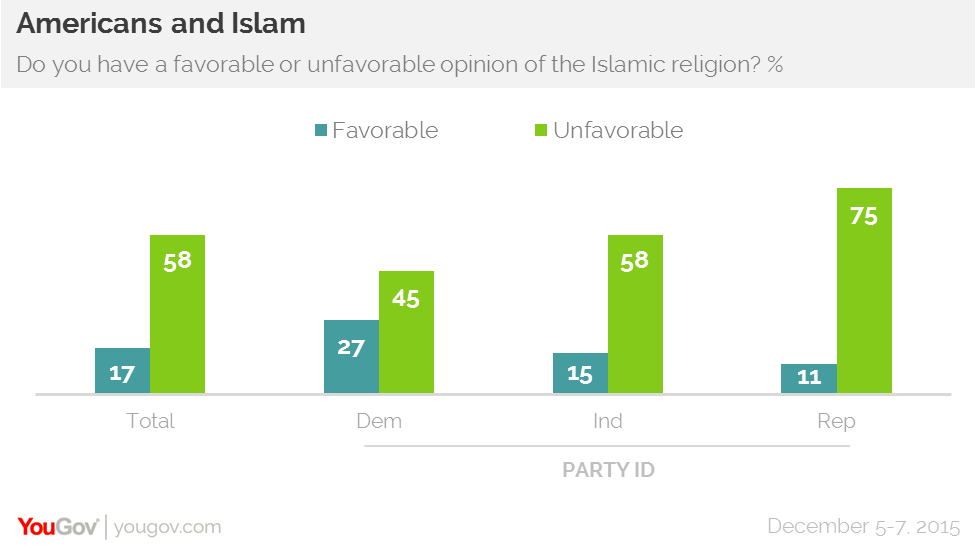
Yesterday, YouGov and the Huffington Post released a poll showing that large majorities of Americans — and pluralities across every political demographic — have an “unfavorable opinion” of the Islamic faith. The numbers are simply not close:

..

There will be no doubt some hand-wringing about “Islamophobia” and further calls to continue the American elite’s fourteen-year track record of whitewashing Islamic beliefs and culture, but I wonder if the media is missing a powerful, largely-uncovered influence on America’s hearts and minds — the experience and testimony of the more than two million Americans who’ve served overseas since 9/11 and have experienced Islamic cultures up-close.

Yes, they were in the middle of a war — but speaking from my own experience — the war was conducted from within a culture that was shockingly broken. I expected the jihadists to be evil, but even I couldn’t fathom the depths of their depravity. And it was all occurring against the backdrop of a brutally violent and intolerant culture. Women were beaten almost as an afterthought, there was a near-total lack of empathy for even friends and neighbors, lying was endemic, and sexual abuse was rampant. Even more disturbingly, it seemed that every problem was exacerbated the more religious and pious a person (or village) became.

I spent enough time outside the wire and interacting with tribal leaders to get a sense of the reality around me, but the younger guys on the line spent weeks at a time living in the heart of the local community. I remember one young soldier, after describing the things he’d seen since the start of the deployment, gestured towards the village around us and said — in perfect Army English — “Sir, this s**t is f**ked up.”

It is indeed. While it’s certainly unfair to judge Indonesia or Malaysia by the standards of Iraq or Afghanistan, it’s very hard to shake the power of lived experience, nor should we necessarily try. After all, when we hear stories from Syria, Yemen, Gaza, the Sinai, Libya, Nigeria, Somalia, Mali, Pakistan, and elsewhere they all fit the same depressing template of the American conflict zones. Nor is the dazzlingly wealthy veneer of Saudi Arabia, Kuwait, or the other Gulf States all that impressive. Tens of thousands of soldiers have seen the veritable slave labor that toils within the oil empires and have witnessed first-hand their casual disregard for “lesser” life.

But this same experience has caused us to treasure the Muslim friends we do have — in part because we recognize the extreme risks of their loyalty and defiance of jihad. That’s why American officers fiercely champion the immigration of local interpreters, even to the point of welcoming them into their own home. That’s why there’s often an intense connection with our Kurdish allies, the single-most effective ground fighting force against ISIS.

Two million Americans have been downrange, and they’ve come home and told families and friends stories the media rarely tells. Those stories have an impact, but because of the cultural distance between America’s warriors and its media, academic, and political aristocracy, it’s an impact the aristocracy hasn’t been tracking. Experience trumps idealistic rhetoric, and I can’t help but think that polls like YouGov’s are at least partly registering the results of a uniquely grim American experience.

Wednesday, September 09, 2015

The Rise of the Culture of Victimhood Explained - Hit & Run : Reason.com


In honor cultures, people (men) maintained their honor by responding to insults, slights, violations of rights by self-help violence. Generally honor cultures exist where the rule of law is weak. In honor cultures, people protected themselves, their families, and property through having a reputation for swift violence. During the 19th century, most Western societies began the moral transition toward dignity cultures in which all citizens were legally endowed with equal rights. In such societies, persons, property, and rights are defended by recourse to third parties, usually courts, police, and so forth, that, if necessary, wield violence on their behalf. Dignity cultures practice tolerance and are much more peaceful than honor cultures.
Sociologists Bradley Campbell and Jason Manning are arguing that the U.S. is now transitioning to a victimhood culture that combines both the honor culture's quickness to take offense with the dignity culture's use of third parties to police and punish transgressions. The result is people are encouraged to think of themselves as weak, marginalized, and oppressed. This is nothing less than demoralizing and polarizing as everybody seeks to become a "victim." 
...
To give readers some idea of what is being argued, I include below a couple of sections highlighted by Haidt. Bracketed comments are by Haidt.
A) Microaggression as OverstratificationAccording to Black (2011), as noted above, changes in stratification, intimacy, and diversity cause conflict. Microaggression complaints are largely about changes in stratification. They document actions said to increase the level of inequality in a social relationship – actions Black refers to as “overstratification.” Overstratification offenses occur whenever anyone rises above or falls below others in status. [Therefore…] a morality that privileges equality and condemns oppression is most likely to arise precisely in settings that already have relatively high degrees of equality… In modern Western societies, egalitarian ethics have developed alongside actual political and economic equality.As women moved into the workforce in large numbers, became increasingly educated, made inroads into highly paid professions such as law and medicine, and became increasingly prominent in local, state, and national politics, sexism became increasingly deviant. The taboo has grown so strong that making racist statements, even in private, might jeopardize the careers of celebrities or the assets of businessmen (e.g., Fenno, Christensen, and Rainey 2014; Lynch 2013). [p.706-707] [In other words, as progress is made toward a more equal and humane society, it takes a smaller and smaller offense to trigger a high level of outrage. The goalposts shift, allowing participants to maintain a constant level of anger and constant level of perceived victimization.]B) Microaggression as underdiversityMicroaggression offenses also tend to involve what Black calls “underdiversity” – the rejection of a culture. Large acts of underdiversity include things like genocide or political oppression, while smaller acts include ethnic jokes or insults. The publicizers of microaggressions are concerned with the latter, as well as more subtle, perhaps inadvertent, cultural slights…. Just as overstratification conflict varies inversely with stratification, underdiversity conflict varies directly with diversity (Black 2011:139). Attempts to increase stratification, we saw, are more deviant where stratification is at a minimum; likewise, attempts to decrease diversity are more deviant where diversity is at a maximum. In modern Western societies, an ethic of cultural tolerance – and often incompatibly, intolerance of intolerance – has developed in tandem with increasing diversity. Since microaggression offenses normally involve overstratification and underdiversity, intense concern about such offenses occurs at the intersection of the social conditions conducive to the seriousness of each. It is in egalitarian and diverse settings – such as at modern American universities – that equality and diversity are most valued, and it is in these settings that perceived offenses against these values are most deviant. [p.707]. [Again, the paradox: places that make the most progress toward equality and diversity can expect to have the “lowest bar” for what counts as an offense against equality and inclusivity. Some colleges have lowered the bar so far that an innocent question, motivated by curiosity, such as “where are you from” is now branded as an act of aggression.]C) Victimhood as VirtueWhen the victims publicize microaggressions they call attention to what they see as the deviant behavior of the offenders. In doing so they also call attention to their own victimization. Indeed, many ways of attracting the attention and sympathy of third parties emphasize or exacerbate the low status of the aggrieved. People portray themselves as oppressed by the powerful – as damaged, disadvantaged, and needy. [They describe such practices going back to ancient Rome and India] … But why emphasize one’s victimization? Certainly the distinction between offender and victim always has moral significance, lowering the offender’s moral status. In the settings such as those that generate microaggression catalogs, though, where offenders are oppressors and victims are the oppressed, it also raises the moral status of the victims. This only increases the incentive to publicize grievances, and it means aggrieved parties are especially likely to highlight their identity as victims, emphasizing their own suffering and innocence. Their adversaries are privileged and blameworthy, but they themselves are pitiable and blameless. [p.707-708] [This is the great tragedy: the culture of victimization rewards people for taking on a personal identity as one who is damaged, weak, and aggrieved. This is a recipe for failure — and constant litigation — after students graduate from college and attempt to enter the workforce].

Monday, July 20, 2015

Ancient Greeks highlight gay marriage flaws

Ancient Greeks highlight gay marriage flaws

Ancient Greeks highlight gay marriage flaws

Date
July 1, 2015
Bill O'Chee
I have many friends around the world, some of whom are gay, and some of whom are lesbian.  At the heart of those friendships is a desire to see people for who they are, and not for the people with whom they have sex.

Yet for all that, I do not support the state legislating to create a class of marriage between two men or two women. Moreover, I believe the arguments advanced in favour of gay marriage reflect poorly upon those who advocate for it.

Gay marriage is not about colouring your Facebook page avatar with a rainbow, nor is it about whether a man may have genuine feelings of love for another man, or a woman another woman. The discussion is, instead, about complex and fundamental issues not always properly considered.

If we go back over 2000 years, we find that both the Greeks and Romans were familiar with love and sex between people of the same gender. Indeed, for the Greeks, same sex relationships were neither uncommon, nor frowned upon; in fact they were probably much more common than they are today.

As was their way, the Greeks felt the need to use different words to describe what they saw as different types of love.

There could be agápe, brotherly love, or love of God; or storge, the love of parents and their children. The Greeks also spoke of philia, which was an idealised form of friendship based on equality and virtue; and of Ã©ros, which was sexual passion. Interestingly, Ã©ros was not restricted by gender.

Even in such a permissive society, gamos was reserved solely for a relationship between a man and a woman for the purposes of creating a family, even if that relationship might not originally be based on love.

There is much we can learn from the Greeks. The modern reality is that the vast majority of people who love each other live together without getting married, even if they may choose to do so later.

The law has moved to accommodate this, and common law couples are able to pass property to each other, to benefit from their partner's superannuation policy, and make decisions as next-of-kin, just the same as those who are married.

If that is so, why do heterosexual couples, who may have been living together for some time, choose to get married?

It is not about love, as that can be had perfectly well in a normal de facto relationship. In fact love - true and deep love - should not need outside validation, and should be independent of what others have to say.

Heterosexual couples don't need to marry to have children, as many children are born to de facto couples, even if some or many of those couples marry later.

However, the vast majority of heterosexual couples who chose to marry, either have children at the time, or intend to have them, and this is the impetus for marriage. Marriage gives those a stability and a clear identity that is the basis of their lifelong emotional development.

Certainly there may be people who marry who don't intend to have children, but they are a tiny minority, and certainly should not be used to characterise marriage.

So the truth is that marriage is not so much about love for our partner, as much as love for the children we hope to bring into the world.

It is at this point that the case for gay marriage starts to fall apart, because having children cannot ever be a natural consequence of two men or two women forming a union, no matter how genuine their emotions may be.

And if the motive for gay marriage is to make it easier for gay and lesbian couples to adopt children, or to access the powers of the state to bring children into the world through surrogacy or artificial insemination, then it is no longer about the love two people feel for each other, and more about wanting babies as lifestyle accessories.

This brings us to a broader, but important, philosophical issue.

I strongly believe the right to determine one's identity - sexual and otherwise - is one of the very few truly inalienable rights which society should accord every individual.

Determining our identity - and deciding on how we live our lives - necessarily involves many choices.
Choices, however, come with consequences.  Those consequences are the very reason we make choices: we sum up the advantages and disadvantages each choice brings, and make our decisions on that basis.

To believe that we can make choices about the way we want to live our lives, and then have the state come in and relieve us of the consequences we don't like is deeply flawed.  The whole basis of the law is built on people being responsible for the consequences of their actions, and marriage and families should be no different.

It is easy and glib to talk about "marriage equality" but what is more important is seeing through our choices to make sure they are meaningful.  This doesn't diminish the love that gay and lesbian couples may feel for each other.  However marriage has a real purpose which is larger than our love for ourselves or our partners, and it is selfish to see it otherwise.

Friday, January 30, 2015

Fleeing the No-Go Zones | TheCollegeConservative

Fleeing the No-Go Zones | TheCollegeConservative

To many in the West, the idea of Muslim ghettos may seem strange, but such places have existed for many years. The existence of such zones has been reported on for at least a decade. When this writer began to study Islam, he came across works like Londonistan, which served to outline the way in which Muslims in London have created zones where only Muslims are welcome. This has since happened in formerly English cities as Birmingham and Liverpool, where large swathes of neighborhood are become an unwelcoming ghetto. London has seen the creation of sharia patrols, groups of young Muslims men who walk the streets at night enforcing their own religious creeds upon the public. The French government has invented a euphemism to refer to such areas, calling them “Sensitive Urban Zones.” This only serves to heighten the way in which the civil government has lost control of the chunks of its own territory. This situation has not gone unreported, as one may see here, here, here, and here.

Thursday, January 01, 2015

The Self-Enforcing Nature of the Old Moral Code — It’s Gone

If it's too late to get it back, what do we do now, “rape crisis” and all?


By William Murchison – 12.12.14


Yeah, yeah, I’m I’m olllllld. I know and confess it. I remember the Kennedy assassination. I remember when all the guys wore coat and tie at college football games. I remember when the New York Times could be characterized as more or less a pro-American institution.


I mean, look — I even recall when a kind of moral consensus about sex, and sexual relationships, denied the likes of Rolling Stone magazine and Lena Dunham the privilege of whomping up national crusades against the Predatory Male.


We no longer have that consensus. But, boy, do we have Lena Dunham. And Taylor Swift. And the president of the United States — to sound the alarm about the male multitudes who view women as disposable playthings, fit for ravaging at will. Presently, America’s rape “crisis,” as we’re probably supposed to call it, vies with CIA torture and Obamacare for Topic of the Moment status.


I intend to lay down a marker for present purposes. The topic of how real, and how widespread, the crisis may be — if it’s a crisis at all — has attracted so many disputants on both sides that I think it better to hang back on that question. The frequently heard assertion that nearly one in five American women has been raped in her lifetime strikes me as grossly overblown, and anyway how would one know such a thing as that?


Well, we do know the male thirst for sexual satisfaction, whether carried out with the cooperation of women or against their will, is not trending on Twitter. That might be called, in theological terms, a consequence of the Fall — the splashy descent of newly created humanity into sustained misbehavior. Oh, you don’t believe in all that religious twaddle? Fine. Around here we protect the right of belief. The point to keep in mind is the timelessness of lust, whether perpetrated out of unconquerable desire or out of (as is widely believed nowadays) the hope for imperial conquest. I take it that understanding requires no spiritual affirmation.


Society figured out the problem long ago. It concocted rules. The rules, a subset of enactments under the moral law, said, hold it: a woman isn’t to be forced; coaxed, that was different (though not necessarily OK). That was because the rules recognized unchecked lust, and the brutality surrounding it — war evidenced these traits in ghastly form — as counter to the purposes of civilized society. You couldn’t have the powerful (men) working their will on the less powerful (women) without major harm to human dignity and social peace. It was a bit like empowering kings and emperors to do as they liked, without responsibility to anyone, least of all their victims. Unchecked power over others would destroy not only the others but the destroyers themselves in the end.


A particular problem arose in the context of unchecked power over women — power unrestrained by love or pity, either one. The woman was — is — the other half of the human race, her responsibilities and pleasures congruent with the responsibilities and pleasures of the other half. The two halves met as one whole, and thrived, or failed to thrive, as they recognized their mutual dependence.


The moral law, its features reframed a bit in every age, held that the mothers and wives on whom depended so much that was good and vital, were owed by the society in which they lived a due measure of respect, and of freedom from unmerited injury.


And they all lived happily ever after… yes? Not quite. We know this. The reason for rules in the first place is the human instinct for self-aggrandizement and the resulting need for boundaries. Rape we’ve always had, the breaking of rules being a feature of the human landscape. At least there were rules. These stayed in place in Western civilization for centuries. They were still around at the time of the Kennedy assassination, and in the days when the New York Times could be counted on for more-than-occasional commendations of America’s purposes and methods.


Those would be the times I remember myself — when the idea of a “rape crisis,” had such a notion been broached, would have sounded incredible. Some powerful institutions stood in the way of such a crisis. There was the family, first of all —the major teaching institution in any country and age. There were bad families aplenty, and broken ones; there were seemingly, even so, more good ones than bad, with two married parents under the roof, working to some degree or other to make sure the rules were understood and enforced. The schools backed them up, both parents and rules. Around the time of the Kennedy assassination, the colleges that some see now as the center of the rape culture stood firm for the doctrine of in loco parentis. The college authorities, that is, stood in for the parents who had entrusted to them the care of precious Johnny and Susie.


There were — imagine it! — rules. And dorms reserved for one sex or the other but not both at the same time. Curfews curtailed the nocturnal activities of women students, for whom the “house mothers” were always keeping an eye open on weeknights and weekends alike. What a sight at curfew hour — passionate good-nights; often enough breezy farewells. (A lot of girls from that era saw curfew as blessed deliverance from a dull, never-to-be-repeated date.)


A signal virtue of the old moral code was its self-enforcing nature. No kidding. There existed what we might call internal restraints: matters of I-really-shouldn’t-do-this. Not everybody owned or exercised such restraints, but they were out there in the general environment, and if you yourself didn’t possess an ample supply your friends might; likelier, your parents would. Parents — you remember; the villains whom the Yippie prankster Jerry Rubin urged you facetiously to “kill” lest they squash your delicate ambitions to express the inner you.


What the self-enforcing nature of the moral code meant was that cops and courts rarely involved themselves in personal matters. Citizens in our land of the free enjoyed entitlement to what is now a rare commodity — trust: a trust broken sometimes, of course, after the manner of fallen man, but not so often as to set university presidents by their ears over frat parties.


It was assumed that, if left generally alone, we would —under the promptings of the moral code — conduct ourselves responsibly enough to let the authorities focus on murder, robbery, and, yes, rape. Not the kind of rape — drunken, overbearing — Lena Dunham makes a centerpiece in her best-selling (if undocumented) account of a hard upbringing; rather, the kind of rape — cruel, vicious — for which government until fairly recently allowed the death penalty. Society, I mean to say, had the innate capacity to draw important behavioral distinctions, and to judge and act accordingly. Not anymore, it seems.


What happened is Question No. 1. A lot of things happened. Being old, I lay particular blame on events of years ago summed up in the rubric of “the counterculture.” The explosive content and consequences of the youth rebellion, c. 1964-1971, have never been adequately measured, it seems to me. Repeated blasts, each one larger than the last, blew down the front doors of the old culture with its rules and regulations: scattering authority figures from deans to parents who were “always telling people what to do;” suppressing joyous passion and the aspirations of oppressed classes — not only blacks but, as the story went, women eager to make their own decisions, live their own lives. The passions of the time quickly overflowed. There had been no culture of rape, 21st century style, in the era that mourned John F. Kennedy. The culture grew slowly; it battened on the new freedoms of the time. Who cared about old rules? Old dead people cared — that was who; dead mentally, dead emotionally, or just plain dead and buried.


And now what? That would be the second question. Enter the authorities, with sheaves of programs and recommendations. President Obama declared in April 2012 that “We must do more to raise awareness about the realities of sexual assault; confront and change insensitive attitudes wherever they persist…” A year later Obama signed the third reauthorization of the Violence Against Women Act — a measure attributed to the vision and inspiration of Senator, now Vice President, Joe Biden.


The compass of this now 20-year-old act is predictably spacious. As Valerie Jarrett, Obama’s right-hand woman, noted with satisfaction: “[T]housands of women and men…who are victims of domestic violence, sexual assault, dating violence, and stalking will be able to access resources they need in their communities to help heal from their trauma. In addition, thousands of law enforcement officers will be better equipped to stop violence before it starts, and respond to calls of help when they are needed.”


As for campus rape: “[O]ne in five women will be the victim of an attempted or completed sexual assault while they [sic] are in college…This act will help by requiring colleges and universities to provide information to students about dating violence, sexual assault, and stalking and improve data collection about these crimes. We call on all of our colleges and universities to make ending sexual assault a top priority.”


Well, that should take care of it! If not, the act reposes authority for violence prevention in an office of the Justice Department. And, thanks to another of the president’s now-famous executive orders, the National Dating Abuse Helpline now has federal funds for digital service. Nor should we overlook creation of a White House Task Force to Protect Students from Sexual Assault: the last nail, we may assume, in the coffin of Unrestrained Male Lust.


Or maybe not. What recent events on the rape front reveal — among other things, all of them bad or dispiriting — is the distance American culture has traveled since the Kennedy assassination. The freedoms so eagerly grasped in the ’60s turn out not to be so liberating after all. Yes, men and women students can live in the same dorms, if not the same rooms, and stay out all night if they like, and drink themselves insensible, and tell deans of student life and house moms (if any there still are) to take a hike, we’re in charge of our own lives now. Do these varied rights and privileges make life objectively better? That proposition would be hard to establish and maintain. We certainly didn’t talk about date rape, frat house rape, dorm rape — the whole catalog of current excesses — back when mom and dad conspired in the cause of maintaining insofar as possible certain well-established moral principles; e.g., your date — a fellow human being — is your responsibility, not your plaything. The practical essence of the old moral code was respect for others. They were entitled to it. So were you. Under that canopy of understanding you worked out and adjusted behaviors.


Plenty of slips and falls there were. That’s the nature of human beings, a tribe generally informed as to the nature of right and wrong, yet beset by temptations of all kinds: personal, financial, professional, sexual. The moral code observed in most particulars up to the past half-century or so helped keep the lid on. Better a code hitting on five out of eight cylinders than on none at all.


Ironically, the feminist quest for power and privilege, in the very act of liberating women from former expectations, ripped from their hands some of the old protections: respect based on admiration as well as friendship, and expectation of fruitfulness, not to mention abiding love, in the man/woman relationship.


Yeah, well, lemme tell you about my husband (or dad or brother or uncle), a genuinely aggrieved woman may reply to such an assertion. Lemme tell you, Mister, about the nights he came home drunk and…and…


We need not ignore such disturbing narratives, with their component of truth. We need them most of all in some sense to remind us of the futility of expecting laws and regulations and federal grants and Valerie Jarrett memos to smooth out male-female relationships and build up the respect that must flow from man to woman and woman to man. The restoration of the old moral code is the proper work for men and women who hope to cure this age’s varied infirmities. It is likewise the hardest possible work.


The Christian and Jewish religions were formerly fundamental to the task of affirming the mutual duties of men and women — partners in service to God in His world. Religion, if not yet flat on its back, no longer commands even the curiosity it once enjoyed.


A moral code — to what end? That would be a modern-sounding query. Why not, instead, Acts of Congress? (Based on whose perceptions of right and wrong?) Why not police lineups and arrest warrants? (Enforcing whose perceptions of right and wrong?)


Why not Valerie Jarrett and Joe Biden? Ah, forgot — they’ll both be elsewhere in a couple of years. What does that leave us with, seen or unseen, to maintain the tricky balance between the responsibilities (how’s that for a musty old word?!) whose fulfillment makes civilization possible?


The question dangles, unanswered, in the air of the 21st century.

Thursday, December 25, 2014

The Big Lie of the Anti-Cop Left Turns Lethal by Heather Mac Donald, City Journal 22 December 2014

The Big Lie of the Anti-Cop Left Turns Lethal by Heather Mac Donald, City Journal 22 December 2014

Since last summer, a lie has overtaken significant parts of the country, resulting in growing mass hysteria. That lie holds that the police pose a mortal threat to black Americans—indeed that the police are the greatest threat facing black Americans today. Several subsidiary untruths buttress that central myth: that the criminal-justice system is biased against blacks; that the black underclass doesn’t exist; and that crime rates are comparable between blacks and whites—leaving disproportionate police action in minority neighborhoods unexplained without reference to racism. The poisonous effect of those lies has now manifested itself in the cold-blooded assassination of two NYPD officers.
....
Some facts: Police killings of blacks are an extremely rare feature of black life and are a minute fraction of black homicide deaths. The police could end all killings of civilians tomorrow and it would have no effect on the black homicide risk, which comes overwhelmingly from other blacks. In 2013, there were 6,261 black homicide victims in the U.S.—almost all killed by black civilians—resulting in a death risk in inner cities that is ten times higher for blacks than for whites. None of those killings triggered mass protests; they are deemed normal and beneath notice. The police, by contrast, according to published reports, kill roughly 200 blacks a year, most of them armed and dangerous, out of about 40 million police-civilian contacts a year. Blacks are in fact killed by police at a lower rate than their threat to officers would predict. In 2013, blacks made up 42 percent of all cop killers whose race was known, even though blacks are only 13 percent of the nation’s population. The percentage of black suspects killed by the police nationally is 29 percent lower than the percentage of blacks mortally threatening them.

There is huge unacknowledged support for the police in the inner city: “They’re due respect because they put their lives every day on the line to protect and serve. I hope they don’t back off from policing,” a woman told me on Thursday night, two nights before the assassination, on the street in Staten Island where Eric Garner was killed.

Sunday, November 02, 2014

Chivalry Is Dead, Long Live Feminism


If You Want Sameness, Don’t Expect Chivalry
Well, our brave new world of gender equality—in which we scoff at gender differences and men and women are encouraged to act the same—often proves harmful to women and girls. While the modern feminist movement won women tremendous freedoms educationally, professionally, personally, and sexually, it often leaves women feeling anything but empowered.
The reality is these freedoms have too often come at the expense of all values and traditions. We’ve in effect thrown the helpful social mores out with the old-fashioned bathwater. But it’s the modern feminist movement, which ushered away any hint of traditional chivalry and gendered expectations, that’s in part to blame. Certainly few want to return to an age when gender roles were excessively rigid, but feminists have gone to extremes and encouraged a culture that undermines healthy gender relationships. Men who hold doors are now viewed as part of the patriarchal society. And girls are expected to just “be one of the guys.”
But gender roles helped men and women and in times past allowed the sexes to better navigate the sometimes-rough waters of romance, courtship, marriage, and sex. Feminists view the chivalry and social mores of previous generations as anachronistic. But the reality is these traditional customs of giving up a seat for a woman on a train, or accompanying a woman in public, weren’t all rooted in sexism. They were social structures to help make men more respectful of women and to curb this kind of inappropriate behavior.
It might not have been perfect, but it had a purpose. Today’s dismissal of gender differences instead creates confusion, disappointment, and often more opportunity for harassment.
The conversation about street harassment has revealed once again that feminism has come with a cost, and women are usually the ones who bear the real price. Society has never been perfect, and I’m not advocating for a return to a time when women’s choices were more limited, but in years past men and women both had a better framework to determine what was acceptable behavior and what was not.

I Am Not Nice

From a post, made years ago, in the Pagan news groups.


Hilda Marshall, citing the Rules of Acquisition to All, said:
In an attempt to neutralize a slanderous and utterly unfounded rumor regarding myself, propagated amongst the Pagan community as a whole by I know not whom, I offer this open letter as a rebuttal.

I am not nice.

If the only people who Truly Understand are those who let you use them for whatever you want to use them for, I do not Truly Understand.

If the only Healers are those who let you deplete their personal energy and other resources, I am not a Healer.

If the only True Witches are those whose only reply to your tales of woe is "There, there, dear, of course you were right all along, and anyone who disagrees is evil," then I am not a True Witch.

Since my limits are so clear-cut and appear to be unusually extreme in this community, let me detail what I *will* allow.

You may visit me if I invite you, and stay for however many days we agree upon ahead of time.  You may not invite yourself or extend your stay without my permission, and you should not expect me to keep up with your changes in plans without reasonable advance notice.

You may not prevail upon my housemates.  If I invite you, I'm responsible for setting boundaries; and for informing you if you overstep those boundaries.  My housemates did not invite you, and should not be held responsible for asking you not to eat their food, talk at them when they're not interested, or instruct them on how to take care of their health, their pets, or their lives in general.

You may call me on the phone to request advice or a sympathetic ear.  You may not do so after 10:00 PM or before 8:00 AM unless it is an emergency.  Nor may you do so at ANY time if your sole intention is to whine the I Can't litany at me.  I hate that song.  Save it for the government.

You may borrow my stuff, provided you ask first, and return it to me in the condition in which you first borrowed it within a reasonable amount of time.  You may not loan or give it to other people without asking me first, and I reserve the right to take back anything that is being misused, broken, or left on a wet floor and trampled.

You are VERY welcome to participate in the many fun projects in which I am involved!  I only ask that you think hard about what you're promising and don't agree to do anything that you'll likely decide later not to do, for whatever reason.  ("Things just got too crazy" is not a reason.)  And if you do end up breaking a promise, please tell me as soon as you decide to, rather than waiting until the last minute, so that I can formulate a backup plan.

I understand that there are many Witches who are doing their best to create a world that runs on Pagan Standard time.  I fully comprehend that there are large numbers of Witches who think that all property belongs to all people and anyone who objects has "control issues."  I know from experience that incredible numbers of Witches believe that they are owed attention and support whenever they need it from whomever they choose.  I realize that there are many, many Witches who hope, work, and dream to create a world free from courtesy.

I am not one of them.

Sunday, September 21, 2014

(16) Tim O'Neill's answer to Why did science make little real progress in Europe in the Middle Ages? - Quora


...The Actual Scientific Dark Age
Of course, there certainly was a period in which western natural philosophy did stagnate and then languish and in which the whole scientific tradition of the Greeks and Romans was in danger of being lost.  Later Hellenic and then Roman scholars inherited the work of the Greek proto-scientists of the Fourth and Fifth Centuries BC and built on it.  By the First Century AD Roman scholars tended to read Greek and so could read the works of Aristotle and Archimedes in their original languages, but there was also an increasing tradition of encyclopaedic collections of summaries and key points from earlier Greek works which tended to be compiled in Latin.  The scholars of the First and Second centuries added some major contributions to science, especially Ptolemy (astronomy and mathematics) and Galen (medicine), but many Roman scholars made do with the Latin summaries and encyclopaedias for their grasp of earlier work.
In the Third Century, however, there were major social and political upheavals that interrupted many aspects of Roman life, including scholarship, with profound later consequences.  The Empire entered what is now called "the Military Anarchy", where rival emperors rose and fell in rapid succession and the Empire was racked with decade after decade of civil war and political oppression.  The weakened Empire suffered from invasions by the newly resurgent Sassanian Persians and by larger and more aggressive federations of Germanic barbarians. Cities that had been peaceful for centuries began constructing defensive walls, resources that once went into buildings and public works went into endless wars and at one point the Empire even split into three parts.
A form of stability was imposed by a new kind of more centralised and more monarchical emperorship, economic reforms and an overhaul of the army and the Imperial administration by Diocletian and his successors, but parts of the Empire never fully recovered, especially in the west.  Intellectual life and education, which had been badly disrupted in the long century of chaos, certainly did not regain its former strength and in the west fewer and fewer scholars were literate in Greek.  As a result, works that were only available in Greek, especially technical, philosophic and detailed scientific works, were read and copied far less and began to be neglected.  Greco-Roman science was increasingly preserved only in the popular Latin encyclopaedic tradition rather than studied in detail via the original Greek works.
By the Fifth Century the administrative division between the Latin-speaking Western Empire and the Greek-speaking Eastern Empire became permanent and then became a political divide.  The weaker, poorer and more vulnerable Western Empire did not even survive the century, with its final collapse coming in 476 AD after another century of civil wars, invasions and spiralling decline.  What followed was centuries of invasions, fragmentation and chaos, with few brief periods of stability and centralised authority.  The faltering intellectual tradition, which had already been in decline since the late Second Century, languished to a low ebb.
The institution which managed to keep this faltering tradition from dying out altogether during these centuries of barbarian invasion and disintegration was actually the one the Enlightenment myth (wrongly) blames for causing the decline in the first place.  The Christian church came to hold political power when the decline in learning in the west had been under way for over a century, and so could not have been its cause.  Initially Christianity was ambivalent toward Greek philosophy and learning, but prominent Christian thinkers who had been trained in philosophy could see it as something to be embraced.  God, they argued, was a rational intelligence and had created the universe along rational lines.  It made sense, therefore, that humans could and should use reason to understand his creation.  Clement of Alexandria argued that just as the Jews had been given a divine gift of special religious revelation, so had the Greeks been given a gift of rational analysis.  Both were to be embraced and used.
So when the Western Empire collapsed, the Church had long since come to terms with Greek philosophy and science and found ways to incorporate both and reconcile them with their religion.  And it was Christian scholars who saw that the decline of Greek literacy in the west meant much of the original works of Greek learning were being lost.  Cassiodorus and Boethius both tried to preserve key works by translating them into Latin.  Boethius was executed before he could complete an ambitious plan to translate all the works of Aristotle, but he did manage to translate most of the key works on logic - something which meant that logic and therefore reason took a central role in early Medieval education, even in the darkest centuries of the chaos.  The seeds of the Medieval revival of science lay in that stroke of luck.
The Medieval Enshrining of Reason
One writer has compared the long road back from the intellectual catastrophe of the collapse of the Western Roman Empire on learning in western Europe to people after a nuclear holocaust trying to revive modern science with nothing but a few volumes of the Encyclopaedia Britannica and a copy of Bill Bryson's A Short History of Nearly Everything.  Scholars in the Eighth or Ninth Centuries had just enough fragments of information to know that they had barely anything at all but not enough to begin reconstructing what had been lost.  What is interesting is what they did with the bits they had - they revered them.  These ancient writers, mostly pagans, were held up as all-knowing authorities and what elements of their works did survive were studied with immense reverence and painstaking scrutiny.
This meant particular attention was paid to one of the few areas in which a reasonable number of works had survived - logic, or "dialectic" as it was known.  A grasp of logic was central to Medieval education and a student had to master it, via Boethius' translations of Aristotle and other works, before they could tackle any other subjects.  This had the curious effect of enshrining reason as the key to all knowledge - a development completely at odds with the popular view of the Middle Ages and the Medieval church in particular as being fixated on unquestioned dogma and irrational superstition.  There were certainly things that these Medieval scholars accepted on faith but they increasingly came to feel they could also arrive at them, and all kinds of other forms of understanding about the universe, via reason.  In a strange way, the loss of so much Greek philosophy actually focused attention on the elements that had survived and had the effect of enshrining reason at the heart of Medieval thought in a way not seen before.  ....The Church's Suppression of Ideas?
Actually, nothing of the history detailed above sits neatly with the idea of the Medieval Church as a violent and intolerant theocracy that immediately consigned anyone with the whiff of a new idea to the flames.  In fact, the parameters for speculation and investigation into the nature of the physical world were quite wide, because the Medieval Church considered the cosmos to the the rational product of the rational mind of God and that humans were given reason partly so they could apprehend and investigate the universe rationally.
This is why Thomas Aquinas spent years and many millions of words painstakingly applying the rational principles of ancient Greek dialectic to Christian theology in an attempt at showing that all the key ideas of Christian belief could be arrived at by pure reason. It is also why the quodlibeta debates at Medieval universities were such open free-for-alls where all kinds of radical and even heretical ideas could be proposed to see if they stood up to logical analysis.
The Medieval Church also did not insist on a purely literal interpretation of the Bible (fundamentalist literalism is a modern and largely American Protestant idea).  This meant that it had no problem with seeing aspects of the Bible as purely allegorical and with the exploration of how their symbolic truth relates to the real world.  Most people who think of the Medieval period as one where Biblical literalists suppressed original thinking though fear would have a hard time explaining, for example, the work of William of Conches.  Way back in the Twelfth Century this scholar, based at Chartres Cathedral, accepted that his audience already understood the creation story in Genesis to be symbolic and went on to interpret it "according to nature'.  He proposed how natural forces set in motion by God brought about the form of the heavens and earth as we have them today.  He went on to talk about life arising from the primordial mud by the natural action of heat and how it developed from simple early forms.  He even talks about how man arose in the same way and how, in theory, some other species of man could arise via natural processes in the same way.
All these very modern-sounding (even Darwinian) ideas were accepted by Medieval scholars without the slightest problem and the Church had no difficulty with them either - indeed, William of Conches, like all other Medieval scientists - was a churchman.
The closest the Church came to suppressing science in any way was when, in reaction to some of the ideas being debated in the University of Paris at the height of the rediscovery of Aristotelian learning in the Thirteenth Century, the Faculty of Theology attempted at putting some limits on what could be discussed by the Faculty of Arts.  In 1210, 1270 and again in 1277 the Pope, at the request of the Parisian Theology Faculty, published lists of ideas proposed by Aristotle or implied by his philosophy that were contrary to Christian doctrine and so were forbidden.  What is remarkable about this is, firstly, how little in Aristotle etc was actually proscribed by these Condemnations.  Secondly, it's remarkable how ineffective the Condemnations were.  They only applied to Paris, whereas discussion of all these topics continued at Oxford and other universities unaffected.  And, as the fact that they had to be repeated twice indicates, they were widely ignored anyway.  They also had another effect - by arguing that Aristotle was actually wrong on several key points, they stimulated a more critical examination of the Greek philosopher's work which led to several of his idea being critically analysed and found to be incorrect (eg the idea that a heavy object falls faster than a lighter one).  IN a strange way, the Condemnations failed to suppress science and actually helped to stimulate it.
The fact is that the idea of the Church suppressing science and rational analysis of the physical world is a myth.  Not one Medieval scholar was ever burned, imprisoned or oppressed by the Medieval Church for making a claim about the physical world.  This why the modern proponents of the myth always have to fall back on an exceptional and post-Medieval example to prop up this idea: the Galileo case.

Sunday, September 14, 2014

Feminist Theory, Human Nature and the Punch Seen ‘Round the World : The Other McCain

Feminist Theory, Human Nature and the Punch Seen ‘Round the World : The Other McCain

Watching the video in which Ray Rice knocked out his fiancée (now wife) Janay, the thought occurs: What was she so angry about?Everybody has focused on the obvious horror of Rice’s punch — the brute force of a 200-pound professional athlete used against a woman — and nobody seems interested in what Janay did immediately before the punch. The couple were in a confined space, inside an elevator, when Janay “got in his face,” screaming and lunging toward Rice. Of course, Janay’s behavior does not justify Rice hitting her, but one wonders why she acted that way, just as one wonders whether the circumstance of being trapped in an elevator with this enraged woman in some way explains Rice’s reaction. That is to say, if her angry rage triggered Rice’s fight-or-flight instinct, he couldn’t flee from her while they were on the elevator, and his adrenalin surge produced an autonomic reflex: BOOM.
That’s one possible reading of the scene, at least, but I’m sure that any attempt to explain what Ray Rice did will be condemned as an attempt todefend or justify what Ray Rice did, so that political correctness erects a wall obstructing access to a knowledge of the motives involved.
....
Because progressives view humans in collective groups, the problems of Ray Rice and his wife Janay are not personal, but political. The fact that Janay’s husband has lost his lucrative employment, and that an African-American family has thus suffered economic harm — an outcome that seemingly contradicts progressive “social justice” goals — is ignored because, as the feminists say, these two people are “a mere microcosm of a larger systemic injustice.” Whereas the O.J. Simpson trial was viewed through the prism of race-based “injustice,” the case of Ray Rice is viewed through the feminist prism.
Whatever the context, this collectivist worldview lends itself easily to paranoid fears. Instead of viewing humans as individuals, capable of acting rationally in their own self-interest and harmonizing their actions in voluntary cooperation, progressives insist that human life is “socially constructed,” and that our behavior is influenced — if not actuallycontrolled — by impersonal forces.  That is to say, everything we do is viewed by progressives not as our individual action, but rather in terms of what our actions mean for our membership in collective groups. Are we male or female? Black, white, Hispanic, Asian? Native or immigrant? Rich or poor? The psychological effect of this worldview is to tell us that we lack personal agency, and are not in control of our own destiny. The collectivist worldview encourages us to externalize responsibility, to blame others for our failures and hardships, so as to exempt ourselves from criticism — “Don’t blame me! It’s not my fault! I’m a victim!”....“Boys don’t hit girls” — my wife and I have insisted on that moral maxim in raising two daughters and four sons. This was what our parents taught us and, in transmitting this basic code of civilization to our children, we expect them to live up to it and pass it on to future generations.
Instilling this code into young people requires boys to understand that the male’s general superiority of physical strength should never be used to harm or threaten women, but rather to protect women from harm. And it requires teaching girls that under no circumstance should they tolerate male violence against them. No man will ever get a second chance to hit you, because the first time he lays a hand on you, it’s over — and he had better pray to God your brothers never find out.
...
This stringent zero-tolerance policy — “Boys don’t hit girls” – sets up a problem: What happens if a woman loses her temper, behaves in an insulting manner, and even acts violently against a man? Some women are simply crazy, and some women have been spoiled rotten by over-indulgent parents who put up with tantrums. The “Daddy’s Precious Darling” Syndrome, as I call it, involves an entitlement mentality that makes it impossible for some women to admit wrongdoing or to accept criticism. If she can’t get what she wants, or if her bad behavior exposes her to criticism, Daddy’s Precious Darling can’t deal with it. She flies into a rage, and whoever she blames for thwarting her will — failing to kowtow to imperious demands or daring to criticize her selfish attitude — will become the target of unrestrained hatred.
....
OK, what if Janay was not a girl?
What if, instead of going to the casino with a date, Ray Rice had gone to the casino with a male buddy who got drunk and caused a scene? What if, after Ray and his buddy got on the elevator, the buddy had started yelling angrily at him, “getting in his face”?
BOOM.There’s your equality. How do you like it?
Of course, feminists don’t believe in this kind of equality, an equality which would make women and men equally vulnerable to the consequences of “getting in the face” of a 200-pound pro athlete. However, as a skinny man who doesn’t enjoy pain, I can absolutely guarantee you that I would never make the mistake of engaging in a face-to-face shouting match with a guy like Ray Rice.
Here’s some helpful advice: Just walk away.
This advice applies to anyone who is tempted to provoke a confrontation, and it also applies equally to anyone who finds themselves confronted with a helpless fool looking for trouble. It especially applies to any man whose girlfriend or wife loses her temper, goes into a rage and begins insulting or threatening him.
Just walk away.
She’s challenging your manhood. She’s calling you every insulting name she can think of, accusing you of every kind of evil.
Just walk away.That was what was so glorious in the way Ashley Wilkes responded after Scarlett O’Hara slapped him. Just two minutes earlier, she had been gushing about how much she loved him, but when he insisted that he loved and intended to marry Melanie Hamilton, the evil in Scarlett’s heart came pouring out in a torrent of hateful insults. And when she slapped his face, the conversation was over.
Just walk away.A good man doesn’t deserve to be treated that way. And a good man doesn’t have to hit a woman to prove his point.
Just walk away.Alas! “We’re not gentlemen and we have no honor,” as Rhett told Scarlett, and no feminist has any respect for honorable gentlemen. Nor can feminists tolerate Christianity and its ideals of unselfish love. Feminist theory views all male/female relationships as a power struggle, wherein men oppress and subjugate women, so that there can be no possibility of voluntary cooperation between them.
No love. No courtesy. No kindness. No mercy.
None of this makes sense in the context of radical equality, where the selfish quest for power turns man and woman into rivals.
BOOM.There’s your equality. How do you like it?

Thursday, September 11, 2014

The Poor Are Not Middle Class | Russell E. Saltzman | First Things


Ruby Payne’s A Framework: Understanding Poverty demonstrates how different classes think. Let me frame this distinction as a test. Among families who still sit down together to eat, which will ask, “Did it taste good?” The wealthy, the middle class, or the poor?
That’s the middle class. The wealthy ask about presentation, “Did it look nice?” The poor will ask “Did you get enough; do you need more?” How the classes think about what’s on the plate is significant, and that’s only one among many differences, what Payne calls the “hidden rules” of class.
There is a definite variance in attitude between classes.

And while cause and effect may be difficult to disentangle, I imagine at least some attitudes are causes of membership in particular classes.

Tuesday, September 02, 2014

The End of Politics—Part One : The Freeman : Foundation for Economic Education


Someday we’ll look back on politics and shake our heads. It will have been a necessary phase—but not one we’ll want to relive. Necessary, because we have been undergoing a series of phases, none of which we could have bypassed.

We have already entered the next phase. Call it the Age of Connection. Once we realize all the benefits of this next phase, we’ll see how wasteful and acrimonious the prior phase had been.

Politics is a way humanely to fight over the control of hierarchy. The U.S. republic was in certain respects designed to create checks between factions and parties by setting them against each other. Ballots over bullets and all that. It was thought of as a necessary evil—an alternative to the subjugation of people, which came from monarchy, feudalism, and aristocratic privilege. In Madison’s Federalist 10, he expressed concern about the “mischiefs of faction” found in democracies of various sizes. The republic had been a way to temper the consequences of faction, even as “causes of faction cannot be removed.” The democratic republic was thus a kind of rationally conceived operating system, forged in compromise after a unique opportunity to start fresh. In other respects, however, the development of this American-style republic was a phase transition.

In other words, the democratic republic was likely to have arisen at some point due to the world’s becoming more complex. Some revere the founding as the explication of timeless principles we only had to discover using reason. And yet we know the founders were crafting rules at a certain stage of technological development and historical context. They were moving headlong into a future informed by reasonable assumptions about human nature and the world in which they found themselves. To understand this stage and stages prior, it will benefit us first to take our time machine a little further into the past, then to zip back to the future.

To read the news, though, you wouldn’t think anybody could claim things are getting better. The media sell more spectacle and turmoil than they offer happier trends over longer timescales. Their reports leave many of us with both a false impression and a general ignorance about just how good we’ve got it compared to people throughout most of history. As writer and cognitive scientist Steven Pinker says in an interview with the New Scientist:
I was struck by a graph I saw of homicide rates in British towns and cities going back to the 14th century. The rates had plummeted by between 30 and 100-fold. That stuck with me, because you tend to have an image of medieval times with happy peasants coexisting in close-knit communities, whereas we think of the present as filled with school shootings and muggings and terrorist attacks.

Then in Lawrence Keeley's 1996 book War Before Civilization I read that modern states at their worst, such as Germany in the twentieth century or France in the nineteenth century, had rates of death in warfare that were dwarfed by those of hunter-gatherer and hunter-horticultural societies. That, too, is of profound significance in terms of our understanding of the costs and benefits of civilization.

From the perspective of the grand sweep of history, we are living in an age of peace and abundance.

Even the poorest places on earth are far better off than they were just a few decades ago. Indeed, in the last 30 years alone, the number of people living in abject poverty has been cut in half. Day by day, violent aggression over resources is rapidly being replaced by the structures of commercial competition and human cooperation.

In thinking about phase transition, though, the Founding still looms large. The American Republic and many democratic republics since were brilliantly crafted systems designed to maximize freedom and limit the excesses of hierarchy. Or, put another way, documents like the Declaration of Independence and the U.S. Constitution put forth answers to the question, “What sort of political order can be created to unleash as much human autonomy possible?”
But our operating system, as operating systems will, has become buggy, strained, and outdated. Not only are people becoming increasingly weary of a system designed to pit people against each other with a crude majoritarian calculus, but new systems are being developed to accommodate phase transition. Indeed, some of these systems don’t require the permission of authorities. They arise from technologically connected people along the lines of what James C. Scott describes in Two Cheers for Anarchism:
More regimes have been brought, piecemeal, to their knees by what was once called “Irish Democracy,” the silent, dogged resistance, withdrawal, and truculence of millions of ordinary people, than by revolutionary vanguards or rioting mobs.
Some will try to argue that our social operating system as originally conceived by the Founders would be a lot better than the corrupted version we have now. I am sympathetic to that position, but Public Choice considerations like those found in the works of James Buchanan, Gordon Tullock, and Mancur Olson caution otherwise. With the rise of special interests, they remind us, something is bound to go wrong. Now there is a sense in which we cannot turn back the clock and debug the program. Instead, for the first time in history, technology and culture are allowing us more and more opportunities to create new systems and migrate between them. Indeed, it used to be that to change systems, one had quite literally to migrate, as in pick up within one territorial jurisdiction and move to another. And that, too, is an increasingly viable option. But migrating between systems is also something that, increasingly, you can do from your sofa.