In the 46-page study, which can be read in its entirety here, Kates and Mauser looked at and compared data from the U.S. and parts of Europe to show that stricter laws don’t mean there is less crime. As an example, when looking at “intentional deaths,” or murder, on an international scope, the U.S. falls behind Russia, Estonia, and four other countries, ranking it seventh. More specifically, data shows that in Russia, where guns are banned, the murder rate is significantly higher than in the U.S in comparison. “There is a compound assertion that guns are uniquely available in the United States compared with other modern developed nations, which is why the United States has by far the highest murder rate. Though these assertions have been endlessly repeated, [the latter] is, in fact, false and [the former] is substantially so,” the authors point out, based on their research.
Thursday, February 06, 2014
Harvard Gun Study Claims Banning Weapons Doesn't Decrease Violence
http://www.bostonmagazine.com/


Wednesday, February 05, 2014
Fifteen Consequences of Same-Sex Marriage
http://www.nationalreview.com/
The 15 effects:1. “First, as many commentators have observed, because procreation is an inherently gendered affair, redefining marriage in genderless terms would break the critical conceptual link between marriage and procreation. . . . Given the manifest ills of fatherless parenting, the State has a compelling interest in sending a powerful message to women that, whenever possible, marriage to the fathers of their children is very important to the welfare of those children and to society itself.”
2. “Second, for similar reasons, the loss of the State’s clear message in favor of biological mother-father parenting within marriage would likely result in a higher percentage of couples conceiving children without the stability that marriage would otherwise bring.”
3. “Third, replacing the child-centric or ‘conjugal’ view of marriage with a more adult-centric view would undermine the existing social norm that often leads parents in acceptable but not ideal marriages to make self-sacrifices and remain married to the parents of their children.”
4. “Fourth, by shifting the understanding of marriage to a more adult-centric view, the redefinition ordered by the district court would also undermine the current social norm (weakened though it may be) that those who wish to have children—or to engage in conduct that could lead to children—should get married.”
5. “Fifth, and most obviously, a genderless definition of marriage would likely increase the number of children being raised by same-sex parents. That could happen because the couple decides to raise together an existing child of one of the partners. Or it could result from the conception of a new child through surrogacy or sperm-donation. Either way, such children will not benefit from the State’s preferred mother-father parenting model; often they will have no way of knowing even the identity of both biological parents. And recent evidence on same-sex parenting, while not conclusive, indicates that same-sex parenting arrangements are less effective than married biological mothers and fathers in producing positive outcomes in the lives of their children.
6. “Sixth, if the traditional male-female aspect of marriage were thrown out as irrational, it would likely become more difficult to resist other innovations that would lead to additional children being raised without a father or mother.”
7. “Seventh, a court-ordered redefinition of marriage could well lead to its wholesale ‘privatization’—for example, by enactment of a civil- union regime for all couples, with religious and other organizations being free to offer the title of ‘marriage’ as they see fit.”
8. “[The] correlation between genderless marriage and lower birthrates. . . . It is also striking that fertility and birthrates tend to be markedly lower in nations and states that have embraced same-sex marriage.”
9. “Because procreation is an inherently gendered matter, redefining marriage in genderless terms breaks the critical conceptual link between marriage and procreation—and in that way alone would dilute the implicit encouragement the institution of marriage currently provides for procreation by married couples.”
10. “By implicitly endorsing the adult-centric model of marriage, a genderless redefinition would send a powerful message that it is entirely appropriate—even expected—for adults to forego or severely limit the number of their children based on concerns for their own convenience. That a new child might ‘cramp the style’ of an adult would come to be seen as sufficient reason not to have the child at all. That too would tend to reduce fertility rates.”
11. “To the extent a genderless marriage definition encourages the further abandonment—or privatization—of marriage, it would almost certainly reduce birthrates. Studies have shown that cohabiting couples tend to produce fewer children on average than married couples do—perhaps because the resulting instability makes the participants less willing to bring children into the mix. Thus, if overall marriage rates decline further, birthrates would likely decline as well.”
12. “Governments would likely be pressured—and perhaps agree—to revoke the tax-exempt status of churches or other non-profit religious organizations that refuse on religious grounds to recognize same-sex marriages or to provide benefits to same-sex couples on the same terms as husband-wife couples.”
13. “Governments would likely be pressured—and perhaps agree—to investigate, prosecute and punish people in wedding-related businesses for refusing on religious conscience grounds to assist with same-sex weddings.”
14. “Government licensing agencies would likely be pressured—and perhaps agree—to investigate and punish counselors for refusing on religious conscience grounds to counsel same-sex married couples on the same terms as heterosexual couples.”
15. “Religion-based conflicts between public schools and parents would likely increase as children are taught about sexuality and marriage in ways that contravene parents’ and students’ deeply held religious beliefs.”
Ten (and counting) Commandments before agreeing to debate a creationist

http://pandasthumb.org/
Note, as commenters did, none of this deals with what should happen at any debate.TEN (well, 7 & counting) COMMANDMENTS THOU SHALT THINK ABOUT, AND RESOLVE, BEFORE YOU EVEN AGREE TO DEBATE A CREATIONIST
(Actually, I only had time at the moment for Seven Commandments. I will take suggestions and improvements. If you write a sufficiently good one, I will include it and list you as an author; if the Commandments come together well, perhaps we can submit it to NCSE Reports or some such.)
(also, all I know about this debate is based on news reports, and the assumption that if something has not been mentioned, it was not thought about by Bill Nye; please correct me if I get something wrong)
I. THOU SHALT THINK ABOUT THE MOOLAH. Is there going to be an admission fee charged to this event? Where will this money go? In today’s debate, something like 800 attendees are paying $30/each to attend (I forget the exact details). That’s $24,000 on the table right there.
....
II. THOU SHALT THINK ABOUT THE DISTRIBUTION RIGHTS. All too often, professors get goaded into debates or “discussions” (or sometimes “interviews”), show up like they would to a normal low-publicity academic event, and then discover that the creationists have a full film crew ready to professionally tape the whole thing. Some nice person sticks a consent form in front of them, they sign it, and then the professor is surprised to find themselves featured in creationist videos and documentaries for the next several decades.
....
III. THOU SHALT THINK ABOUT THE TICKET SALES. If the tickets will be on sale, who is going to have access? According to reports, the tickets for the Nye/Ham debate sold out in 2 minutes once ticket sales opened up. I wouldn’t be at all surprised to find out that the creationists had many of the tickets, or perhaps virtually all of the tickets, reserved ahead of time, for donors, supporters, and the like.
....
So: get some tickets alotted to yourself, that you may distribute as you wish.
....
IV. THOU SHALT THINK ABOUT DONATION APPEALS. You can bet that AiG will be hitting up the audience for donations in some fashion. At the actual event, it could just be donation cards handed out at the entrance, or it could be explicit appeals and passing the hat before and after the event. You can be sure that the video versions distributed to the fundamentalist churches and schools contain donation appeals in some form too. Did you sign up to this debate to help the creationists fundraise? No? Then why didn’t you stipulate that you would refuse to participate unless such donation appeals were excluded?
Alternatively, you could demand that at the event, and in any subsequent videos, NCSE (for example) gets a plug for donations.
....
V. THOU SHALT THINK ABOUT PRE- AND POST-DEBATE EVENTS. This never occurs to scientists until after the fact, but on the occasions when evolutionists (or mainstream Bible scholars, or whatever) do get invited to speak before fundamentalist audiences, it is entirely standard for the fundamentalists to have organized ahead of time for the audience to be subjected to post-debate rebuttals from other speakers. This ensures the creationists get the last word and gives them a chance to paper-over any cracks you might have opened up in the mind of creationists in the audience.
....
VI. THOU SHALT THINK ABOUT EDUCATIONAL MATERIALS. I strongly suspect that for their $30, the audience at the debate will get a bonus armful of AiG propaganda, ads for AiG materials, etc. Why aren’t there any pro-science materials being handed out as well?
....
VII. THOU SHALT GET ALL OF THE ABOVE AGREED UPON IN WRITING, AND PUBLICLY ANNOUNCED, BEFORE PROCEEDING FURTHER. None of the above has any point unless it is in writing, legally binding, and agreed to by all parties. Announcing it publicly helps create a tradition of less-than-total-naiveté amongst science defenders, and also lets audience members, etc., know what they are signing up for and what they are supporting with their time and perhaps money.
Wednesday, January 29, 2014
Organic vs. conventional produce for kids: You don't need to fear pesticides.
http://www.slate.com/articles/double_x/the_kids/2014/01/organic_vs_conventional_produce_for_kids_you_don_t_need_to_fear_pesticides.html
So let’s focus on that other major claim about organic food—that is it’s healthier, particularly for kids, because it contains fewer pesticides. First, let’s start with the fact that organic does not mean pesticide-free. As scientist and writer Christie Wilcox explains in several eye-opening blog posts over at Scientific American, organic farmers can and often do use pesticides. The difference is that conventional farmers are allowed to use synthetic pesticides, whereas organic farmers are (mostly) limited to “natural” ones, chosen primarily because they break down easily in the environment and are less likely to pollute land and water. (I say “mostly” because several synthetic chemicals are approved for use in organic farming, too.)
The assumption, of course, is that these natural pesticides are safer than the synthetic ones. Many of them are, but there are some notable exceptions. Rotenone, a pesticide allowed in organic farming, is far more toxic by weight than many synthetic pesticides. The U.S Environmental Protection Agency sets exposure limits for the amount of a chemical that individuals (including kids) can be exposed to per day without any adverse effects. For Rotenone, the EPA has determined that people should be exposed to no more than 0.004 milligrams per kilogram of body weight per day. Let’s compare this toxicity to that of some commonly used synthetic pesticides, like the organophosphate pesticide Malathion. The nonprofit Pesticide Action Network calls organophosphates “some of the most common and most toxic insecticides used today.” (Sarin, the nerve gas used in two Japanese terrorist attacks in the 1990s, is a potent organophosphate.) Yet the EPA has deemed it safe, based on animal tests, for humans to be exposed to 0.02 milligrams of Malathion per kilogram of body weight per day. This is five times more than the amount deemed safe for Rotenone. In other words, by weight, the natural pesticide Rotenone is considered five times more harmful than synthetic pesticide Malathion. The EPA’s recommended exposure limit for Glyphosate, another widely used synthetic pesticide—you might know it as Roundup—is 0.1 milligrams per kilogram per day, which means it’s 25 times less toxic by weight than Rotenone. The synthetic pesticide Captan is 32.5 times less toxic than Rotenone, and another one, Pyrimethanil, is 42.5 times less toxic than Rotenone. Rotenone is also not the only natural pesticide that out-ranks synthetic pesticides in terms of toxicity. The pyrethrins, a class of pesticides derived from chrysanthemums that are approved for use in organic farming, are more toxic by weight than Roundup, Captan, and Pyrimethanil, too.
Ah, but what about all those studies that suggest that organic fruits and veggies harbor fewer pesticide residues than conventionally farmed produce does? Those studies only tested for synthetic pesticides. In the few studies that have also looked for natural pesticides—the USDA’s Pesticide Data Program tested for them on organic lettuce in 2009, the California Department of Pesticide Regulation tested a handful of organic fruits and vegetables for certain natural and synthetic pesticides in 2010, and the USDA did an analysis of organic produce in 2010—scientists have found that between 15 and 43 percent of organic produce samples harbor measurable traces of either natural or synthetic pesticides or both. As far as I can tell, however, no one has published a comparison of the overall amounts of both types of pesticides on organic versus conventional produce, so it’s hard to conclude much from these findings other than that, yes, organic produce can be pesticide-tainted, too.
Saturday, January 25, 2014
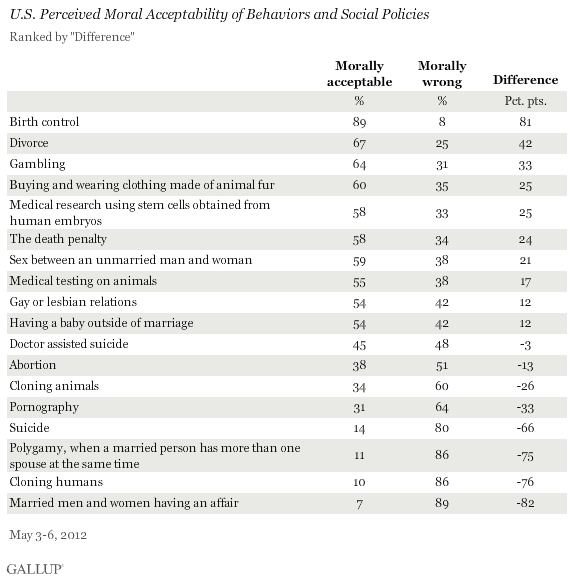
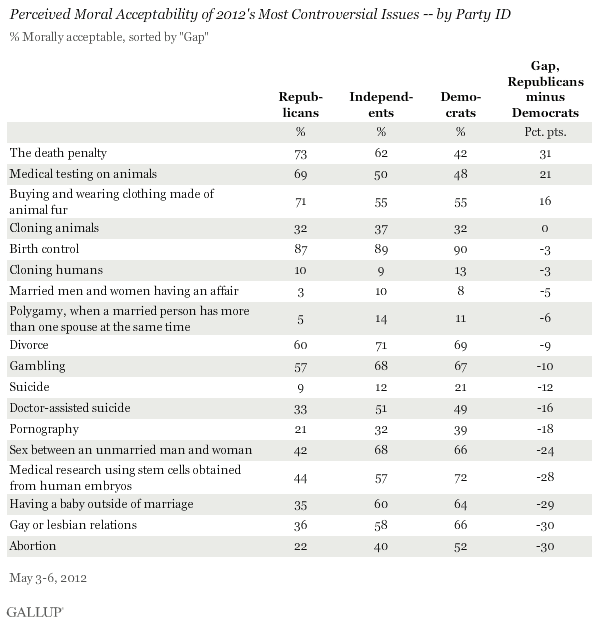
Americans, Including Catholics, Say Birth Control Is Morally OK
http://www.gallup.com/poll/154799/americans-including-catholics-say-birth-control-morally.aspx
Results for this Gallup poll are based on telephone interviews conducted May 3-6, 2012, with a random sample of 1,024 adults, aged 18 and older, living in all 50 U.S. states and the District of Columbia.
For results based on the total sample of national adults, one can say with 95% confidence that the maximum margin of sampling error is ±4 percentage points.
The White House Overreaches on Campus Rape
http://www.mindingthecampus.com/originals/2014/01/the_white_house_overreaches_on.html
I analyzed the CSA and its numbers nearly three years ago when the administration launched its first initiative to combat campus sexual assault in April 2011, with the "Dear Colleague" letter to college and university presidents from the Department of Education Office of Civil Rights. The vast majority of the incidents counted as assault involved what the study termed "incapacitation" by alcohol (or, rarely, drugs). But "incapacitation" is a misleading term, since the question used in the study also measured far lower degrees of intoxication: "Has someone had sexual contact with you when you were unable to provide consent or stop what was happening because you were passed out, drugged, drunk, incapacitated, or asleep?" This wording does not differentiate between someone who is unconscious or barely conscious and someone who is just drunk enough to go along with something he or she wouldn't do when sober. The questions related to sexual assault by physical force--particularly attempted sexual assault--are also worded so ambiguously that they could refer to a clumsy attempt to initiate sex, even if the "attacker" stops at once when rebuffed.
Moreover, the government's numbers are wildly at odd with actual crime records. Several years ago, Carnegie Mellon business professor Chad Hermann analyzed the number of sexual assault reported at Pittsburgh's three major campuses (the University of Pittsburgh, Carnegie Mellon, and Duquesne) and concluded that even if 90 percent of such assaults go unreported, a woman's annual risk of sexual assault at these schools ranges from 1 in 3,700 to 1 in 650. Spread out over four or five years of college attendance, that still adds up to somewhere between 1 in 130 and 1 in in 925. There is little doubt that records from other campuses would yield similar results.
Already, many have expressed concern that excessive zeal in the campus "war on rape" is creating a "presumed guilty" mindset toward accused men. One thing you will not find in either the official White House statement or the council's report is any recognition that protections for victims must be balanced with fairness to the accused, or any acknowledgment of that such concerns legitimately exist. Instead, the focus is exclusively on "survivors." The only mention of false accusations in the report is a passage decrying the "myth" that "many women falsely claim rape." Cited in rebuttal is a 2010 article by University of Massachusetts psychologist David Lisak and his colleagues, which analyzes several studies (and a sample of its own) and concludes that "only 2-10% of reported rapes are false."Of course, the upper range of that estimate is hardly a trivial rate. But there is another issue, too. Lisak's numbers refer to cases in which a rape allegation is more or less definitively proven to be false. Given how difficult it is to prove a negative, the existence of these confirmed false allegations suggests that a certain percentage of unresolved charges--in which there is no conclusive proof one way or the other--are likely false as well.The orthodox feminist position, apparently endorsed by the Obama administration, is that unless a charge of rape is clearly demonstrated to be false, it must be true. That is the very definition of "presumed guilty."
Friday, January 24, 2014
Why is polygamy declining? -- Matt Ridley
http://www.rationaloptimist.com/blog/why-is-polygamy-declining.aspx
Yet we are clearly monogamous by instinct as well as by tradition. Even in societies that allow polygamy, most people are in one-partner couples. Free-love communes always, without exception, collapse because people will insist on falling in love with particular individuals. This pairing tendency would baffle a bonobo, where sexual jealousy is apparently unknown.
Polygamy, in this reading, was mainly an aberration of the last 10,000 years caused by agriculture, which allowed the accumulation of huge surpluses, which powerful men translated into prodigious sexual rewards. Herding societies in particular became highly polygamous, causing people with names such as Attila, Ghenghis or Tamerlane to conquer other lands so as to supply women to their sex-starved followers: polygamy and violence tend to go together.
In a recent paper entitled "The puzzle of monogamous marriage", three American anthropologists argue that this trend is partly explained by competition between societies. To be economically successful, modern nations had to suppress violence within themselves.
This was incompatible with rulers grabbing all the best girls: "In suppressing intrasexual competition and reducing the size of the pool of unmarried men, normative monogamy reduces crime rates, including rape, murder, assault, robbery and fraud, as well as decreasing personal abuses . . . By shifting male efforts from seeking wives to paternal investment, normative monogamy increases savings, child investment and economic productivity."
Thursday, January 23, 2014
Neumark and Wascher on minimum wages and youth unemployment
Here is the abstract from their piece from 2003 (pdf):
We estimate the employment effects of changes in national minimum wages using a pooled cross-section time-series data set comprising 17 OECD countries for the period 1975-2000, focusing on the impact of cross-country differences in minimum wage systems and in other labor market institutions and policies that may either offset or amplify the effects of minimum wages. The average minimum wage effects we estimate using this sample are consistent with the view that minimum wages cause employment losses among youths. However, the evidence also suggests that the employment effects of minimum wages vary considerably across countries. In particular, disemployment effects of minimum wages appear to be smaller in countries that have subminimum wage provisions for youths. Regarding other labor market policies and institutions, we find that more restrictive labor standards and higher union coverage strengthen the disemployment effects of minimum wages, while employment protection laws and active labor market policies designed to bring unemployed individuals into the work force help to offset these effects. Overall, the disemployment effects of minimum wages are strongest in the countries with the least regulated labor markets.More recently, Modeled Behavior has a relevant update on how minimum wages reduce the number of new teenage hires. Brochu and Green you will find here, the effects on teen hiring are pretty clear.- See more at: http://marginalrevolution.com/marginalrevolution/2014/01/neumark-and-wascher-on-minimum-wages-and-youth-unemployment.html#sthash.kMCLdsde.dpuf
Instapundit: CAMPUS SEXUAL ASSAULTS: Grossly Overstated?
http://pjmedia.com/instapundit/182939/
CAMPUS SEXUAL ASSAULTS: Grossly Overstated? "At the University of Pittsburgh, there are roughly 14,800 female students. If their chances of being sexually assaulted are 1-in-4, there should be about 3,700 sexual assaults each year. In 2009, the most recent year for which full statistics are available, Pitt students reported 4. At Carnegie Mellon University, there are roughly 3,900 female students. If their chances of being sexually assaulted are 1-in-4, there should be about 975 sexual assaults each year. In 2009, CMU reported 6. (That figure was a three-year high.) At Duquesne University, there are roughly 5,700 female students. If their chances of being sexually assaulted are 1-in-4, there should be about 1,425 sexual assaults each year. In 2009, Duquesne reported 3."
Wednesday, January 22, 2014
Bill Gates Explains How World Is Getting More Awesome and Less Poor - Hit & Run : Reason.com
Link: http://reason.com/blog/2014/01/22/bill-gates-explains-how-world-is-getting (via shareaholic.com)
So begins a very lengthy debunking of what Gates sees as three myths first-world citizens tend to have about third-world countries. His letter can be read here. There's a pdf version here.
His three myths:
Poor countries are doomed to stay poor
Poverty levels are down just about everywhere, not just major Western countries. Gates goes so far as to say we need to rethink what we mean when we're talking about "developing" countries:
Foreign aid is a big waste
This may be a tougher sell for libertarians who are so attuned to recognizing the corruption of government power in nations both large and small. Gates believes that fears of corruption or waste are overstated based on anecdotes rather than data and also a result of a well-established problem of folks who believe Western governments spend more on foreign aid than they actually do.
Saving lives leads to overpopulation
I was half-tempted to declare this myth to actually be a straw man, but Gates says his foundation gets comments like this all the time. People believe that these poor countries will continue to grow at the same population rate as they do when they're no longer poor, despite all evidence that birth rates drop in wealthier countries. And as Gates points out, higher mortality rates do nothing to halt population growth anyway:
Sunday, January 19, 2014
Tip Sheet: Hydraulic Fracturing | Heartland Institute
http://heartland.org/policy-documents/tip-sheet-hydraulic-fracturing
Point 1: The Yale Graduates in Energy Study Group found the benefits of hydraulic fracturing exceed the costs by a ratio of 400–1.
Point 2: By using horizontal drilling techniques, producers are able to drill multiple wells from the same drilling pad, reducing surface disturbance while increasing access to oil and gas resources.
Point 3: Fracking fluid is composed of 99.51 percent water and sand, and .49 percent chemical additives, according to the U.S. Department of Energy. Such additives prevent corrosion in the well, reduce surface tension in liquids, stabilize clay particles, adjust pH, and eliminate bacteria.
Point 4: Shale gas production consumes less water per unit of energy generated than onshore oil production, ethanol production, and washing coal after it has been mined.
Point 5: Increasing reliance on natural gas has been a key reason why U.S. carbon dioxide emissions have fallen to their lowest levels since 1994 and are not expected to reach their 2005 levels again through 2040.
Point 6: Current available science and track record suggests moratoria on hydraulic fracturing are unnecessary.
Point 7: Low energy costs due to abundant and affordable oil and natural gas are projected to add one million jobs by 2025.
Wednesday, January 15, 2014
Five Myths About Inequality: Newsroom: The Independent Institute
Link: http://www.independent.org/newsroom/article.asp?id=4844 (via shareaholic.com)
Myth No 1: Income for the average family has stagnated over the past 30 years.
Myth No. 2: People at the bottom of the income ladder are there through no fault of their own.
Myth No. 3: Government transfer programs, like unemployment insurance, are an effective remedy.
Myth No 4: Raising the minimum wage is an effective remedy.
Myth No. 5: Income is the best measure of wellbeing.
Craig’s Five Ways, Part Two – EvolutionBlog
Link: http://scienceblogs.com/evolutionblog/2013/12/19/craigs-five-ways-part-two/ (via shareaholic.com)
We found his first two arguments to be inadequate. Do his other three fare any better?
3. God provides the best explanation of objective moral values and duties.
....
I always find it funny when theists insist that God is the only sound basis for morality. The argument seems to be that if you believe murder, say, is wrong because you regard it as obvious that humans have certain obligations towards one another, then you are being capricious and arbitrary and have no firm basis for your moral beliefs. But if you believe murder is wrong because you hypothesize God into existence and then assert that He has commanded us not to murder, then you have a firm, solid ground for morality. That is not reasonable.
4. God provides the best explanation of the historical facts concerning Jesus' life, death, and resurrection.
Craig is just making stuff up here. I can promise you there is no consensus among serious historians that Jesus actually performed miracles or that the tomb was empty. How could there be? What we know about Jesus' ministry and burial is found, in its entirety, in the Gospel accounts in the New Testament. These accounts were written decades after the fact by propagandists who were specifically trying to win support for their religious beliefs. They were not written by eye-witnesses, and they were not written independently of one another. So there is no reason at all for believing that the tomb was empty.
5. God can be personally known and experienced.
That people sometimes have powerful psychological experiences is scarcely in doubt, but the interpretation of those experiences as communications from God certainly is.
Saturday, January 11, 2014
True facts about ocean radiation and the Fukushima disaster
Link: http://www.cfact.org/2014/01/07/true-facts-about-ocean-radiation-and-the-fukushima-disaster/
How afraid should you be?
Not very.
How afraid should you be?
Not very.
Friday, January 10, 2014
Antibiotic surprise | Somewhat Reasonable
Link: http://blog.heartland.org/2014/01/antibiotic-surprise/
The thing about antibiotic resistance is that it takes resources for a bacterium to maintain it. If you change antibiotics and attack from a different direction, not only does the bacterium have to re-tool, it's already weakened from spending the resources to build the first adaptation. Given enough time, it would lose the genes for the first adaptation to save resources, and then suddenly, the original antibiotic works again.
The thing about antibiotic resistance is that it takes resources for a bacterium to maintain it. If you change antibiotics and attack from a different direction, not only does the bacterium have to re-tool, it's already weakened from spending the resources to build the first adaptation. Given enough time, it would lose the genes for the first adaptation to save resources, and then suddenly, the original antibiotic works again.
The trick is to have enough alternatives in stock to force bacteria to give up at least one of their adaptations.
Almost everyone these days uncritically accepts that the solution to antibiotic-resistant disease is to use fewer antibiotics. What about using more antibiotics? More varieties that is.
When doctors found penicillin was losing its efficacy as our first line of defense against bacterial infections, the medical community didn’t throw up its hands and use less. New antibiotics were developed! And thankfully so.
No… not stronger antibiotics. New varieties were developed that kept us ahead of the bacteria that ail us, humans and animals alike, to the point where doctors and veterinarians now have well in excess of 100 antibiotics to rely upon in fighting infection.
But now, thanks to overregulation resulting from tax-funded lobbying by anti-antibiotic, naturopathic, homeopathic, sustainability and organic activists, pharmaceutical companies have largely abandoned the development of new antibiotics. It simply does not pay to bring new antibiotic strains to market in the current regulatory environment. Pharmaceutical companies find it much simpler and more profitable to focus instead on treating phony ailments like attention-deficit disorder, obesity and erectile dysfunction.
Thursday, January 09, 2014
Robert Asher on Stephen Meyer's "uniformitarianism" argument in Darwin's Doubt - The Panda's Thumb
Link: http://pandasthumb.org/archives/2014/01/robert-asher-on.html (via shareaholic.com)
Meyer basically claims that inferring intelligent design is an application of uniformitarianism, because in everyday human experience the only known explanation of “information” is intelligence, therefore we should infer ID when new information arises billions of years ago in the origin of life, or hundreds of millions of years ago in the Cambrian Explosion. (Meyer really believes that intelligence is necessary for any nontrivial evolutionary adaptation or complexity increase, i.e. he thinks there were millions of miraculous interventions in the history of life, but he’s a bit coy about admitting this up front.)....But, there are yet other problems with the inference, namely, how uniformitarian is Meyer, really? Robert Asher argues that Meyer is being selectively uniformitarian. Meyer basically uses the term as rhetoric, and then arbitrarily drops uniformitarianism whether it would lead to problems with his ID argument.
Tuesday, January 07, 2014
Politics and the minimum wage | WashingtonExaminer.com
http://washingtonexaminer.com/politics-and-the-minimum-wage/article/2541663
There's little debate among academic economists about the effect of minimum wages. University of California, Irvine economist David Neumark has examined more than 100 major academic studies on the minimum wage. He reports that 85 percent of the studies "find a negative employment effect on low-skilled workers." A 1976 American Economic Association survey found that 90 percent of its members agreed that increasing the minimum wage raises unemployment among young and unskilled workers. A 1990 survey reported in the American Economic Review (1992) found that 80 percent of economists agreed with the statement that increases in the minimum wage cause unemployment among the young and low-skilled. If you're searching for a consensus in a field of study, most of the time you can examine the field's introductory and intermediate college textbooks. Economics textbooks that mention the minimum wage say that it increases unemployment for the least skilled worker. The only significant debate about the minimum wage is the magnitude of its effect. Some studies argue that a 10 percent increase in the minimum wage will cause a 1 percent increase in unemployment, whereas others predict a higher increase.
On soaking the rich :: Jeff Jacoby
http://www.jeffjacoby.com/6163/on-soaking-the-rich
The belief that the tax code is skewed to benefit the rich is one that many Americans share. When pollsters ask whether high-income people are paying too much, too little, or their fair share in federal taxes, 60 percent or more of respondents routinely answer: too little.
But the data tell a different story.
By any reasonable standard the rich pay far more than their fair share. According to the latest (2007) IRS data, the top 1 percent of US taxpayers earn 22.8 percent of adjusted gross income but pay 40.4 percent of all federal income taxes. By contrast, the bottom 95 percent of taxpayers, who earn 62.5 percent of the income, pay just 39.4 percent of the income tax burden. That bears repeating: The income tax burden of the top 1 percent, who comprise just 1.4 million taxpayers, now exceeds that of the bottom 134 million combined.
While envy and economic resentment make a potent political brew, the hangover it leaves can be fierce. Democrats should resist the clamor to soak the rich. Better instead to remember Paul Tsongas's admonition: "No goose, no golden eggs."
Saturday, January 04, 2014
The Most Abused Principle in all of Science — Starts With A Bang! — Medium
The anthropic principle, fine tuning, and the like...
Subscribe to:
Posts (Atom)