Wednesday, April 20, 2016

What economic lessons can we learn about the $15 minimum wage law from an '$8 per pound minimum beef price law'? - AEI | Carpe Diem Blog » AEIdeas

What economic lessons can we learn about the $15 minimum wage law from an '$8 per pound minimum beef price law'? - AEI | Carpe Diem Blog » AEIdeas


meat1Here’s a quick economic quiz about the labor market, with important implications for the $15 an hour minimum wage hysteria that is sweeping the country:
True or False? Unskilled employees compete against employers in the labor market for higher wages.
Answer: False
Economic lesson: Despite what we hear from labor unions and the “Fight for $15” crowd, employees compete not against employers for higher wages, butagainst other employees. And it’s also the case that employers compete against other employers for the best employees. It’s like that in every market: buyers (employers) always compete against other buyers (employers), and sellers (employees) always compete against other sellers (employees).
For example, if you’re in the market to buy a home, you’re competing against other home buyers, not against home sellers, to get the best (lowest) price. And the home sellers are competing against other sellers to get the best (highest) price. As a result, the more buyers competing for a fixed number of available homes, the higher the home sales prices; and the more home sellers competing for a fixed number of buyers, the lower the home sales prices,ceteris paribus.
Economic implications of a $15 an hour minimum wage for the labor market: Unskilled workers compete against other workers – especially skilled workers — for a limited number of available jobs at a given point in time. If the minimum wage is increased from $7.25 or $10 to $15 an hour, that will give skilled workers an advantage over unskilled workers, and will take away from unskilled workers the one advantage they currently have to compete against skilled workers – the ability to offer to work for a significantly lower wage than what skilled workers can command. And to the extent that we remove the wage advantage for unskilled workers, we reduce their ability to compete against skilled workers, and reduce employment opportunities for those unskilled workers.
Here’s an example: Suppose that an employer can hire two unskilled workers at $7.25 an hour for a total cost of $14.50 an hour and provide them with on-the-job training, or hire one skilled worker for $20 an hour, provide no training, and get the same hourly output as two unskilled workers. Given that choice, the employer hires two unskilled workers and saves $5.50 an hour in labor costs. Now suppose that the minimum wage goes to $15 an hour, which would require the employer to pay $30 an hour for two unskilled workers. In that case, the employer would switch to hiring one skilled worker at $20 an hour over two unskilled workers, and save $10 an hour in labor costs. Result of a minimum wage hike to $15 an hour? Demand for skilled workers goes up, demand for unskilled workers goes down, and employment opportunities for unskilled workers are reduced.
Economist Walter E. Williams has used the following example to illustrate the competition described above between unskilled and skilled workers by looking at the market for different qualities of beef (see examples here, here, andhere). Suppose that hamburger sells for $4 per pound and sirloin steak sells for $8 per pound. Hamburger is a much lower quality variety of beef compared to sirloin steak, but can attract a significant number of buyers who choose hamburger over the higher quality option for the 50% savings in price. Likewise, many employers may choose lower quality, unskilled workers over higher skilled employees for the significant savings in labor costs.
But now suppose the government imposes a “$8 per pound minimum beef price law.” In that case, most shoppers who buy beef will then purchase more sirloin steak and less hamburger because the lower quality meat has lost it main weapon to successfully compete against higher quality sirloin steak – a significantly lower price that compensates for the lower quality. Result? Hamburger sales will suffer due to the “minimum beef price law” and sirloin steak sales will increase. Just like in the labor market, a $15 an hour minimum wage will remove the most effective weapon that unskilled workers currently have to compete against skilled workers – the ability to work for a lower wage. Result? Employment opportunities for unskilled and limited-experience workers will contract, while employment opportunities for skilled workers will increase.
Bottom Line: Much of the economic confusion about the $15 an hour minimum wage hysteria can be traced to the mistaken assumption that unskilled workers are competing against their employers to get higher and higher wages. That’s absolutely not the case. The economic reality is that unskilled workers compete against other workers to get higher wages, especially skilled workers, and ultimately against investments in labor-saving technologies and automation. If you understand and agree that a “minimum beef price law” would disadvantage hamburger sales and enhance sirloin steak sales, then you should also understand and agree that a $15 an hour minimum wage law would disadvantage unskilled workers and deny many of them the valuable opportunity to get an entry-level job and gain the skills, training, and experience that will put them on the path to a better and more prosperous economic future. At $15 an hour, many unskilled workers simply won’t be able to effectively compete against skilled workers and against automation, and we’ve therefore handicapped America’s most vulnerable workers by taking away from them the most effective strategy they have – the ability to offer to work for a competitive wage that is consistent with their lack of skills.
Update 3: From Walter Williams:
The steak example applies to any mandated minimum price. In the case of minimum wage laws, a mandated minimum lowers the cost of – hence encourages – the indulgence of racial preference in the labor market.
Some might object to the validity of my example by saying that people are not the same things as cuts of meat. That is true – just as steel balls are not the same as people. However, although steels balls and people are different, both obey the law of gravity. The independent influence of gravity on a steel ball’s acceleration is 32 feet per second and its influence on a person is exactly the same. Similarly, quantities demanded for cuts of meat are influenced by the law of demand, and so are quantities demanded of a person’s labor service.
Update 2: Related quote from Milton Friedman:
The minimum wage law is most properly described as a law saying that employers must discriminate against people who have low skills. That’s what the law says. The law says that here’s a man who has a skill that would justify a wage of $5 or $6 per hour (adjusted for today), but you may not employ him, it’s illegal, because if you employ him you must pay him $9 per hour. So what’s the result?  To employ him at $9 per hour is to engage in charity. There’s nothing wrong with charity. But most employers are not in the position to engage in that kind of charity. Thus, the consequences of minimum wage laws have been almost wholly bad. We have increased unemployment and increased poverty.
Update 1: In the related video below (“The Cruelty of the $15 Minimum Wage“), Don Boudreaux reminds us that “Taking away from workers an important bargaining chip, namely the ability to offer to work at a wage less than the minimum, is the cruelest thing you can do for a lot of these workers.”

Teenage unemployment in cities


New research that examines New York’s Summer Youth Employment Program (SYEP) finds that participation in the program positively impacts student academic outcomes. As the authors state in the introduction, youth employment has many benefits:
“Prior research suggests that adolescent employment improves net worth and financial well-being as an adult. An emerging body of research indicates that summer employment programs also lead to decreases in violence and crime. Work experience may also benefit youth, and high school students specifically, by fostering various non-cognitive skills, such as positive work habits, time management, perseverance, and self-confidence.” (My bold)This is hardly surprising news to anyone who had a summer job when they were young. An additional benefit from youth employment not mentioned by the authors is that the low-skill, low-paying jobs held by young people also provide them with information about what they don’t want to do when they grow up. Working in a fast food restaurant or at the counter of a store in the local mall helps a young person appreciate how hard it is to earn a dollar and provides a tangible reason to gain more skills in order to increase one’s productivity and earn a higher wage.
Unfortunately, many young people today are not obtaining these benefits. The chart below depicts the national teenage unemployment rate and labor force participation rate (LFP) from 2005 to 2015 using year-over-year August data from the BLS.national teen unemp, LFP
During the Great Recession teenage employment fell drastically, as indicated by the simultaneous increase in the unemployment rate and decline in the LFP rate from 2007 to 2009. From its peak in 2010, the unemployment rate for 16 to 19 year olds declined slowly until 2012. This decline in the unemployment rate coincided with a decline in the LFP rate and thus the latter was partly responsible for the former’s decline. More recently, the labor force participation rate has flattened out while the unemployment rate has continued to decline, which means that more teenagers are finding jobs. But the teenagers who are employed are part of a much smaller labor pool than 10 years ago – nationally, only 33.7% of 16 to 19 year olds were in the labor force in August 2015, a sharp decline from 44% in 2005.
Full-time teenage employment is unique in that it has a relatively high opportunity cost – attending school full time. Out of the teenagers who work at least some portion of the year, most only work during the summer when school is not in session. Some teenagers also work during the school year, but this subset of teenage workers is smaller than the set who are employed during the summer months. Thus a decline in the LFP rate for teenagers may be a good thing if the teenagers who are exiting the labor force are doing so to concentrate on developing their human capital.
Unfortunately this does not seem to be the case. From 2005 to 2013 the enrollment rate of 16 and 17 year olds actually declined slightly from 95.1% to 93.7%.  The enrollment rate for 18 and 19 year olds stayed relatively constant – 67.6% in 2005 and 67.1% in 2013, with some mild fluctuations in between. These enrollment numbers coupled with the large decline in the teenage LFP rate do not support the story that a large number of working teenagers are exiting the labor force in order to attend school full time. Of course, they do not undermine the story that an increasing amount of teenagers who are both in the labor force and attending school at the same time are choosing to exit the labor force in order to focus on school. But if that is the primary reason, why is it happening now?
Examining national data is useful for identifying broad trends in teenage unemployment, but it conceals substantial intra-national differences. For this reason I examined teenage employment in 10 large U.S. cities (political cities, not MSAs) using employment status data from the 5-year American Community Survey (ACS Table S2301. 2012 was the latest data available for all ten cities).
The first figure below depicts the age 16 – 19 LFP rate for the period 2010 – 2012. As shown in the diagram there are substantial differences across cities.
City teenage LFP
For example, in New York (dark blue) only 23% of the 16 – 19 population was in the labor force in 2012 – down from 25% in 2010 – while in Denver 43.5% of the 16 – 19 population was in the labor force. Nearly every city experienced a decline over this time period, with only Atlanta (red line) experiencing a slight increase. Five cities were below the August 2012 national rate of 34% – Chicago, Philadelphia, Atlanta, San Francisco, and New York.
Also, in contrast to the improving unemployment rate at the national level from 2010 – 12 shown in figure 1, the unemployment rate in each of these cities increased during that period. Figure 3 below depicts the unemployment rate for each of the 10 cities.
City teenage unemp rate
In August 2012 the national unemployment rate for 16 – 19 year olds was 24.3%, a rate that was exceeded by all 10 cities analyzed here. Atlanta had the highest unemployment rate in 2012 at 48%. Atlanta’s high unemployment rate and relatively low LFP rate reveals how few Atlanta teens were employed during this period and how difficult it was for those who wanted a job to find one.
The unemployment rate may increase because employment declines or more unemployed people enter the labor force, which would increase the labor force participation rate. Figures 2 and 3 together indicate that the unemployment rate increased in each of these cities due to a decline in employment, not increased labor force participation.
The preceding figures are evidence that the teenage employment situation in these major cities is getting worse both over time and relative to other areas in the country. To the extent that teenage employment benefits young people, fewer and fewer of them are receiving these benefits. From the linked article:
“The substantial drop in teen employment prospects has had a devastating effect on the nation’s youngest teens (16-17), males, blacks, low income youth, and inner city, minority males,” wrote Andrew Sum in a report on teen summer employment for the Center for Labor Market Studies at Northeastern University. “Those youth who need work experience the most get it the least, another example of the upside down world of labor markets in the past decade.”
Unfortunately, in many cities the response to this situation will only exacerbate the problem. Seattle and Los Angeles have already approved local $15 minimum wages, and a similar law in the state of New York that applies only to fast food franchises was recently approved by the state’s wage board. While many people still question the effect of a minimum wage on overall employment, there is substantial empirical evidence that arelatively high minimum wage has a negative effect on employment for the least skilled workers, which includes inner-city teenagers who often attend mediocre schools. Thus it is hard to believe that any of the seemingly well-intentioned increases in the minimum wage that are occurring around the country will have a positive effect on the urban teenage employment situation presented here. A better response would be to eliminate the minimum wage so that in the short run low-skilled workers are able to offer their labor at a price that is commensurate to its value. In the long run worker productivity must be increased which involves K-12 school reform.

Wednesday, April 13, 2016

FDR's policies prolonged Depression by 7 years, UCLA economists calculate | UCLA

FDR's policies prolonged Depression by 7 years, UCLA economists calculate | UCLA

Two UCLA economists say they have figured out why the Great Depression dragged on for almost 15 years, and they blame a suspect previously thought to be beyond reproach: President Franklin D. Roosevelt.

After scrutinizing Roosevelt's record for four years, Harold L. Cole and Lee E. Ohanian conclude in a new study that New Deal policies signed into law 71 years ago thwarted economic recovery for seven long years.

"Why the Great Depression lasted so long has always been a great mystery, and because we never really knew the reason, we have always worried whether we would have another 10- to 15-year economic slump," said Ohanian, vice chair of UCLA's Department of Economics. "We found that a relapse isn't likely unless lawmakers gum up a recovery with ill-conceived stimulus policies."

In an article in the August issue of the Journal of Political Economy, Ohanian and Cole blame specific anti-competition and pro-labor measures that Roosevelt promoted and signed into law June 16, 1933.

"President Roosevelt believed that excessive competition was responsible for the Depression by reducing prices and wages, and by extension reducing employment and demand for goods and services," said Cole, also a UCLA professor of economics. "So he came up with a recovery package that would be unimaginable today, allowing businesses in every industry to collude without the threat of antitrust prosecution and workers to demand salaries about 25 percent above where they ought to have been, given market forces. The economy was poised for a beautiful recovery, but that recovery was stalled by these misguided policies."

Using data collected in 1929 by the Conference Board and the Bureau of Labor Statistics, Cole and Ohanian were able to establish average wages and prices across a range of industries just prior to the Depression. By adjusting for annual increases in productivity, they were able to use the 1929 benchmark to figure out what prices and wages would have been during every year of the Depression had Roosevelt's policies not gone into effect. They then compared those figures with actual prices and wages as reflected in the Conference Board data.

In the three years following the implementation of Roosevelt's policies, wages in 11 key industries averaged 25 percent higher than they otherwise would have done, the economists calculate. But unemployment was also 25 percent higher than it should have been, given gains in productivity.

Meanwhile, prices across 19 industries averaged 23 percent above where they should have been, given the state of the economy. With goods and services that much harder for consumers to afford, demand stalled and the gross national product floundered at 27 percent below where it otherwise might have been.

"High wages and high prices in an economic slump run contrary to everything we know about market forces in economic downturns," Ohanian said. "As we've seen in the past several years, salaries and prices fall when unemployment is high. By artificially inflating both, the New Deal policies short-circuited the market's self-correcting forces."

The policies were contained in the National Industrial Recovery Act (NIRA), which exempted industries from antitrust prosecution if they agreed to enter into collective bargaining agreements that significantly raised wages. Because protection from antitrust prosecution all but ensured higher prices for goods and services, a wide range of industries took the bait, Cole and Ohanian found. By 1934 more than 500 industries, which accounted for nearly 80 percent of private, non-agricultural employment, had entered into the collective bargaining agreements called for under NIRA.

Cole and Ohanian calculate that NIRA and its aftermath account for 60 percent of the weak recovery. Without the policies, they contend that the Depression would have ended in 1936 instead of the year when they believe the slump actually ended: 1943.

Roosevelt's role in lifting the nation out of the Great Depression has been so revered that Time magazine readers cited it in 1999 when naming him the 20th century's second-most influential figure.

"This is exciting and valuable research," said Robert E. Lucas Jr., the 1995 Nobel Laureate in economics, and the John Dewey Distinguished Service Professor of Economics at the University of Chicago. "The prevention and cure of depressions is a central mission of macroeconomics, and if we can't understand what happened in the 1930s, how can we be sure it won't happen again?"

NIRA's role in prolonging the Depression has not been more closely scrutinized because the Supreme Court declared the act unconstitutional within two years of its passage.

"Historians have assumed that the policies didn't have an impact because they were too short-lived, but the proof is in the pudding," Ohanian said. "We show that they really did artificially inflate wages and prices."

Even after being deemed unconstitutional, Roosevelt's anti-competition policies persisted — albeit under a different guise, the scholars found. Ohanian and Cole painstakingly documented the extent to which the Roosevelt administration looked the other way as industries once protected by NIRA continued to engage in price-fixing practices for four more years.

The number of antitrust cases brought by the Department of Justice fell from an average of 12.5 cases per year during the 1920s to an average of 6.5 cases per year from 1935 to 1938, the scholars found. Collusion had become so widespread that one Department of Interior official complained of receiving identical bids from a protected industry (steel) on 257 different occasions between mid-1935 and mid-1936. The bids were not only identical but also 50 percent higher than foreign steel prices. Without competition, wholesale prices remained inflated, averaging 14 percent higher than they would have been without the troublesome practices, the UCLA economists calculate.

NIRA's labor provisions, meanwhile, were strengthened in the National Relations Act, signed into law in 1935. As union membership doubled, so did labor's bargaining power, rising from 14 million strike days in 1936 to about 28 million in 1937. By 1939 wages in protected industries remained 24 percent to 33 percent above where they should have been, based on 1929 figures, Cole and Ohanian calculate. Unemployment persisted. By 1939 the U.S. unemployment rate was 17.2 percent, down somewhat from its 1933 peak of 24.9 percent but still remarkably high. By comparison, in May 2003, the unemployment rate of 6.1 percent was the highest in nine years.

Recovery came only after the Department of Justice dramatically stepped up enforcement of antitrust cases nearly four-fold and organized labor suffered a string of setbacks, the economists found.

"The fact that the Depression dragged on for years convinced generations of economists and policy-makers that capitalism could not be trusted to recover from depressions and that significant government intervention was required to achieve good outcomes," Cole said. "Ironically, our work shows that the recovery would have been very rapid had the government not intervened."

Wednesday, March 16, 2016

Why a “Living Wage” in D.C. Does Not Make Sense | Retirement Reform Policy | NCPA.org

Why a “Living Wage” in D.C. Does Not Make Sense | Retirement Reform Policy | NCPA.org


Recently, Washington D.C.’s council almost (but not quite) passed an ordinance that would require Walmart and other large big-box stores to pay a “living wage” of $12.50 an hour. Being that 23,000 applications were submitted for the 600 jobs that will be available as Walmart opens its first store in the area, it is evident that workers have not balked at the current D.C. minimum wage of $8.50 an hour.

Should Walmart Imitate Costco? | Retirement Reform Policy | NCPA.org


The following is the Executive Summary from a soon-to-be-published NCPA policy report.  (Now published here.)
There has been much debate over the past few years about raising the national minimum wage to $10 or even $15 an hour. In areas where the minimum wage is at or slightly above the federal level of $7.25, unions have complained that big box retailers and fast food restaurants do not pay “living” wages. Living wage advocates often accuse Walmart of being the worst offender, and point to Costco as a model to follow because it allegedly pays higher wages. But is it realistic to expect all retailers to pay the same wage?
Retail Wages Vary by Store Type and Product Specialty. Average wages for various retail stores vary widely depending on the type of retail. According to the Bureau of Labor Statistics, if all the retail subsectors are combined, the average hourly earnings of retail nonsupervisory employees was $14.90 as of October 2015. Divided by retail store type, some have lower average hourly wages than others — ranging from $11.19 for gas station clerks to $22.12 for electronics and appliance store clerks.
Profit Margins in Retail Compared to Other Industries. If a large firm earned “record profits” last year, surely they have the money to boost the pay and benefits of their workers. However, profits as measured by dollars do reveal much about a firm’s expenditures. The question should be: What is the profit margin — the percentage of income earned on a dollar of expenditure? The retail industry has some of the lowest profit margins of all industries. After-tax operating margins (after-tax operating income divided by total revenues) in retail segments range from 2.23 percent to 4.38 percent.
Walmart Compared to Costco. In addition to differing types of retail stores with different profit margins and labor productivity, retailers have various business models — which include the products they sell, their customer base and their sources of potential revenue. Consider the two primary stores labor activists like to compare in terms of wages, Walmart versus Costco. The inherent difference between Costco and Walmart is their business model.
Walmart operates 5,300 stores (including the smaller Neighborhood Markets and Sam’s Clubs) and tries to cater to the widest range of customers and provide quality and cost options that appeal to a range of lower to higher income shoppers.
Costco operates about 447 stores under a subscription business model, charging customers for membership. It offers relatively fewer choices to customers compared to Walmart. Costco is geared toward a smaller, more selective clientele than Walmart. Costco stores tend to be located in more affluent neighborhoods and a higher percentage of Costco’s customers are business buyers.
A Statistical Analysis of Walmart and Costco Locations. Given that Costco targets a higher income demographic than Walmart, one could surmise that both store chains would locate in areas that suit their desired income demographic. To test this hypothesis, we compiled a dataset of counties in Texas and Florida (states selected for their population size, relatively weak zoning laws, and presence of both Walmart and Costco) using five explanatory variables of interest: population, median household income in each county, number of Costco stores in each county and number of Walmart stores and Sam’s Clubs in each county. The results indicate that Costco locations are largely dependent on income, while Walmart locations are not. Given two equally sized (500,000 residents) counties, if one is in the top 40 percent of median income it has a 76 percent probability of having a Costco; if it is in the bottom 60 percent, it has only a 20 percent probability.
Do Retailers Pass on Labor Costs to Their Customers? Several studies have found that “price sensitive” shoppers (those who are more likely to change their buying habits based on price changes) were more likely to have larger families, lower incomes and patronize more stores. Those who were less price sensitive were more likely to be older, of higher income and loyal to a particular store. If high-income consumers are less sensitive to price changes, as the research suggests, stores that cater to higher income shoppers could pass on the costs of higher wages to their consumers (to some degree) through increases in product prices. But a store that caters to price sensitive shoppers would more likely be unable to raise prices.
Researchers from Georgia State University measured the effect of the 2007 to 2009 incremental minimum wage increases (from $5.15 to $7.25 an hour) on 81 fast food restaurants in Georgia, including medium and large-sized cities and rural areas. They found that among adjustments in response to the wage hikes, there was a nearly 11 percent increase in the price of the combo meal.
Conclusion. Living wage advocates claim that putting more money in the pockets of low-wage workers boosts the economy by enabling them to buy more goods and services. But this argument ignores the potential increased price of products as a result of labor costs being passed on to consumers. If lower income earners are already as price-sensitive as the research suggests, making basic goods more expensive will not financially benefit them, particularly if they have large families with several dependents who do not work. There are better ways to help lower-income households than to mandate high minimum wages.


Related posts:
Why Did Walmart Raise its Minimum Wage?
More Flimsy Reasons For a $15 Minimum Wage
The Fast Food Industry Takes an Unfair Beating…Yet Again
Will Minimum Wage Hikes Help Red States or Hurt Them?
The Minimum Wage Fairy Can’t Fix Everything

The $15 Minimum Wage and the End of Teen Work | Foundation for Economic Education


A new report from JP Morgan Chase & Co. finds that the summer employment rate for teenagers is nearing a record low at 34 percent. The report surveyed 15 US cities and found that despite an increase in summer positions available over a two year period, only 38 percent of teens and young adults found summer jobs.
This would be worrying by itself given the importance of work experience in entry-level career development, but it is also part of a long-term trend. Since 1995 the rate of seasonal teenage employment has declined by over a third from around 55 percent to 34 percent in 2015. The report does not attempt to examine why summer youth employment has fallen over the past two decades. If it had, it would probably find one answer in the minimum wage.
Most of the 15 cities studied in this report have minimum wage rates above the federal level, with cities such as Seattle having a rate more than double that. Recent data from the Bureau of Labor Statistics seen in the chart show exactly how a drastic rise in the minimum wage rate affects the rate of employment.

Seattle has experienced the largest 3 month job loss in its history last year, following the introduction of a $15 minimum wage. We can only imagine the impact such a change has had on the prospects of employment for the young and unskilled.
Raising the minimum wage reduces the number of jobs in the long-run. It is difficult to measure this long-run effect in terms of the numbers of never materializing jobs. However, the key mechanism behind the model—that more labor-intensive establishments are replaced by more capital-intensive ones—is supported by evidence. That is why recent research suggesting that minimum wages barely reduce the number of jobs in the short-run, should be taken with caution. Several years down the line, a higher real minimum wage can lead to much larger employment losses.
Nevertheless, politicians continue to push the idea that minimum wage laws are somehow helping the young “earn a decent wage.” It is important to remember the underlying motives behind pushes for higher minimum wage rates. Milton Friedman characterized it as an “unholy coalition of do-gooders on the one hand and special interests on the other; special interests being the trade unions.”
Several empirical studies have been conducted over the course of more than two decades, with all evidence pointing toward negative effects of minimum wage rises on employment levels among the young and unskilled. A study conducted by David Neumark and William Wascher in 1995 noted that “such increases raise the probability that more-skilled teenagers leave school and displace lower-skilled workers from their jobs. These findings are consistent with the predictions of a competitive labor market model that recognizes skill differences among workers. In addition, we find that the displaced lower-skilled workers are more likely to end up non-enrolled and non-employed.”
Policy makers who continuously raise the minimum wage simply assure that those young people, whose skills are not sufficient to justify that kind of wage, will instead remain unemployed. In an interview, Friedman famously asked “What do you call a person whose labor is worth less than the minimum wage? Permanently unemployed.”
The upshot: Raising the minimum wage at both federal and local levels denies youth the skills and experience they need to get their career going.
This post first appeared at CEI.org.

Low-Skilled Workers Flee the Minimum Wage | Foundation for Economic Education


What happens when, in a country where workers are free to move, a region raises its minimum wage? Do those with the fewest skills seek out the regions with the highest wage floors?
New minimum wage research by economist Joan Monras of the Paris Institute of Political Studies (Sciences Po) attempts to answer that question. Monras theoretically shows that there should be a close relationship between the employment effects of raising the minimum wage and the migration of low-skilled workers.
When the demand for local low-skilled labor is relatively unresponsive (or inelastic) to wage changes, raising the minimum wage should lead to an influx of low-skilled workers from other states in search of better-paying jobs. On the other hand, if the demand for low-skilled labor is relatively responsive (or elastic), raising the minimum wage will lead low-skilled workers to flee to states where they will more easily find employment.
To test the model empirically, Monras examined data from all the changes in effective state minimum wages over the period 1985 to 2012. Looking at time frames of three years before and after each minimum wage increase, Monras found that
  1. As depicted in the graph below on the left, those who kept their jobs earned more under the minimum wage. No surprise there.
  1. As depicted in the graph below on the right, workers with the fewest skills were having an easier time finding full-time employment prior to the minimum wage increase. But this trend completely reversed as soon as the minimum wage was increased.
  1. A control group of high-skilled workers didn’t experience either of these effects. Those affected by the changing laws were the least skilled and the most vulnerable.

These results show that the timing of minimum wage increases is not random.
Instead, policy makers tend to raise minimum wages when low-skilled workers’ real wages are declining and employment is rising. Many studies, misled by the assumption that the timing of minimum wage increases is not influenced by local labor demand, have interpreted the lack of falling low-skilled employment following a minimum wage increase as evidence that minimum wage increases have no effect on employment.
When Monras applied this same false assumption to his model, he got the same result. However, to observe the true effect of minimum wage increases on employment, he assumed a counterfactual scenario where, had the minimum wages not been raised, the trend in low-skilled employment growth would have continued as it was.
By making this comparison, Monras was able to estimate that wages increased considerably following a minimum wage hike, but employment also fell considerably. In fact, employment fell more than wages rose. For every 1 percent increase in wages, the share of a state’s population of low-skilled workers in full-time employment fell by 1.2 percent. (The same empirical approach showed that minimum wage increases had no effect on the wages or employment of a control group of high-skilled workers.)
Monras’s model predicts that if labor demand is sensitive to wage changes, low-skilled workers should leave states that increase their minimum wages — and that’s exactly what his empirical evidence shows.
According to Monras,
A 1 percent reduction in the share of employed low-skilled workers [following a minimum wage increase] reduces the share of low-skilled population by between .5 and .8 percent. It is worth emphasizing that this is a surprising and remarkable result: workers for whom the [minimum wage] policy was designed leave the states where the policy is implemented.
These new and important findings reinforce the view that minimum wage increases come at a cost to the employment rates of low-skilled workers.
They also pose a difficult question for minimum wage proponents: If minimum wage increases benefit low-skilled workers, why do these workers leave the states that raise their minimum wage?

Tuesday, March 15, 2016

Investigating global warming using a new graph style | Watts Up With That?


Because there is so much detail in a contour map, it is best to look at a large image. I think that I am limited to a small image in this article, so I will put a link after the small image, which will take you to a large image that I put on the Photobucket website. I hope that this works, it is the first time that I have tried this. If you can’t get to the large image, then you could try magnifying the small image using your browser. I know that Chrome has a Zoom control, and I assume that other browsers will have something similar.

Walker-GW-contour-Graph 1For a large image of this contour map, from the Photobucket website, click this link:
http://i1042.photobucket.com/albums/b424/mta-graphs/Contour%201880%20to%202015%20-%20big%20with%20copyright_zps6tvnym4k.pngThe legend for global warming contour maps is here:Walker-GW-contour-graphkey-Table 1Now that you have looked at a contour map, and looked at the legend, we can discuss what is on the map.
Along the bottom of the contour map, there is a line of what appear to be small red flames. These are not real flames, but they do represent a source of heat. These are the natural warming events, like El Nino and the Blob. If you count them, then you will find that there are about 46 of them between 1880 and 2015. Some of them merge together, so an exact count is difficult. That is about one natural warming event every 3 years, and I believe that El Nino’s occur about once every 2 to 5 years, so the number seems about right.
There are often small black regions between the natural warming events. I use black to show cooling, so these small black regions are either the cooling phase of an El Nino, or possibly a La Nina.
Now look at the big black area near the middle of the graph, As I said before, I use black to show cooling, so this appears to be a large cooling event. When I first found this, I thought that it might be an error in the graph. I checked it carefully, and found that it was an approximately 40 year cooling trend, that started about 1935, and finished in about 1975. As soon as I saw the year 1975, I knew what this was. I remembered that in 1976 there was a scare about a possible ice age happening. Time magazine ran 2 cover stories, one about “The coming Ice Age”, and the other about “How to survive the coming Ice Age”. I don’t believe that Time magazine would invent these stories with no evidence. It would make sense if some scientist noticed the 40 year cooling trend, and said something to somebody.

Saturday, March 12, 2016

Trevor Loudon's New Zeal Blog » WATCH: Debunking anti-Cruz myths (video)

Trevor Loudon's New Zeal Blog » WATCH: Debunking anti-Cruz myths (video)

Why the Holocaust Should Matter to You | Foundation for Economic Education


The Deeper Roots of the HolocaustFor the last six months, I’ve been steeped in studying and writing about the American experience with eugenics, the “policy science” of creating a master race. The more I’ve read, the more alarmed I’ve become that it was ever a thing, but it was all the rage in the Progressive Era. Eugenics was not a fringe movement; it was at the core of ruling-class politics, education, and culture. It was responsible for many of the early experiments in labor regulation. It was the driving force behind marriage licenses, minimum wages, restrictions on opportunities for women, and immigration quotas and controls.

The more I’ve looked into the subject, the more I’m convinced that it is not possible fully to understand the birth of the 20th century Leviathan without an awareness of eugenics. Eugenics was the original sin of the modern state that knows no limits to its power.

Tuesday, March 01, 2016

The Right Geek: Dear SJW's: We Sad Puppies CAN'T Repent

The Right Geek: Dear SJW's: We Sad Puppies CAN'T Repent

More on the Daisy Hill Hugo Farm, with interesting comments.

The Right Geek: Opening a Moderate Conversation on Fandom with "Standback"

The Right Geek: Opening a Moderate Conversation on Fandom with "Standback"

More on the Daisy Hill Hugo Farm
Dear "Standback,"

Again, thank you for your willingness to talk about these controversies without shouting or vitriol. Constructive discussion is indeed sorely needed; if we can at least get to a place of mutual understanding, that will only redound to fandom's benefit.

Disclaimer: Like you, I don't represent anyone in particular; other Pups may dispute some of the points in my analysis. Still, I've been active in the various Puppy groups for a while, so I'd like to think my impressions are fairly accurate.

Let's talk first about what I like to call the "pre-history" of the Sad Puppies. For the past fifteen years (at least), the character of fandom has shifted in a way that many Puppies find very troubling -- and by the way, for the vast majority of our number, this has nothing to do with race, gender, or sexuality. A significant number of us are women who accept the precepts of first wave feminism at the very least. A number of us are "people of color." And a number of us are gay or, at minimum, amenable to leaving gay people alone to live their lives as they see fit. No -- what has disturbed the Puppies is the increasingly strident tone that many fans have adopted in support of their favored cultural and political causes. In our perception, the vague "codes of conduct," the "shit lists," the pilings on, the endless internet flame-wars, and the non-falsifiable accusations of racism/sexism/homophobia/etc. have all created an environment that is extraordinarily hostile to points of view that don't hew to a particular left-wing party line. The result? We've felt unwelcome and stomped on for what, to our mind, should be recognized as sincere and well-meant differences of opinion.

Over the same time frame, the Puppies have also become concerned about the artistic direction of our field. The "Human Wave" movement, the "Superversive" movement, and the more generalized complaints about "message fic" and "grey goo" that started gaining steam before last year's Sad Puppies campaign are all flailing attempts by the Puppies to describe the flatness we've perceived in many recent award winners -- particularly in the shorter fiction categories, where the stylistic sophistication and emotional catharsis beloved by creative writing professors and MFA programs the world over appear to be crowding out more accessible stories with identifiable plots and recognizably science-fictional ideas. Have the aforementioned accessible stories been shut out of the mix entirely? No, thankfully -- but prominent fannish critics have definitely been agitating against any "traditional" authors who happen to be short-listed. When Larry Correia was nominated for the Campbell back in 2011, for example, one such critic hyperbolically proclaimed that a win for Larry would "end writing forever."

Finally, before the Puppies became a controversial sensation, many of the same people were getting nominated for the Hugo year after year after year. Now, this state of affairs may have been justifiable if fandom were really tiny, but it's not. As I remarked in my previous post, thousands of science fiction works are published and bought every year, and the most recent circulation figures I could find for, say, Asimov's or Analog exceed the number of people who voted in the Hugos in 2012 by over 1000%. To us Puppies, the proposition that a couple thousand super-motivated Pre-Puppy World Con voters were in any way representative of the fandom in the aggregate was and is ridiculous on its face.

So we got involved.

I've already acknowledged the flaws in our process. We should've checked the eligibility rules more carefully before making our suggestions, we should've widened our crowd-sourcing pool, we should've included more options on our list, and we shouldn't have called it a "slate," as that wasn't really what we intended it to be. Additionally, while we've recommended authors who were conservative, liberal, apolitical, and every flavor in between, we've often failed to separate our political disputes from our artistic arguments when responding to our detractors. But overall, we Sads really did just want to vote for what we liked; we wanted to give several very successful authors and editors a fighting chance to be recognized, and we wanted to highlight some newer writers (like Kary English) who may otherwise have been overlooked. Was there also a little "we hate those guys!" folded into the mix? I'd be lying if I denied it; as I explained above, a lot of us have been "hit" in the fandom over the years, and the anger has been simmering for quite a while. But this "resentment vote" was driven less by a desire to destroy the Hugo and more by a desire to assert our right to dissent without being abused.

I can understand our opponents' being upset that their choices were effectively locked out of the ballot by the combined activities of the Sad and Rabid Puppies campaigns. Indeed, I highly respect certain prominent Antis - like Eric Flint and George R.R. Martin - who've written calmly worded blog posts on the subject. What I can't understand is the manner in which other Antis have often expressed their disappointment. Steve Davidson is, even now, busily trying to define us out of the fandom even though many of us have loved science fiction for decades. Others, meanwhile, have repeatedly called us vile and defamatory names in some very high profile venues and have yet to retract their statements. And the less said about the comments on File 770, the better.

Do we have unsavory characters on our side? Yes. However, I do think there's a critical difference between the Puppy trolls and the Anti trolls: the Antis, as a group, have more power in the fandom. You may scoff at this, but I invite you to consider several key facts. Number one, it wasn't the Puppy position that was spread far and wide in mainstream entertainment publications once the 2015 ballot was announced. Number two, among the Antis behaving badly were editors and art directors from at least one major publishing house, while among the Puppies behaving badly was -- well, no one of any import. Number three, we lost. The Antis trounced us when it came to the final vote and felt perfectly free to gloat about it in public afterwards; indeed, I saw at least one officer of SFWA congratulating the Antis for their "victory" on Twitter. And lastly, there's a objective double standard in the way the opposing trolls are treated. While the Sad Puppies are urged to denounce Vox Day and other malefactors, Requires Hate continues to be published in Clarkesworld with nary an acknowledgement of the contradiction.

Above, I mentioned our resentment. Sadly, the events of last year did much to sharpen those feelings of ill-will. That's why you're hearing talk of "conspiracies" -- and why you may have heard a Sad or two saying, "To hell with those twat-waffles. They can fuck themselves with rusty chainsaws for all I care." Personally, I think this is deeply unfortunate; though our respective groups may have irreconcilably different tastes in science fiction, there's no reason we can't find some common ground when it comes to the need for more civility in our disputes -- not to mention greater participation and viewpoint diversity in both the nominating and voting rounds of the Hugo Awards. MOAR recs, MOAR voters, and MOAR discussion? Sounds good to me! So let's try to make it happen.

Monday, February 29, 2016

Why Wal-Mart Will Never Pay Like Costco - Bloomberg View

Why Wal-Mart Will Never Pay Like Costco - Bloomberg View


I found this link to my old employer on one of our many local housing blogs this morning. It's an old piece on the high wages paid by Trader Joe's, Costco and a handful of other outlets. The text in the link: "A not-so-subtle message for Wal-Mart: Big retailers can pay decent wages and thrive. [Atlantic]" Here's a clip from the article:

The average American cashier makes $20,230 a year, a salary that in a single-earner household would leave a family of four living under the poverty line. But if he works the cash registers at QuikTrip, it's an entirely different story. The convenience-store and gas-station chain offers entry-level employees an annual salary of around $40,000, plus benefits. Those high wages didn't stop QuikTrip from prospering in a hostile economic climate. While other low-cost retailers spent the recession laying off staff and shuttering stores, QuikTrip expanded to its current 645 locations across 11 states.


Many employers believe that one of the best ways to raise their profit margin is to cut labor costs. But companies like QuikTrip, the grocery-store chain Trader Joe's, and Costco Wholesale are proving that the decision to offer low wages is a choice, not an economic necessity. All three are low-cost retailers, a sector that is traditionally known for relying on part-time, low-paid employees. Yet these companies have all found that the act of valuing workers can pay off in the form of increased sales and productivity. Wal-Mart is trying to move into Washington, a move that said local housing blog has not enthusiastically supported. Hence, we've been treated to a lot of impassioned reheatings of that old standby: "Costco shows it's possible" for Wal-Mart to pay much higher wages. The addition of Trader Joe's and QuikTrip is moderately novel, but basically it's the same argument: Costco/Trader Joe's/QuikTrip pays higher wages than Wal-Mart; C/TJ/QT have not gone out of business; ergo, Wal-Mart could pay the same wages that they do, and still prosper.


Obviously at some level, this is a true but trivial insight: Wal-Mart could pay a cent more an hour without going out of business. But is it true in the way that it's meant -- that Wal-Mart could increase its wages by 50 percent and still prosper?

I wrote about this last spring in regard to Wal-Mart and Costco. Upper-middle-class people who live in urban areas -- which is to say, the sort of people who tend to write about the wage differential between the two stores -- tend to think of them as close substitutes, because they're both giant stores where you occasionally go to buy something more cheaply than you can in a neighborhood grocery or hardware store. However, for most of Wal-Mart's customer base, that's where the resemblance ends. Costco really is a store where affluent, high-socioeconomic status households occasionally buy huge quantities of goods on the cheap: That's Costco's business strategy (which is why its stores are pretty much found in affluent near-in suburbs). Wal-Mart, however, is mostly a store where low-income people do their everyday shopping.

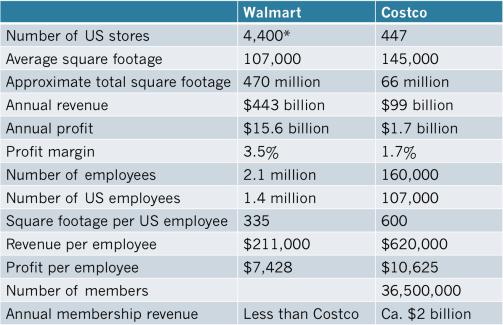
As it happens, that matters a lot. I produced the following graphic to sum up the differences that these two strategies produce: 
113367104
(*WALMART FIGURES INCLUDE SAM’S CLUB, WHICH DESPITE HAVING MORE STORES, IS MUCH LESS PROFITABLE THAN COSTCO.)
What do you see? Costco has a tiny number of SKUs in a huge store -- and consequently, has half as many employees per square foot of store. Their model is less labor intensive, which is to say, it has higher labor productivity. Which makes it unsurprising that they pay their employees more.

But what about QuikTrip and Trader Joe's? I'm going to leave QuikTrip out of it, for two reasons: first, because they're a private company without that much data, and second, because I'm not so sure about that statistic. QuikTrip's website indicates a starting salary for a part-time clerk in Atlanta of $8.50 an hour, which is not all that different from what Wal-Mart pays its workforce. That $40,000 figure is for an assistant manager, and seems to include mandatory overtime. To this let's add a third reason: QuikTrip is a convenience store, a business that bears minimal resemblance to a department store, the category into which Wal-Mart falls. I mean, yes, you can buy candy at both places, but you can also buy a candy bar at the movie theater, and I still wouldn't head to my local Wal-Mart for a 3:30 p.m. showing of "The Butler."

Trader Joe's is also private, but we do know some stuff about it, like its revenue per-square foot (about $1,750, or 75 percent higher than Wal-Mart's), the number of SKUs it carries (about 4,000, or the same as Costco, with 80 percent of its products being private label Trader Joe's brand), and its demographics (college-educated, affluent, and older). "Within a 15-minute driving radius of a potential site," one expert told a forlorn Savannah journalist, "there must be at least 36,000 people with four-year college degrees who have a median age of 44 and earn a combined household income of $64K a year." Costco is similar, but with an even higher household income -- the average Costco household makes more than $80,000 a year.

In other words, Trader Joe's and Costco are the specialty grocer and warehouse club for an affluent, educated college demographic. They woo this crowd with a stripped-down array of high quality stock-keeping units, and high-quality customer service. The high wages produce the high levels of customer service, and the small number of products are what allow them to pay the high wages. Fewer products to handle (and restock) lowers the labor intensity of your operation. In the case of Trader Joe's, it also dramatically decreases the amount of space you need for your supermarket ... which in turn is why their revenue per square foot is so high. (Costco solves this problem by leaving the stuff on pallets, so that you can be your own stockboy).

Both these strategies work in part because very few people expect to do all their shopping at Trader Joe's, and no one expects to do all their shopping at Costco. They don't need to be comprehensive. Supermarkets, and Wal-Mart, have to devote a lot of shelf space, and labor, to products that don't turn over that often.

Wal-Mart's customers expect a very broad array of goods, because they're a department store, not a specialty retailer; lots of people rely on Wal-Mart for their regular weekly shopping. The retailer has tried to cut the number of SKUs it carries, but ended up having to put them back, because it cost them in complaints, and sales. That means more labor, and lower profits per square foot. It also means that when you ask a clerk where something is, he's likely to have no idea, because no person could master 108,000 SKUs. Even if Wal-Mart did pay a higher wage, you wouldn't get the kind of easy, effortless service that you do at Trader Joe's because the business models are just too different. If your business model inherently requires a lot of low-skill labor, efficiency wages don't necessarily make financial sense.

That's not the only reason that the Trader Joe's/Costco model wouldn't work for Wal-Mart. For one thing, it's no accident that the high-wage favorites cited by activists tend to serve the affluent; lower income households can't afford to pay extra for top-notch service. If it really matters to you whether you pay 50 cents a loaf less for generic bread, you're not going to go to the specialty store where the organic produce is super-cheap and the clerk gave a cookie to your kid. Every time I write about Wal-Mart (or McDonald's, or [insert store here]), several people will e-mail, or tweet, or come into the comments to say they'd be happy to pay 25 percent more for their Big Mac or their Wal-Mart goods if it means that the workers are well paid. I have taken to asking them how often they go to Wal-Mart or McDonald's. So far, no one has reported going as often as once a week; the modal answer is a sudden disappearance from the conversation. If I had to guess, I'd estimate that most of the people making such statements go to Wal-Mart or McDonald's only on road trips.

However, there are people for whom the McDonald's Dollar Menu is a bit of a splurge, and Wal-Mart's prices mean an extra pair of shoes for the kids. Those people might theoretically favor high wages, but they do not act on those beliefs -- just witness last Thanksgiving's union action against Wal-Mart, which featured indifferent crowds streaming past a handful of activists, most of whom did not actually work for Wal-Mart.

If you want Wal-Mart to have a labor force like Trader Joe's and Costco, you probably want them to have a business model like Trader Joe's and Costco -- which is to say that you want them to have a customer demographic like Trader Joe's and Costco. Obviously if you belong to that demographic -- which is to say, if you're a policy analyst, or a magazine writer -- then this sounds like a splendid idea. To Wal-Mart's actual customer base, however, it might sound like "take your business somewhere else."

This is not actually just a piece on how Wal-Mart can only pay low wages -- I don't know how much more they could afford to pay before they started to lose customers (or the board kicked the CEO out), and neither does anyone else writing about this. I'm actually interested in the larger point: the way that things most people rarely think about -- like the number of products that a store carries -- have far-reaching effects on everything from labor, to location, to customer service and demographics. We tend to look at the most politically salient features of the stores where we shop: their size, their location, the wages that we pay. But these operations are not so simple. They are incredibly complex machines, and you can no more change one simple feature than you can pull out your car's fuel injection system and replace it with the carburetor from a 1964 Bonneville.

http://econlog.econlib.org/archives/2016/02/why_minimum_wag.html

http://econlog.econlib.org/archives/2016/02/why_minimum_wag.html


Jonathan Meer and Jeremy West have found that increases in the minimum wage destroy jobs, not so much by destroying current jobs as by reducing the growth rate of new jobs.

That makes sense if employers' investments in capital are even partially irreversible, that is, if some costs of capital investment are sunk, as seems plausible.

Here's a simple numerical example to illustrate the point.

Imagine that an employer is contemplating investing $100K in the price and installation of a piece of machinery that he expects to last 5 years. Assume for simplicity that once it is bought and installed, the salvage value is zero. (Numbers greater than zero work also, but complicate the analysis, with no additional insight.)

Assume that the current minimum wage is $7 an hour and that the employer contemplates hiring a worker for a standard work year of 2,000 hours. At that wage rate, he can find a suitable worker. Assume that there are no other components of the pay package and that there are no other costs of production. Assume that the employer expects to be able to sell the annual output from the machine/worker combination for $37,000. Assume, for simplicity, a zero real interest rate. (That, by the way, is often a bad assumption but in recent years, it is not far off.)

If the employer expects no increases in wages over the next 5 years, will he make the investment? Yes.

The reason is that his costs over the 5 years are $100K for equipment and $70K for labor, for a total of $170K. His revenues are $185K. Net profit: $15K.

But now imagine that after 2 years of operating profitably, the employer faces a minimum wage of $10 an hour.

Had he known this in advance, he would have known that his cost of labor over the 5 years would have been $14K plus $14K plus $20K plus $20K plus $20K, or $88K. So his total costs would have been $188K. Compare that to the $185K of revenue and the employer would not have invested.

But the employer has invested. The equipment cost is sunk. Will the employer continue? Yes he will. The reason: he now compares $20K of annual labor cost to $37K of annual revenue and finds that it is worthwhile to continue.

So he will not lay off the labor.

However, other potential employer/investors facing the same numbers will not make the investment. So whatever growth rate of jobs there would have been will not come about. The growth rate will be lower.

Saturday, February 27, 2016

Higher wages wouldn't help fired Yelp millennial (Opinion) - CNN.com

Higher wages wouldn't help fired Yelp millennial (Opinion) - CNN.com
(CNN)What happened late last week to Talia Jane -- who became suddenly Internet famous after being fired from her job at Yelp -- fits an all-too-easy narrative: underpaid 20-something writes desperate complaint about low wages and greedy corporate employer suppresses dissent by firing her.

But millennials working for starvation pay should learn something from Jane's fate: Things could be worse, and will be, when minimum-wage laws price them out of their jobs.

For many, Jane -- who wrote an open letter to her CEO about her situation -- is a sympathetic figure. She claimed she was making just $8.15 an hour after taxes working a boring job in customer relations for Yelp/Eat24. That's not a lot of money -- especially in San Francisco, and especially for an unfulfilled college graduate with an English degree and journalism aspirations.

Jane claimed her situation was so hopeless that she often went to sleep hungry, and many of her co-workers found themselves in similar situations. (Hours after publishing the letter, Jane was fired. Yelp denies her public statements had anything to do with it).

Critics pointed out that Jane did herself no favors by whining, and was in far-from-desperate straits.

"The issue is that this girl doesn't think working a second job or getting roommates should be something she has to do in order to get ahead after three months of an entry level job in the most expensive city in the country," wrote Stefanie Williams, a fellow millennial who started out waiting tables and worked her way up to the New York City lifestyle and job she wanted.

For others, Jane's circumstances present a compelling argument for the government to raise the minimum wage. Indeed, union activists would like the state of California to raise its minimum wage from $10 to $15. Numerous cities are gradually doing so -- San Francisco will have a $15-per-hour minimum by 2018.

Younger workers might cheer this news. They shouldn't. That's because a company like Yelp wouldn't pay an employee like Jane any more money, even if forced to do so. Instead, it would never have hired her in the first place.

It may sound harsh, but the reality is that a person's labor is only worth so much. Markets are far from perfect, but competition (not always, but usually) prevents companies from getting away with drastically undervaluing their employees -- if Yelp did that, a rival could poach all its workers by offering them slightly more money.

On the other hand, if Yelp had a policy of paying workers exactly what they needed to get by, rather than exactly what their labor was worth, the company would go out of business.

That's why high-minimum-wage laws are actually bad for the very people who think they need them most: millennials. Companies that are forced to pay workers a minimum of $15 an hour won't hire from the young, inexperienced, fresh-out-of-college crowd. They can't spend that much money on an unproven, untested investment.

Millennials may not realize it, but working for low pay is a competitive advantage (and a temporary one). Older workers have more obligations -- families to provide for, house payments to make, kids' tuition costs to pay -- and can't afford to work for less. Recent graduates can't beat them on raw talent, but they can beat them on price. For hardworking young people who just need to get a foot in the door and gain some experience, the minimum wage is, as Forbes editor John Tamny put it, "a cruel barrier."

The science bears this out. Studies often find that higher minimum wages correspond with decreased youth employment In fact, if the government's explicit goal were to make it harder for young people to compete for jobs, they could scarcely design a more perfect policy.

Writing on behalf of aging workers everywhere, the Foundation for Economic Education's Isaac Morehouse satirically observed:

"The obvious solution is to make it illegal to work for low wages. Working for free is absolutely out of the question. If young and poor people could simply offer to work for little or no pay, they'd soon be gaining valuable skills and competing with us for jobs!"

The recently fired Jane may need more money, but first she needs to find a new job, period. Raising the minimum wage would only make that harder for her.

Sunday, February 21, 2016

Raising the Minimum Wage Won’t Reduce Inequality | New Republic

Raising the Minimum Wage Won’t Reduce Inequality | New Republic
(See original for links in document)

Raising the Minimum Wage Won’t Reduce Inequality
BY CHRISTOS MAKRIDIS
February 5, 2016
Walmart is giving more than one million of its employees a raise later this month as part of a plan that will lift all but its newest hires to at least $10 an hour.

The move, first announced last year, follows an aggressive campaign to get the largest private employer in the U.S. to lift worker wages and coincides with a nationwide push to raise federal and state minimum wages and a prolonged period of little growth in pay.

While Walmart’s decision is at least in part a result of that pressure, it’s still the action of a private company to revamp its own wage policies, as opposed to the result of a government forcing it to lift worker pay. Proponents of requiring just that argue raising the minimum helps reduce inequality. Critics contend it can actually worsen it by driving up unemployment and weakening economy-wide labor market flexibility by raising the costs firms face.

So what does the economic research say about the impact of minimum wages on income inequality and is there a better way to reduce it?

Minimum wage fallacies

Many of the articles in the mainstream press promoting minimum wages are incompatible with basic economic principles.

The first fallacy is that changes in the minimum wage do not affect the behavioral response among firms and individuals. The second fallacy is that higher wages will force companies to innovate in order to reduce costs. Both these arguments overlook some very basic, but informative, economic principles.

The first overlooks the fact that wages are designed to compensate workers for productivity. When wages are distorted, they affect the profit-maximizing decisions that businesses make. The textbook prediction, which is generally supported in the data, is that higher minimum wages reduce employment since companies restrict the number of workers they will hire. These adverse effects are especially likely given the pace of technological change and automation.

The second overlooks the fact that there are effective and ineffective ways to stimulate innovation among businesses. The idea that making hiring more costly will spur innovation is tantamount to requiring companies to reduce the size of their physical presence so they become more productive. While these types of distortions may prompt a small fraction of companies to innovate, misallocation more generally is a major factor behind cross-country differences in productivity.

Minimum wage and inequality

Nonetheless, economists themselves have debated how minimum wages affect employer decisions for many years.

In 1994, economists David Card and Alan Krueger were the first to provide some evidence that such effects may be small. But more recently, a consensus has generally emerged that changes to minimum wages have strong effects on jobs growth.

How minimum wages affect inequality, however, remains controversial. Detecting it with standard statistical methods is very challenging because their full effects are constantly changing and require data on both individuals and companies.

Back in 1999, Princeton economist David Lee used the Consumer Population Survey (CPS) from 1979 to 1989 to argue that the declining purchasing power of the minimum wage largely explains why inequality surged in the 1980s.

Other new research, however, has put that conclusion in doubt. Perhaps the most conclusive reassessment comes from economists David Autor, Alan Manning, and Christopher Smith earlier this year. Using many more years of microdata from the CPS, as well as a different statistical approach, they found that the minimum wage explains at most 30 percent to 40 percent of the rise in wage inequality among the lowest earners.

Since economists had thought that changes in the minimum wage could explain as much as 90 percent of the shift in inequality, these new estimates are important.

How wages affect worker behavior

While the extent is still uncertain, it’s clear that the minimum wage and other wage-setting forces such as tax rates and union bargaining power do in fact affect inequality and the labor market.

My own ongoing research, which focuses on the link between such wage-setting mechanisms and company behavior, suggests labor-market distortions like raising the minimum wage can have other negative effects on workers, businesses and inequality beyond the overall impact on employment.

The first adverse effect concerns how much people work. If, for example, worker wages rise due to a government mandate, the employer may reduce the number of hours staff work, leading to lower paychecks even after the raise. That’s part of the reason why we’ve seen companies like McDonald’s increasingly try to automate tasks that were once held by people.

In addition, my research suggests one of the major ways people acquire new skills is by spending more time at work. Thus policies that lead to fewer hours could lower employees’ ability to improve their long-run earnings potential.

The second is an indirect effect on the way businesses invest in workers and design compensation and organizational policies. When companies are forced to pay higher wages, they may offset the cost by reducing how much they invest in workers. There is evidence that minimum wage laws have this effect.

This can result in weaker compensation contracts (e.g., purely salary-based), which provide employees with fewer incentives to accumulate skills. As a result, workers paid fixed wages suffer greater long-run earnings volatility than those receiving performance-based pay.

Put simply, if a recession comes and an individual loses his or her job, having more skills makes it easier to find a new position and return to the previous income level.

Minimal impact on inequality

Even setting aside all the plausible economic arguments against the minimum wage, under the best case scenario, what does it really achieve?

If the average full-time employee works 1,700 hours per year, then moving from $7.25 an hour to $9 an hour produces only about $2,975 in additional annual earnings. While some may argue that something is better than nothing, this would be at best a marginal solution to inequality.

Taking a look at the most recent 2015 Current Population Survey data and restrict the sample to full-time earners with over $10,000 earnings per year, Americans at the 90th income percentile (they earn more than 90 percent of their compatriots, or $80,000 a year) make 5.6 times as much, on average, as those at the 10th percentile ($14,200). Increasing the minimum wage to $9 an hour would put the ratio around 4.65.

In other words, even in the best of worlds—where the minimum wage has no unintended side effects—it appears to only marginally reduce inequality.

Alternatives to raising the minimum wage

Where does this leave us in trying to reduce inequality?

First, companies are welcome to raise wages at any time they want. And letting them do so may be more effective at reducing inequality than when they’re forced to because it avoids the adverse consequences such as reducing hours.

Businesses are well aware of their marginal costs and benefits—how much it costs to produce an additional unit of output versus the incremental gain. When governments set uniform wage regulations, they require all companies—each with their own and distinct marginal costs and benefits—to abide by the same rules. In contrast, when companies decide to change their own pay practices—as Walmart is doingthey do so in a more efficient way.

Second, as Stanford economist John Cochrane has remarked, instead of addressing the short-term problem of low wages, governments and companies can address the more structural problem: a lack of skills.

Companies and local governments can provide training programs and support for additional education, such as through community colleges, in order to equip workers with additional skills that translate into meaningful value for their companies. Investing in worker skills can lead to increased employee productivity and creativity, which in turn translates into sustained higher wages. And these benefits have broad spillover effects throughout the labor market and make sustainable gains in narrowing the gap between the richest and the poorest.

While the economic effects of minimum wage laws are very complex and a subject of scrutiny within the economics community, there are much better ways to deal with systematic challenges in the labor market. Getting more people to work, reducing the barriers for businesses to hire and encouraging the accumulation of new skills are all strategies for promoting sustainable long-term growth in wages.

Show This Column to Anyone Who Claims Bush Lied about WMDs in Iraq - John Hawkins - Page 1

Show This Column to Anyone Who Claims Bush Lied about WMDs in Iraq - John Hawkins - Page 1


...you have to be malicious or just an imbecile at this point to accuse Bush of lying about WMDs.
To begin with, numerous foreign intelligence agencies also believed that Saddam Hussein had an active WMD program. The "intelligence agencies of Germany, Israel, Russia, Britain, China and France" all believed Saddam had WMDs. CIA Director George Tenet also rather famously said that it was a “slam dunk” that there were weapons of mass destruction in Iraq.
Incidentally, it’s hard to fault the CIA for their conclusions when even, “In private conversations that were intercepted by U.S. intelligence, Iraqi officials spoke as if Saddam continued to possess WMD. Even Iraqi generals believed he did. In the fall of 2002, the Iraqi military conducted exercises in chemical protective gear – but not because they thought the U.S.-led coalition was going to use chemical weapons.”
Additionally, many prominent Democrats who had access to the same intelligence that George Bush did came to the same conclusion and said so publicly. If George W. Bush lied, then by default you have to also believe that Bill Clinton, Hillary Clinton, Al Gore, John Kerry, John Edwards, Robert Byrd, Tom Daschle, Nancy Pelosi and Bernie Sanders also lied. Some of them, like Hillary Clinton, even alleged that Saddam was working on nuclear weapons.
“In the four years since the inspectors left, intelligence reports show that Saddam Hussein has worked to rebuild his chemical and biological weapons stock, his missile delivery capability, and his nuclear program. He has also given aid, comfort, and sanctuary to terrorists, including Al Qaeda members, though there is apparently no evidence of his involvement in the terrible events of September 11, 2001. It is clear, however, that if left unchecked, Saddam Hussein will continue to increase his capacity to wage biological and chemical warfare, and will keep trying to develop nuclear weapons. Should he succeed in that endeavor, he could alter the political and security landscape of the Middle East, which as we know all too well affects American security.” — Hillary Clinton, October 10, 2002