Friday, March 16, 2012

Michael Hayden: Birthers, Truthers and Interrogation Deniers - WSJ.com

Link: http://online.wsj.com/article/SB10001424052702303745304576359820767777538.html?mod=djemITP_h

Let me add a third denomination to this faith-based constellation: interrogation deniers, i.e., individuals who hold that the enhanced interrogation techniques used against CIA detainees have never yielded useful intelligence. They, of course, cling to this view despite all evidence to the contrary, despite the testimony of four CIA directors, and despite Mr. Obama's chief counterterrorism adviser John Brennan's statement that there's been "a lot of information that has come out from these interrogation procedures that the agency has in fact used against the real hard-core terrorists."

The recent dispute over what strains of intelligence led to the killing of Osama bin Laden highlights the phenomenon. It must appear to outside observers like a theological debate over how many angels can reside on the head of a pin. So we see carefully tailored arguments designed to discount the value of enhanced interrogations: the first mention of the courier's name came from a detainee not in CIA custody; CIA detainees gave false and misleading information about the courier; there is no way to confirm that information obtained through enhanced interrogation was the decisive intelligence that led us directly to bin Laden.
All fair enough as far as they go. But let the record show that when I was first briefed in 2007 about the brightening prospect of pursuing bin Laden through his courier network, a crucial component of the briefing was information provided by three CIA detainees, all of whom had been subjected to some form of enhanced interrogation. One of the most alerting pieces of evidence was that two of the detainees who had routinely been cooperative and truthful (after they had undergone enhanced techniques) were atypically denying apparent factual data—a maneuver taken as a good sign that the CIA was on to something important.
So that there is no ambiguity, let me be doubly clear: It is nearly impossible for me to imagine any operation like the May 2 assault on bin Laden's compound in Abbottabad, Pakistan, that would not have made substantial use of the trove of information derived from CIA detainees, including those on whom enhanced techniques had been used.
It is easy to imagine the concerns at the political level as the CIA built its case that bin Laden was in the Abbottabad compound, and it became obvious that detainee data was an important thread of intelligence. To his credit, and obviously reflecting this reality, White House spokesman Jay Carney has not denied that fact but correctly pointed out that there were multiple co-dependent threads that led to this success.

In response to a direct question on the CBS Evening News about enhanced interrogation and the bin Laden success, CIA Director Leon Panetta confirmed on May 3 that, "Obviously there was some valuable information that was derived through those kind of interrogations." He also added that it was an "open question" whether the information could have been elicited through other means, implicitly contradicting those who claim that other means would have produced the same information.

Let me add that this is not a discussion about the merits or the appropriateness of any interrogation technique. Indeed, I personally took more than half of the techniques (including waterboarding) off the table in 2007 because American law had changed, our understanding of the threat had deepened, and we were now blessed with additional sources of information. We can debate what was appropriate then, or now, but this is a discussion about a particular historical fact: Information derived from enhanced interrogation techniques helped lead us to bin Laden.
And so those who are prone to condemn the actions of those who have gone before (while harvesting the fruits of their efforts) might take pause. I've been personally asked about the appropriateness of waterboarding and—recognizing the immense challenge of balancing harsh treatment with saving innocent lives—usually respond: "I thank God that I did not have to make that decision." At the same time, I thank those who preceded me, made such decisions and thereby spared me the worst of the dilemma. Those who deny the usefulness of enhanced interrogation techniques might consider similar caution.

But if they cannot or will not, shouldn't they be true to their faith? If they truly believe that these interrogations did not and could not yield useful intelligence, they should demand that the CIA identify all the information derived directly or indirectly from enhanced interrogation. And then they should insist the agency destroy it. They should also insist that significant portions of the 9/11 Commission Report be rescinded, as it too was based on this data. This would be perfectly consistent with the interrogation deniers' transcendental faith that nothing of use could have come from enhanced interrogations after 9/11.

Strange that we have not heard such calls, even from the most ardent interrogation deniers. Perhaps they are not really like "birthers" and "truthers" after all. Perhaps, when all the public ideological posturing is done, and they are through attacking both their opponents' arguments and their character, they quietly concede to themselves that facts really do matter.

What the “Skeptics” of Climate Catastrophe are Skeptical Of: Nordhaus Recons...


via MasterResource by Eric Dennis on 3/15/12

The most frustrating thing about being a scientist skeptical of catastrophic global warming is that the other side is continually distorting what I am skeptical of.
In his immodestly titled New York Review of Books article "Why the Global Warming Skeptics Are Wrong," economist William Nordhaus presents six questions that the legitimacy of global warming skepticism allegedly rests on.
  1. Is the planet in fact warming?
  2. Are human influences an important contributor to warming?
  3. Is carbon dioxide a pollutant?
  4. Are we seeing a regime of fear for skeptical climate scientists?
  5. Are the views of mainstream climate scientists driven primarily by the desire for financial gain?
  6. Is it true that more carbon dioxide and additional warming will be beneficial?
Since the answers to these questions are allegedly yes, yes, yes and no, no, no, it's case closed, says Nordhaus.
Except that he is attacking a straw man. Scientists (or non-scientists) who are "skeptics" are skeptical of catastrophic global warming—not warming or human-caused warming as such. So much for 1 and 2. We refuse to label CO2 a "pollutant" because it is essential to life and because we do not believe it has the claimed catastrophic impact. So much for 3. And since 4-6 don't pertain to the scientific issue of catastrophic warming, so much for them, as well.
The object of our skepticism, catastrophic global warming, means warming caused by greenhouse gasses that would so dramatically heat up the earth that despite the proven climate adaptability of hydrocarbon-powered civilization (see "How Capitalism Makes Catastrophes Non-Catastrophic"), populations the world over would experience impoverishment, mass suffering, and death.
Why are we skeptical of this claim? Because there is radically insufficient evidence for it.
This may seem implausible, because the news media bombard us with stories of new studies, new findings, new models, new international summits allegedly confirming catastrophic global warming. But what these stories leave out is the evidential status of these developments—what any given study or model actually proves. And the answer is, little to nothing, because the present ability of scientists to understand, model, and predict the climate is far, far lower than we are led to believe.
To say that modeling the climate for long-term predictions is difficult given the current state of climate science is like saying that it would be difficult for your five-year-old son to build a 400 horsepower car from re-purposed Toys 'R' Us purchases. Imagine that he comes to you with pages and pages of plans he's sketched out in crayon. The "car" will cost $22,827.35 worth of toys.
Why wouldn't you reach for your credit card? Is that because you're against teaching kids engineering? Is it because his sworn enemy, your daughter, is paying you off? Or perhaps it's because this project is obviously beyond the capability of a five-year-old, and that his crayon schematics don't offer convincing evidence that he is in fact the kind of once-in-a-generation prodigy who could somehow pull it off.
If one understands how monumental an undertaking it would be to produce a sound climate model, one can see that today's climate modelers are making assertions no less implausible than our five-year old's fantasy.
In physics it is generally possible to exactly predict the behavior of systems involving two independent bodies, whether planets interacting through gravity or elementary particles through the electromagnetic field. More bodies means no exact solution to the dynamical equations and a zoo of different approximations, usually requiring computational simulation, which takes more and more time as the number of bodies being simulated increases. Indeed the computation time generally grows exponentially with the number of bodies.
The global climate system comprises an astronomical number (at least billions) of effectively independent "bodies," which is to say of isolatable, relatively uniform chunks of air, ocean, and earth. Their interactions span the complexity spectrum, from the mechanical push-and-pull of an ocean current to the lesser-known dynamics of cloud formation to intricate, biological mechanisms like plant growth and respiration that have evolved over billions of years.
Solving this kind of complex system is outside the realm of controlled approximations and reasonable estimates. It's in the realm of random stabs, on any objective assessment of our current scientific powers. Since attempts to model this system are the basis of claims for catastrophic global warming, the evidence we need to consider pertains to whether or not such models are capturing enough of the detailed mess of forces that actually drives the climate.
Many different climate processes affect the energy balance between the earth and outer-space and thus affect temperatures on the Earth. One such process is the greenhouse effect, by which CO2 and other gases trap some extra solar energy in the atmosphere and convert it into heat. It is widely acknowledged that the CO2-linked greenhouse effect itself can produce only a modest warming going forward because the incremental warming produced by each extra liter of CO2 gets smaller and smaller as more CO2 is added.
The catastrophist projections are based on the idea that this modest warming will trigger an entirely separate set of feedback mechanisms that will multiply the warming many times. For instance warming is projected to increase ambient levels of water vapor, itself a greenhouse gas; melting ice will expose more earth or open water, which tend to absorb more solar energy as heat; temperature-linked changes in cloud patterns affect how much solar energy gets reflected back to space or back to the Earth.
There are also negative feedbacks, meaning processes that come into play due to warming, or to CO2 increases, that wind up counteracting that warming. Examples include enhanced re-radiation of energy back into space at higher temperatures, increased absorption of CO2 into the oceans, and increased quantities of organic matter capturing CO2. Indeed some supposedly positive feedbacks, like certain cloud effects, may turn out actually to be negative ones.
Moreover, nature does not simply provide us with a list of all the relevant feedbacks, or climate processes in general. There is no systematic procedure by which the set of processes included in current climate models are picked out from the catalogue of all possible such processes. The procedure is simply for modelers to engage their own imaginations, given our current knowledge, to conceive possible effects and gather evidence to confirm or falsify them.
How many known ones have been intentionally discarded due to a lack of knowledge and evidence about how to incorporate them? How many have just not been thought of to date?
In a certain sense, this is the nature of any scientific theory. But this is why such theories have to produce specific, detailed predictions, confirmed by observation, to show that they have captured the relevant causal factors. Apart from this, there is a lot of room here for the ultimate outcome of the models to be controlled by ideological predispositions—like that, of all the underlying drivers, the decisive one just happens to be CO2, the one with a clear link to the functioning of modern, industrial capitalism.
What would be a rational response when your five-year-old car enthusiast presents you with his crayon plans, protesting that he's also proven his case by putting together a scale model in Legos? First you might point out that while his plans are impressive for a boy his age, it's rarely the case that reality works out just like a priori plans and models suggest.
Rather than setting him loose at toysrus.com with your credit card, you might suggest he start off with a scaled-down project, like an RC kit. Then, if that's a success, maybe an introduction to simple wood and then metal work. As he gets older and proves himself at each stage, he could move on to machine shop projects, welding, and an apprenticeship with a real car mechanic.
This kind of demonstrated, step-by-step progress is how legitimate inventions, and inventors, are made. At the end of the process, they no longer agitate for sizable investments on the basis of their original crayon plans.
And such demonstrated, step-by-step progress is exactly what a reasonable person ought to demand from the global warming catastrophists. Not mere simulations, generated by model code that they control and have played with for years. Since the odds are so small, a priori, that they have actually cracked the excruciatingly complicated problem of global climate prediction, we need dramatic positive evidence. Lesser evidence is powerless to overcome the overwhelming odds against being able to delicately sort out the mess of climate drivers and feedbacks.
The catastrophists need to demonstrate their methodology by applying it to smaller problems whose outcomes we don't have to wait a century for. They need to derive unambiguous, detailed predictions for these outcomes and see them borne out. By "detailed" I mean predictions of not just a single number, like a cumulative warming trend, that could just be accidentally correct—and they're not even getting predictions on these simpler metrics right. I mean predictions of a more intricate, unaccidental nature.
For instance, climate models predict a detailed pattern of warming that occurs at different rates in different parts of the globe and, importantly, at different altitudes in the atmosphere. But when we look in actual climate data for the specific, altitude-dependent warming signature produced by these models, we find something entirely different.
And that's only half the problem. Before we can test models, we need this historical climate data to be accurate in order for the comparison to mean anything. Even for the one central climate variable, global average temperature, the reconstructed data is fraught with uncertainties and scientific misconduct.
What has always to be kept in mind on these issues, is (i) the massive complexity of the problem the catastrophist modelers are claiming to have solved relative to the current state of climate science, and (ii) what this implies about the onus of proof. Their claim is to have accomplished a scientific miracle with tools that by any reasonable analysis are far from capable of the task.
Absent shocking evidence of success on their part, the conclusion to draw is not: catastrophic global warming has just moderate odds of occurring. The conclusion is that these models bear as much relationship to reality as your son's crayon plans bear to a real car. And suggestions about how to transform the entire world economy based on these models should be treated accordingly.
—————————-
Eric Dennis, who holds a Ph.D. in physics from UC Santa Barbara, is a Senior Fellow at the Center for Industrial Progress.

Complex Societies Need Simple Laws - Reason Magazine

Link: Complex Societies Need Simple Laws)

"If you have 10,000 regulations," Winston Churchill said, "you destroy all respect for law."
He was right. But Churchill never imagined a government that would add 10,000 year after year. That's what we have in America. We have 160,000 pages of rules from the feds alone. States and localities have probably doubled that. We have so many rules that legal specialists can't keep up. Criminal lawyers call the rules "incomprehensible." They are. They are also "uncountable." Congress has created so many criminal offenses that the American Bar Association says it would be futile to even attempt to estimate the total. 
 So what do the politicians and bureaucrats of the permanent government do? They pass more rules.
That's not good. It paralyzes life.
Politicians sometimes say they understand the problem. They promise to "simplify." But they rarely do. Mostly, they come up with new rules. It's just natural. It's how the public measures politicians. Schoolchildren on Washington tours ask, "What laws did you pass?" If they don't pass new laws, the media whine about the "do-nothing Congress."
This is also not good.
When so much is illegal, common sense dies. Out of fear of breaking rules, people stop innovating, trying, helping.
Think I exaggerate? Consider what happened in Britain, a country even more rule-bound than America. A man had an epileptic seizure and fell into a shallow pond. Rescue workers might have saved him, but they wouldn't enter the 3-foot-deep pond. Why? Because "safety" rules passed after rescuers drowned in a river now prohibited "emergency workers" from entering water above their ankles. Only 30 minutes later, when rescue workers with "stage 2 training" arrived, did they enter the water, discover that the man was dead and carry him to the approved inflatable medical tent. Twenty other cops, firemen and "rescuers" stood next to the pond and watched.
The ancient Chinese philosopher Lao Tzu, sometimes called the first libertarian thinker, said, "The more artificial taboos and restrictions there are in the world, the more the people are impoverished....The more that laws and regulations are given prominence, the more thieves and robbers there will be." He complained that there were "laws and regulations more numerous than the hairs of an ox." What would he have thought of our world?
Big-government advocates will say that as society grows more complex, laws must multiply to keep up. The opposite is true. It is precisely because society is unfathomably complex that laws must be kept simple. No legislature can possibly prescribe rules for the complex network of uncountable transactions and acts of cooperation that take place every day. Not only is the knowledge that would be required to make such a regulatory regime work unavailable to the planners, it doesn't actually exist, because people don't know what they will want or do until they confront alternatives in the real world. Any attempt to manage a modern society is more like a bull in a darkened china shop than a finely tuned machine. No wonder the schemes of politicians go awry.
F.A. Hayek wisely said, "The curious task of economics is to demonstrate to men how little they really know about what they imagine they can design." Another Nobel laureate, James M. Buchanan, put it this way: "Economics is the art of putting parameters on our utopias."
Barack Obama and his ilk in both parties don't want parameters on their utopias. They think the world is subject to their manipulation. That idea was debunked years ago.
"With good men and strong governments everything was considered feasible," the great Austrian economist Ludwig von Mises wrote. But with the advent of economics, "it was learned that ... there is something operative which power and force are unable to alter and to which they must adjust themselves if they hope to achieve success, in precisely the same way as they must taken into account the laws of nature."
I wish our politicians knew that. I wish they'd stop their presumptuous schemes.
We need to end the orgy of rule-making at once and embrace the simple rules that true liberals like America's founders envisioned.

Thursday, March 15, 2012

A Fluke by any other name

A Fluke by any other name

via Wizbang by Baron Von Ottomatic on 3/13/12

Sure it's a losing issue for conservatives with women, but I can't stop myself from beating this dead horse's ass.  Frankly, I don't care how this particular issues polls.  This Fluke character is indicative of everything that is wrong with the Obama administration.  Turning wants into needs into something that must be provided free of charge.  Completely oblivious to reality in the productive sector of the economy – easy when you've never been a part of it – yet certain they know best how everyone else should manage their affairs.

Let's not forget that last point is the most important.  This kerfuffle is about Obama using the power of the federal government to silence someone's religious conscience.  Yeah, the idea of a 30 year old law student without the wherewithal to purchase health insurance with prescription drug coverage standing before Congress begging for free birth control is bad enough.  Doing it to force the church to give you birth control is despicable.

Separation of Church and State is a one way street, I suppose.  Or was there a constitutional line-item veto buried somewhere in the Obamacare bill?

It stands to reason that if Obama is comfortable imposing medical practices against religious conscience on the church pretty much in direct violation of the First Amendment any future resistance to his diktats will be as worrisome to him as a fly on a Rhino's back.  And Gloria Allred wants Rush Limbaugh arrested for blaspheming Saint Sandra the Unchaste.  Two out of four ain't bad for one healthcare mandate.  You can petition for redress of grievances but Obama isn't listening.  Of course, we've still got freedom of the press.  For now.

Since it's come up in the comments, a couple of preemptive strikes.  The first is, all Fluke wants is for the health insurance she paid for to cover birth control.  Here in America we have these things called contracts.  These "contracts" are legally binding agreements between two parties defining the scope of their relationship.  When a person signs a "contract" they are agreeing to the terms and conditions as written.  Any changes to a "contract" must be mutually agreed upon and cannot be enacted unilaterally.

No one forced her to enter into a contract with Georgetown.  There are hundreds of health insurance policies from which one may choose that offer varying levels of coverage – including prescription drug coverage.  She chose a plan that does not offer coverage for birth control.  To expect Georgetown to offer her coverage beyond the scope of the contract to which she agreed because she wants it is unjustifiable and unreasonable.

Next up, refuting my assertion that insurance is for unexpected events by pointing out pregnancy is unexpected.  I suppose if you're 10 years old and living in a cave pregnancy might be an unexpected result of intercourse, but beyond that I assume the mechanics of child production are well disseminated.  Pregnancy may be untimely, it may be unlikely, and it may be unwanted – but it shouldn't be unexpected.  I'm reasonably certain that all forms of birth control come with a warning they may not be 100% effective.

You don't hear couples talking about looking forward to it someday but they're just not ready to have cancer.  Most people expect a pregnancy in their life at some point.  I stand by my assertion that insurance should be reserved for truly unexpected medical emergencies.  I also believe that insurance companies should be free to offer policies that cover pregnancies if they so choose.  Mandating pregnancy coverage may serve a useful purpose, but the end result is higher premiums for everyone.  Clearly, taking money from large numbers of people and using it to pay for utterly predictable expenses is not insurance – it is a subsidy.

Last, the idea that Georgetown and conservatives are trying to restrict access to contraception.  I want a new stainless steel .45ACP longslide with laser sighting.  I have a Constitutional right to bear arms.  If someone doesn't provide me with handguns for free on demand they are restricting access to the firearms necessary to exercise my right to bear arms.  I pay my taxes, I have a right to bear arms, I should be provided guns free of charge.  I'll see your birth control and raise you an AK-47.

This whole Fluke imbroglio stinks to high heaven.  I would assume freedom-loving people would be outraged that our government would be so brazen as to force Americans to buy health insurance whether they want it or not AND force the church to provide abortions.  Rugged individualists?  No mas.  We're nothing but a bunch of timid wards of the state.  Our future, and Ms. Fluke's is self evident:

President Obama's national health care law will cost $1.76 trillion over a decade, according to a new projection released today by the Congressional Budget Office, rather than the $940 billion forecast when it was signed into law.
Double?  I wish.  Government cost estimates for sweeping social programs always end up off by an order of magnitude over time.  No, I mean a little farther into the future:
Greek Students Fight Stray Dogs and Despair Amid College Cuts

Fluke is just deadweight on Obama's Freeshit Express as it hurtles down the tracks for the inescapable head-on collision with the Broke-as-hell Cannonball.  I hope they hand out free birth control in the bread line.

Republican Frat Brothers Reignite Dems’ “War on Women” Theme

Republican Frat Brothers Reignite Dems’ “War on Women” Theme

via Power Line by John Hinderaker on 3/14/12

(John Hinderaker)
Just when it seemed that the Democrats' "War On Women" theme had petered out, a group of college Republicans at Duke poured gasoline on the flames by posing for an outrageous photograph with a cardboard cutout of Hillary Clinton. One of the Republicans pretended to kiss the cutout while holding a beer to "Hillary's" mouth while another, in an even more offensive gesture, cupped the cutout's right breast. Republican leaders quickly sought to distance themselves from this latest bombshell, while Democrats saw the photo as more evidence that sexism is deeply entrenched in the Republican Party.

"This confirms what we've always suspected," said Nancy Pelosi. "Republicans are sexist to the core. Where do you think these Republican frat brothers got their misogynistic ideas? From the leaders of their party, that's where!"
Harry Reid was equally vehement: "These young Republicans are obviously part of Rush Limbaugh's radio audience. They may be the ones with their hands on Hillary's cleavage, but Limbaugh put the idea into their heads!"
Barack Obama agreed, saying…
No, wait. Sorry. Those aren't Republican frat brothers, they are Obama staffers. The one with his hand on Hillary's breast is Jon Favreau, Barack Obama's head speechwriter, who currently earns $172,000 a year as your employee. The photo appeared on Facebook shortly after the 2008 election and Favreau sent an apology to Mrs. Clinton, who by then was slated to be Secretary of State. She apparently found the photo amusing and, according to Wikipedia, responded: "Senator Clinton is pleased to learn of Jon's obvious interest in the State Department, and is currently reviewing his application." Time magazine has named Favreau one of the 100 most influential people in the world; he has also been honored as one of the World's Most Beautiful People by People magazine.
Wow, this women business is tricky. You don't want to jump to any conclusions about whether you are witnessing a war or just good, clean fun until you check out the party registration.
Via InstaPundit.

Wednesday, March 14, 2012

Weather Extremes and Insurance Claims

Link: http://ruby.fgcu.edu/courses/twimberley/envirophilo/WeatherExtremes.pdf


ABSTRACT

Frequent and extremely damaging severe weather conditions in the United States during 1991–94 caused $40 billion in insured losses, creating major impacts and eliciting diverse responses in the weather insurance industry. Population, one reason for the growing national sensitivity to storm damage, explained much of the increase in the number of catastrophes (property losses > $10 million) as well as the increases in the amount of losses. The largest increases in storms occurred in areas experiencing the greatest population growth (west, southwest, south, and southeast). Shifts in atmospheric variables (particularly in the frequency of extratropical cyclones) explained most of the 1949–94 fluctuations found in the intensity of catastrophic storms (losses divided by storm frequency). The property-casualty sector raised rates, made major changes in insurance availability in high-risk areas, tightened underwriting restrictions in hurricane-prone areas, and is making extensive assessments of weather risks. The reinsurance industry raised rates up to 200%, sought and received funds from the financial markets, and developed new firms. However, some existing firms also withdrew from the marketplace. Crop losses led to major changes in the nation's crop insurance program. The property casualty and reinsurance sectors, which experienced the greatest losses, have gained a greater appreciation of the need to incorporate atmospheric data, information, and expertise into their operations. Assessment of the problems created by recent weather extremes and possible solutions identified ways that the atmospheric sciences community and industry can work together more effectively to deal with future climate conditions and weather extremes.

AMS Journals Online - Have Disaster Losses Increased Due to Anthropogenic Climate Change?

Link: http://journals.ametsoc.org/doi/abs/10.1175/2010BAMS3092.1 (via shareaholic.com)

Abstract
The increasing impact of natural disasters over recent decades has been well documented, especially the direct economic losses and losses that were insured. Claims are made by some that climate change has caused more losses, but others assert that increasing exposure due to population and economic growth has been a much more important driver. Ambiguity exists today, because the causal link between climate change and disaster losses has not been addressed in a systematic manner by major scientific assessments. Here, the author presents a review and analysis of recent quantitative studies on past increases in weather disaster losses and the role of anthropogenic climate change. Analyses show that, although economic losses from weather-related hazards have increased, anthropogenic climate change so far did not have a significant impact on losses from natural disasters. The observed loss increase is caused primarily by increasing exposure and value of capital at risk. This finding is of direct importance for studies on impacts from extreme weather and for disaster policy. Studies that project future losses may give a better indication of the potential impact of climate change on disaster losses and needs for adaptation than the analysis of historical losses.

Some Sins of Textbook Economics | The Freeman | Ideas On Liberty

Link: http://www.thefreemanonline.org/columns/thoughts-on-freedom/some-sins-of-textbook-economics/?utm_source=The Freeman&utm_campaign=439af82f53-Freeman_Jan2010_Issue&utm_medium=email (via shareaholic.com)

Textbook writers are often not the best choice for writing textbooks.
A frequently encountered instance of this confusion is economists' discussion of competition. What introductory economics textbooks describe as "perfect" (or "pure") competition resembles nothing that occurs in the real world. In the world of the textbooks, firms don't differentiate their products from those of their rivals. Firms never try to win more customers by improving the quality of their products. Also, firms don't advertise. Indeed they don't even cut prices because each "perfectly competitive" firm is a "price taker": It's too small to affect the market price and so can sell as much as it wishes at whatever price prevails in the market.
These and other problems with the model of "perfect competition" have been pointed out repeatedly, especially by economists steeped in the Austrian tradition—see, for example, Hayek's essay "The Meaning of Competition." Yet the typical economist still clings to the notion that "perfect competition" is perfect competition. This typical economist, it must be admitted, does understand that the conditions necessary for "perfect competition" to prevail in actual markets can never exist. But the model remains the ideal against which real-world markets are judged. The closer real-world markets appear to be to textbook "perfectly competitive" markets, the more competitive real-world markets are assumed to be.
And competition being a good thing, this typical economist presumes that policies advertised as moving real-world markets closer to the "perfectly competitive" ideal are desirable.

Assumed Conclusions

But such a presumption is unwarranted, in part because many of the conclusions of the analysis are snuck into the model's initial assumptions.
Most important among this model's foundational assumptions is that competitive forces play out only in the form of price cuts. Therefore anything that prevents prices from being cut (down to levels that the model specifies as appropriate) is regarded as an obstacle to competition—indeed, as an element of monopoly that prevents the economy from operating more efficiently.
To this day, many mainstream economists describe any firm that can raise, even modestly, the price it charges for its product without driving away all of its customers as possessing some monopoly power.
Note the confusion: A pest-control producer that aims to increase its sales by making a better mousetrap is regarded by this model as behaving monopolistically! Competing for customers by doing something other than simply cutting prices is, according to the model, not competitive.
You can't make this stuff up.
Another example of how economists commonly confuse themselves (and others) involves the issue of "market failure." That same introductory economics textbook that teaches the model of "perfect competition" explains a few chapters later that markets perform suboptimally whenever some groups of people act in ways that affect other groups of people without the consent of these third parties. The textbook then explains that, happily, economists know how to design taxes or regulations to fix the problem.

Externalities and Assumptions

Such situations—economists call them "externalities"—are indeed bad. If Smith pays Jones to hit me in the head with a hammer without my consent, I—the third party—am unquestionably made worse off. (A simple, and best, solution in this case is to give me an enforceable property right in my person: No one can hit me and get away with it without my consent.)
But the stories that economists typically tell of externalities—and of how to "solve" them—too loosely sneak in illegitimate assumptions.
Here's an example: Smith pays Jones for pork chops whose production at Jones's pig farm next door to where I live fills my house with obnoxious odors. The economist leaps to the conclusion that I am wronged. Perhaps I am. But suppose that I bought my house knowing that it was next door to a pig farm. Am I still wronged? No: The price I paid for my house was discounted because of its location within smelling distance of the farm. Not only have I consented to endure swinish odors in my home, I've been compensated for doing so (in the form of a lower price than that of a similar home located in a sweeter-smelling neighborhood).
Or suppose, alternatively, that the pig farm moves into my neighborhood by surprise, after I buy my house. Now am I harmed? The answer is unclear. If the location of my house is such that homebuyers should reasonably expect the possibility that farms might set up shop nearby, then when I bought my house there was an open question about whether or not home-owners have the right to odor-free air in the neighborhood. And because this question cannot be answered by economics alone, it's illegitimate for an economist to conclude that the farm necessarily should be taxed or regulated for the purpose of cleansing the neighborhood air of stinky odors.

The Largest Externalities

Economists are correct to point out that externalities exist. But economists are far too frivolous in going about labeling this or that effect an "externality"—and, what is even worse, are far too glib in supposing that government can be trusted to "internalize" externalities in ways that improve the allocation of resources rather than making it worse.
Don't forget what too many economists seem never to grasp: Collective decision-making itself—from citizens voting to politicians spending taxpayers' money—is infected with what are perhaps the largest and most intractable externalities. Costs are imposed on third parties constantly.
Economics done properly would highlight the dangers of trying to cure externalities with a process that itself is deeply infected with externalities. Unfortunately economics is too often done improperly.


Tuesday, March 13, 2012

Blog: Liberal intolerance, by the numbers

Link: http://www.americanthinker.com/blog/2012/03/liberal_intolerance_by_the_numbers.html (via shareaholic.com)

At last we have statistical evidence that liberals are less tolerant of views that disagree with theirs than are conservatives.  Andrew Malcolm of Investor's Business Daily points us to the data, found in a Pew Center for the Internet and American Life Project study.
The new research found that instead of engaging in civil discourse or debate, fully 16% of liberals admitted to blocking, unfriending or overtly hiding someone on a social networking site because that person expressed views they disagreed with. That's double the percentage of conservatives and more than twice the percentage of political moderates who behaved like that.
The proportion jumps even higher when someone on a social site disagrees with a liberal's post.
Only 1% of moderates would block or shut out someone who dared to disagree with them, compared to 11% of liberals, whose rate was nearly three times that of conservatives.
The same 11% of liberals would block or unfriend people who offended them by daring to argue about political issues, vs 6% and 7% for other political views.
Liberals (14%) even blocked or shut out those they deemed posted too frequently on politics, vs 8% and 9% for moderates and conservatives, respectively.
The delightful title of the piece sums it all up: "Online, liberals far less tolerant than normal people"

Monday, March 12, 2012

CBO | Federal Financial Support for the Development and Production of Fuels and Energy Technologies

CBO | Federal Financial Support for the Development and Production of Fuels and Energy Technologies

Lots of support for renewable and "green" energy, much less for fossil fuels.

Cathy Ruse: Limbaugh and Our Phony Contraception Debate - WSJ.com

Cathy Ruse: Limbaugh and Our Phony Contraception Debate - WSJ.com

I was not Catholic when I attended Georgetown Law, but I certainly knew the university was. So did Ms. Fluke. She told the Washington Post that she chose Georgetown knowing specifically that the school did not cover drugs that run contrary to Catholic teaching in its student health plans. During her law school years she was a president of "Students for Reproductive Justice" and made it her mission to get the school to give up one of the last remnants of its Catholicism. Ms. Fluke is not the "everywoman" portrayed in the media.  


In her testimony, Ms. Fluke claimed that, "Without insurance coverage, contraception, as you know, can cost a woman over $3,000 during law school." That's $1,000 per year. But an employee at a Target pharmacy near the university told the Weekly Standard last week that one month's worth of generic oral contraceptives is $9 per month. "That's the price without insurance," the employee said. (It's also $9 per month at Wal-Mart.) 

At issue isn't inhalers for asthmatics or insulin for diabetics. Contraception isn't like other kinds of "health care." Yes, birth-control pills can be prescribed to address medical problems, though that's relatively rare and the Catholic Church has no quarrel with their use in this circumstance. And the university's insurance covers prescriptions in these cases.
Still, Ms. Fluke is not mollified. Why? Because at the end of the day this is not about coverage of a medical condition.
Ms. Fluke's crusade for reproductive justice is simply a demand that a Catholic institution pay for drugs that make it possible for her to have sex without getting pregnant. It's nothing grander or nobler than that. Georgetown's refusal to do so does not mean she has to have less sex, only that she has to take financial responsibility for it herself.
Should Ms. Fluke give up a cup or two of coffee at Starbucks each month to pay for her birth control, or should Georgetown give up its religion? Even a first-year law student should know where the Constitution comes down on that.

Do We Really Want a Right to Health Care? | The Freeman | Ideas On Liberty

Do We Really Want a Right to Health Care? | The Freeman | Ideas On Liberty

Just because something is a right doesn’t mean in practice it can’t be restricted. The “right” to K-12 education doesn’t include home tutoring or guarantees of tasty lunch choices in the cafeteria. Even if health care is viewed as a right, it may not include the coverage you hope to have.

Rights Don’t Guarantee Access

The Supreme Court clarified, in the 2008 District of Columbia vs. Heller case, that the right to have a gun to protect your own home is an individual right. The Supreme Court was interpreting the Second Amendment, but the amendment had been operative for over 200 years. A right doesn’t guarantee easy access.  

The bottom line: Expensive medical therapies are typically available in the United States years before they are available in countries with universal health care. Politicizing health care by making it a “right” simply pushes health care decisions into the political process, routinely leading to delays.

The Right to iPods?

People don’t have a right to iPods. They just have iPods. People who want them buy them. They were once expensive, but have come down dramatically in price in a remarkably short time; now much better units–more memory, more functions, smaller–cost less than half what the original units did. Some claim health care is special, that similar price drops can’t happen there. But when the market is allowed to work–in Lasik eye surgery or cosmetic surgery or when patients with health savings accounts shop around–similar price drops are seen. It’s only when third parties, like the government or large, highly regulated insurance companies, pay for health care that prices go up every year.
Is health care a right? Do we even want it to be a right? People fight about rights. Abortion has been recognized as a right since the 1973 Roe decision, but most Americans want restrictions on that right and many want it taken away. That is a risk of making things rights; rights can be modified, restricted, curtailed, or eliminated, depending on the political climate. Do we want people to be fearful that their right to liver transplants–or hair transplants–might also be someday taken away? Do we really want people feeling they must man picket lines on a regular basis to protect their “right to health care”?

Instapundit � Blog Archive � NATIONAL HEALTH CARE: If Obama could say “Maybe you’re better off not having the surgery, but t…

Link: http://pjmedia.com/instapundit/138765/

March 11, 2012

NATIONAL HEALTH CARE:
If Obama could say "Maybe you're better off not having the surgery, but taking painkillers" to an elderly woman with a bad heart…
… then, in parallel fashion, why shouldn't the government tell young women who want birth control that they are better off using condoms rather than more expensive methods? Condoms, after all, give protection against STDs as well as pregnancy. It would control costs: no doctor visits needed, no calamitous side-effects to treat. Make free condoms plentifully available everywhere.
Remember, Obama took some heat for standing up to the woman who talked about the "spirit" of her 100-year-old mother. If old people are going to get pills instead of surgery, why shouldn't young people have to accept condoms? And shouldn't the government be promoting condoms for disease control anyway?
If it saves just one man's life, it's worth it.
But, from the comments: "Unless you actually make a Catholic bishop hand condoms out, you won't satisfy the urge behind the mandate."

Saturday, March 10, 2012

Bookworm Room » In honor of Andrew Breitbart, here’s what Progressives think of you

Bookworm Room » In honor of Andrew Breitbart, here’s what Progressives think of you
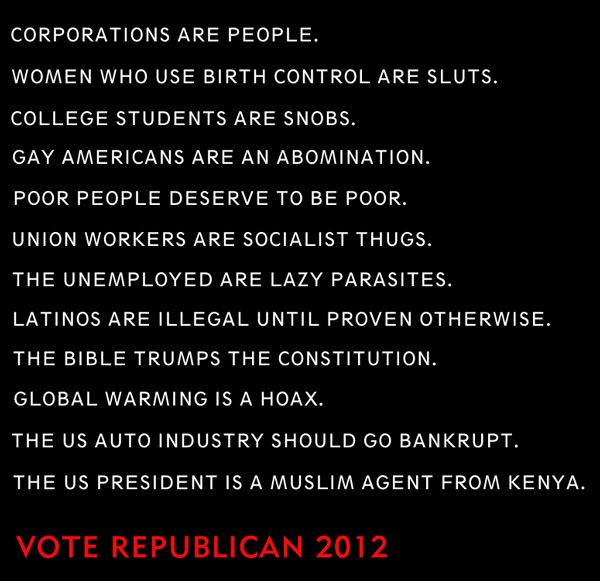
This little bit of propaganda is wending its way through the Progressive side of Facebook


Let’s deconstruct a little:

Corporations are people:  It’s a legal fiction that seems to elude Democrats.   Corporations are “people” so that they can be forced to pay taxes and so that they can appear in court.  You know, court, where Progressives are constantly suing them.  I’m happy to end corporate personhood, as long as the Left is happy to stop taxing and suing them.


Women who use birth control are sluts. Women who demand that others pay for $3,000 worth of birth control
annuallyevery three years (when there’s good evidence that birth control runs about $140 annually) are clearly trying to profit from sex.

Advice Goddess Columns

Advice Goddess Columns
 http://www.advicegoddess.com/ag-column-archives/2005/10/fetal-attractio.html

Fetal Attraction
Five months ago, I slept with a woman I dated for a few weeks. She said she was on the pill, so I didn't use a condom. Last week, out of the blue, she called and told me she's pregnant and is having the baby. When I asked how it could be mine, she said she lied about being on the pill because she's 36 and desperately wanted a child. I suspect she doesn't know who the father is, but hopes I'll be a good guy and "do the right thing." I'm not trying to shirk responsibility (I'm a committed father to a 4-year-old daughter I had with my ex-wife), but I caught this woman in several lies while dating her, so I can't help worrying I'm being played. What should I do?

--Parent Apparent


Surely, you've heard some of the names for a man whose only form of birth control was the word of a woman he barely knew: "Daddy," "Da-da," "My Old Man," and "The Dupe Who's Gonna Pay My Kid's Tuition To Harvard."

The mere prospect of having sex often reduces even a man of genius-level intelligence to one with all the sense of a sand flea. If only men were more frank about this tendency, they might arm themselves with wallet-sized translators like tourists use to keep from accidentally ordering fish nostril sashimi. These, however, would convert sexual fantasy phrases to reflect the likely post-sexual reality: "Hey, baby, wanna get naked and make twins?" Or, "Something tells me you're into the real phreaky stuff, like bankrolling a full set of braces and eight years of birthday clowns."

In no other arena is a swindler rewarded with a court-ordered monthly cash settlement paid to them by the person they bilked. While you don't mention being forced at gunpoint to have sex without a condom, potentially getting socked with two decades of hefty fines for being a careless idiot seems a bit like being sentenced to 100 years hard labor for stealing a muffin. The law is not on men's side. Matt Welch reported in Reason magazine (2/04) that welfare reform legislation forces some men to pay child support for kids who aren't theirs -- sometimes, kids of women they've never even met -- unless they protest, in writing, within 30 days, that they're victims of a daddy-scam.


Friday, March 09, 2012

Review & Outlook: The Cellulosic Ethanol Debacle - WSJ.com

Link: http://online.wsj.com/article/SB10001424052970204012004577072470158115782.html?mod=djemITP_h (via shareaholic.com)

The Cellulosic Ethanol Debacle

Congress mandated purchase of 250 million gallons in 2011. Actual production: 6.6 million.


'We'll fund additional research in cutting-edge methods of producing ethanol, not just from corn but from wood chips and stalks or switch grass. Our goal is to make this new kind of ethanol practical and competitive within six years."
—George W. Bush, 2006 State of the Union address


Years before the Obama Administration dumped $70 billion into solar and wind energy and battery operated cars, and long before anyone heard of Solyndra, President Bush launched his own version of a green energy revolution. The future he saw was biofuels. In addition to showering billions of dollars on corn ethanol, Mr. Bush assured the nation that by 2012 cars and trucks could be powered by cellulosic fuels from switch grass and other plant life.

To launch this wonder-fuel industry, the feds under Mr. Bush and President Obama have pumped at least $1.5 billion of grants and loan subsidies to fledgling producers. Mr. Bush signed an energy bill in 2007 that established a tax credit of $1.01 per gallon produced.
Most important, the Nancy Pelosi Congress passed and Mr. Bush signed a law imposing mandates on oil companies to blend cellulosic fuel into conventional gasoline. This guaranteed producers a market. In 2010 the mandate was 100 million barrels, rising to 250 million in 2011 and 500 million in 2012. By the end of this decade the requirements leap to 10.5 billion gallons a year.
When these mandates were established, no companies produced commercially viable cellulosic fuel. But the dream was: If you mandate and subsidize it, someone will build it.


Guess what? Nobody has. Despite the taxpayer enticements, this year cellulosic fuel production won't be 250 million or even 25 million gallons. Last year the Environmental Protection Agency, which has the authority to revise the mandates, quietly reduced the 2011 requirement by 243.4 million gallons to a mere 6.6 million. Some critics suggest that even much of that 6.6 million isn't true cellulosic fuel.
The EPA has already announced that the 2012 mandate of 500 million gallons is unattainable, so it is again expected to lower the mandate to fewer than 12 million gallons for next year.

One reason the mandates can't be met is the half-dozen or so companies that received the first round of subsidies to produce cellulosic fuel never got off the ground. Some 70 million gallons, or 70% of the cellulosic supply to meet the 2010 mandate, was supposed to come from Alabama-based Cello Energy. Incredibly, those projections were made before Cello had built its plant to produce the fuel and before the technology was proven to work.

In 2009 a jury in a civil fraud case ruled that Cello had lied about how much cellulosic fuel it could produce. Some of the fuel that Cello showed to investors was derived from petroleum, not plants. The firm produced little biofuel and in October 2010 it declared bankruptcy.

It gets worse. Because there was no cellulosic fuel available, oil companies have had to purchase "waiver credits"—for failing to comply with a mandate to buy a product that doesn't exist. In 2010 and this year, the EPA has forced oil companies to pay about $10 million for these credits. Since these costs are eventually passed on to consumers, the biofuels mandate is an invisible tax paid at the gas pump.
And for what? An October 2011 report on biofuels by the National Academy of Sciences concluded that the mandates "may be an ineffective way to reduce global greenhouse gas emissions." Because production is so low, advanced cellulosic fuels also do very little to reduce U.S. dependence on foreign oil. The report notes that "currently, no commercially viable biorefineries exist for converting cellulosic biomass to fuel."

Why? Because of what the National Academy report calls "the high cost of producing cellulosic biofuels compared with petroleum-based fuels, and uncertainties in future biofuel markets." The report does say that technological breakthroughs could make cellulosic fuels cost-competitive in the future, but that same leap of faith has driven subsidies to alternative energy for 40 years.

Still, the subsidies roll on. In August 2011 the Obama Administration funded a $510 million program in partnership with the Navy to produce advanced biofuels for the military. In September the feds loaned $134 million to Abengoa Bioenergy to build a cellulosic plant in Kansas. The optimistic forecast is that this plant will produce about 23 million barrels a year—a fraction of what Washington promised in 2006. In September the Department of Energy provided POET, which advertises itself as the "world's largest ethanol producer," a $105 million loan guarantee for cellulosic.
To recap: Congress subsidized a product that didn't exist, mandated its purchase though it still didn't exist, is punishing oil companies for not buying the product that doesn't exist, and is now doubling down on the subsidies in the hope that someday it might exist. We'd call this the march of folly, but that's unfair to fools.
A version of this article appeared Dec. 13, 2011, on page A20 in some U.S. editions of The Wall Street Journal, with the headline: The Cellulosic Ethanol Debacle.

Occupy AstroTurf

The 'movement' faded as soon as the tents were removed.

PERC: Free Market Environmentalism in Action

PERC: Free Market Environmentalism in Action

via MasterResource by rwatson on 3/8/12

The Property and Environment Research Center (PERC) is the nation's oldest and largest institute dedicated to improving environmental quality through private property rights and markets.
Founded 30 years ago in Bozeman, Montana, PERC began as a think tank where scholars documented how government regulation and bureaucracy have led to environmental degradation. At the same time, they sought to explain how markets could be harnessed to improve environmental quality. From this work originated the idea of free market environmentalism.
What is FME?
PERC senior fellow emeritus Richard Stroup has written a 2,400-word essay on free market environmentalism (FME) for the Library of Economics and Liberty. "Free-market environmentalism emphasizes markets as a solution to environmental problems," explains Stroup. "Proponents argue that free markets can be more successful than government—and have been more successful historically—in solving many environmental problems."
Stroup's 2,400-word essay is worth reading, but here are some excerpts:
"While [market failures] can be quite real, growing evidence indicates that governments often fail to control pollution or to provide public goods at reasonable cost. Furthermore, the private sector is often more responsive than government to environmental demands. This evidence, which is supported by much economic theory, has led to a reconsideration of the traditional view."
"For markets to work in the environmental field, as in any other, rights to each important resource must be clearly defined, easily defended against invasion, and divestible (transferable) by owners on terms agreeable to buyer and seller. Well-functioning markets, in short, require "3-D" property rights. When the first two are present—clear definition and easy defense of one's rights—no one is forced to accept pollution beyond the standard acceptable to the community."
"Environmental problems stem from the absence or incompleteness of these characteristics of property rights. When rights to resources are defined and easily defended against invasion, all individuals or corporations, whether potential polluters or potential victims, have an incentive to avoid pollution problems. When air or water pollution damages a privately owned asset, the owner whose wealth is threatened will gain by seeing—in court if necessary—that the threat is abated."
"Could parks, even national parks like Grand Canyon or Yellowstone, be run privately, by individuals, clubs, or firms…? Private individuals and groups have preserved wildlife habitats and scenic lands in thousands of places in the United States."
Ideas to Action
PERC researchers have carefully documented real world examples of FME in action. And to get from theory to action, PERC established a program to empower individuals – environmental entrepreneurs – by showing them how to use property, contracts and the market process to enhance environmental quality. PERC's Enviropreneur Institute attracts people from around the globe who are seeking to put FME to work.
PERC continues to grow with the newly created PERC University. As PERC seeks solutions to some of our toughest environmental problems, the university is a place where scholars, journalists, policy makers, and environmental practitioners can come together to share knowledge, refine their work, and engage in robust discussion. The university is flourishing as representatives of many disciplines inspire each other as they explore the possibilities for applying FME.
The late Julian Simon once said, "With every mouth to feed comes two hands and a brain." Ever the optimist, especially on environmental issues, Simon was alluding to the ability of human ingenuity to overcome resource scarcity in an increasingly populous world.
This sentiment is at the core of PERC's Enviropreneur Institute, a two-week educational program that empowers environmental entrepreneurs in the application of property, contracts, and markets to enhance environmental assets. Watch the video!
This year's Institute will run from June 24 to July 6, in scenic Bozeman, Montana. The curriculum features lectures in economics, business planning, marketing, and project management, field trips to nearby businesses that exemplify Simon's enviropreneurial ethic, and one-on-one mentoring from experts in free market environmentalism.
During the two weeks, fellows develop their own business plans for linking environmental conservation with economic opportunity. Successful applicants will be early to mid-career environmental leaders with an interest in innovative approaches to conservation. Those accepted will receive a $2,000 travel stipend. [1]
–
[1] The curriculum, on-line application, and more details are available at www.enviropreneurs.org. The application deadline is March 12, 2012.
————————–
Mr. Watson (reed@perc.org) is Director of Applied Programs at PERC, as well as co-director of Enviropreneur Institute. His expertise lies in developing and promoting market-based solutions to natural resource conflicts, particularly for water and wildlife. Watson is coauthor (with Terry Anderson and Brandon Scarborough) of Tapping Water Markets (forthcoming, RFF Press/Routledge).
Watson holds a J.D. and M.A. in Environmental Economics from Duke University and a B.S. in Economics from Clemson University.

The winds of change | The Spectator

Link: http://www.spectator.co.uk/essays/all/7684233/the-winds-of-change.thtml


The government has finally seen through the wind-farm scam – but why did it take them so long?

To the nearest whole number, the percentage of the world’s energy that comes from wind turbines today is: zero. Despite the regressive subsidy (pushing pensioners into fuel poverty while improving the wine cellars of grand estates), despite tearing rural communities apart, killing jobs, despoiling views, erecting pylons, felling forests, killing bats and eagles, causing industrial accidents, clogging motorways, polluting lakes in Inner Mongolia with the toxic and radioactive tailings from refining neodymium, a ton of which is in the average turbine — despite all this, the total energy generated each day by wind has yet to reach half a per cent worldwide.

If wind power was going to work, it would have done so by now. The people of Britain see this quite clearly, though politicians are often wilfully deaf. The good news though is that if you look closely, you can see David Cameron’s government coming to its senses about the whole fiasco. The biggest investors in offshore wind — Mitsubishi, Gamesa and Siemens — are starting to worry that the government’s heart is not in wind energy any more.

Wednesday, March 07, 2012

Wind power is expensive

Wind power is expensive

via PrairiePundit by Merv on 3/6/12

Tim Worstall:
Now it does have to be said, this information comes from something of a biased source, the Global Warming Policy Foundation in London. I know several of the people in it, share many views with those people, but there, you've had fair warning. And their report out today really does seem to show that, for the UK at least, wind power is simply too expensive to be worth using. The full report is here.

4. Meeting the UK Government's target for renewable generation in 2020
will require total wind capacity of 36 GW backed up by 13 GW of open
cycle gas plants plus large complementary investments in transmission
capacity – the Wind Scenario. The same electricity demand could be
met from 21.5 GW of combined cycle gas plants with a capital cost of
£13 billion – the Gas Scenario. Allowing for the shorter life of wind turbines,
the comparative investment outlays would be about £120 billion for the
Wind Scenario and a mere £13 for the Gas Scenario.
Fair enough, but we all know that. Gas has a much lower capital cost but you do in fact have to go and buy the gas: meaning that you've got much higher running costs (or consumables costs if you prefer). However, they answer that:

5. Wind farms have relatively high operating and maintenance costs
but they require no fuel. Overall, the net saving in fuel, operating and
maintenance costs for the Wind Scenario relative to the Gas Scenario
is less than £500 million per year, a very poor return on an additional
investment of over £105 billion.
Yes, that is a very low return. To a reasonable approximation it's half a percent return, 0.5%. And that really isn't good enough when even the Government's cost of funding is around 3.9% at present. So wind power just does not make sense on any financial grounds at all. But perhaps it does make sense on environmental grounds?

7. Under the most favourable assumptions for wind power, the Wind
Scenario will reduce emissions of CO2 relative to the Gas Scenario by 23
million metric tons in 2020 – 2.8% of the 1990 baseline – at an average cost
of £270 per metric ton at 2009 prices. The average cost is far higher than
the average price under the EU's Emissions Trading Scheme or the floor
carbon prices that have been proposed by the Department of Energy
and Climate Change (DECC).
Ah, no, it doesn't even meet that test, of being expensive but still worth it for environmental reasons....
... 
There is more.

Gas obviously gives you more bang for the buck and the equipment is likely to last longer.  In the US we have an abundant supply of natural gas to work with and the UK may also, if they can overcome their fear of fracking.  The Poles are already testing to exploit their shale gas.  It does not make much sense not to do so.

Monday, March 05, 2012

Obama's Manufactured Media Tactic

via Breitbart Feed on 3/3/12


You know the story by now, right? Republicans run the he-man women haters club. As the media has it the story goes like this: poor, unassuming, innocent Georgetown coed, accidentally ends up in front of Congress pleading for "reproductive rights." Evil mean conservatives led by scalawag Rush Limbaugh unfairly call her a slut and announce a war on women to end their "access to contraception."
Of course, that's the left-wing media's narrative. The real tale is that this is as manufactured a story as you can find, one created for the purpose of assisting Obama and his Democrat cohorts win the upcoming election. It's all a scam.
The "coed" in question is one Sandra Fluke, a young woman that has been presented as some sort of expert in "reproductive rights" (another one of those faux rights we that have been foisted onto the public debate of late), but is she? Where did Mz Fluke really come from and what is her background? Why was she presented as some sort of "expert" by a sitting Congresswoman, the former Speaker of the House, no less?
The media is presenting this Fluke character as if she is just a fresh-faced, wide-eyed, 23-year-old coed that has been accidentally swept up in this story. But the fact is, this Fluke woman is hardly the simple Georgetown coed that she's being portrayed as. Fluke has years of big government, left-wing activism under her belt. It's hardly a "fluke" that she was the one picked to ladle out this coordinated election season campaign game plan.
As early as 2009 Mz. Fluke was involved in left-wing efforts to create the nanny state. As her bio on the Georgetown Law website tells us:
...Sandra is the Development Editor of the Journal of Gender and the Law, and served as the President of Law Students for Reproductive Justice, and the Vice President of the Women's Legal Alliance. In her first year, she also co-founded a campus committee addressing human trafficking. Cornell University awarded her a B. S. in Policy Analysis & Management, as well as Feminist, Gender, & Sexuality Studies in 2003.
Other notations include her gay rights activism and other "women's rights" activism. No mention made of her concern for the rights of men, naturally.
She is also not an innocent young kid. She's 30 years-old despite being reported as but an innocent 23-year-old student.
There's something else she is not, and that is just an aggrieved student accidentally caught up in this media maelstrom. In fact, she is an activist against conservatives. Last year, for instance, Fluke took her campaignagainst "conservative" universities on the road and led seminars to that end held at Berkeley. (Thanks JWF)
In other words, we've been sold a bill of goods. This woman is a hardcore, middle-aged, political left-winger, not any innocent law student.
Another thing is that Democrats tried to foist this faux "expert" on a congressional committee hearing before. In the middle of February, the House Oversight Committee held a hearing to hear expert testimony on President Obama's decision to force religious organizations to fund contraception use for employees.
The hearing had actual experts that spoke on both sides of the issue but the meeting was about the Constitutional issue of religious freedom, not so-called "reproductive rights." Mz. Fluke's inclusion as a speaker was therefore denied because she is neither an expert on the Constitution, interested in religious freedom, nor is she an actual expert on the medical uses of contraception. She was merely a left-wing activist with no pertinent expertise.
This is why Representative Nancy Pelosi (D, CA) held her own special hearing to give Fluke her platform for activism. Amusingly, while Democrats complained that it was a crime Fluke was not allowed to testify at the earlier hearing, in Pelosi's dog and pony show, Fluke was the only one allowed to speak. Hypocrisy, thy name is Democrat.
Democrats are also attempting to fund raise off this issue. Democrat National Committee Chair Debbie Wasserman Schultz recently sent out a fundraising email lamenting: "Why we're debating a woman's access to birth control is beyond me." Schultz lying continued in the letter when she said, "we need to stand up for the women and men whose access to care would be denied if the GOP has their way."
Of course, those are outright lies. No one is trying to keep women form access to birth control. What Republicans are saying is that there is no reason to expect taxpayers to give free contraception to horny -- and rich -- Georgetown law students! Or any other student, for that matter, rich or poor. There is no right to taxpayer-funded contraception. Further government has no right to tell private, religious entities that they have to pay for it either despite that it may violate their religious consciences. The Constitution rather prevents such assumed government powers, actually.
Now, we know that this controversy was fueled by Rush Limbaugh's off handed comments that Fluke (or the coeds she was pleading to get free contraception) are "sluts." But, injudicious as his comment was, Limbaugh did not start this fire. The Democrats did and chief among them is President Obama whose decision to rip the Constitution to shreds and supplant it with his left-wing powergrab is what started this whole ball rolling.
If President Obama had not decided to summarily dispense with the First Amendment -- one of America's original, founding principles -- by Presidential fiat, this discussion would not be in the offing. And why is this the story of the day? Because Obama thinks it is in his best interest to try and keep the GOP portrayed as anti-woman and the Old Media establishment -- Obama's defacto campaign press office -- is pleased to help him do that.
This story has been manufactured from day one. It is a false narrative invented in the White House, furthered by the President's extremist, left-wing Party, and kept rolling by their lapdogs in the Old Media establishment.