Wednesday, October 10, 2012

Lara Logan’s War Cry - The Daily Beast

It's said a conservative is a liberal who's been mugged.
Lara Logan is sounding awfully conservative of late.


Link: http://www.thedailybeast.com/articles/2012/10/09/lara-logan-s-war-cry.html

...the foreign correspondent and 60 Minutes star skewered American policy in Afghanistan and Libya, called for a ramped-up military campaign against terrorists, and criticized the Obama administration and others for both underestimating the Taliban’s strength in Afghanistan and for tolerating Pakistan’s obvious coddling of terrorists killing American soldiers.The Taliban and al Qaeda, she made clear, “want to destroy the West and us,” and we must fight fire with fire, She appeared to leave the assembled alternatively riveted and just a bit troubled by a critique with interventionist implications clearly drawn from her reporting.
As one nonprofit executive, a former magazine editor, put it the next day when asked to describe her speech: “Shoot ’em, bomb ’em, fuck ’em. They will kill your children.”

Monday, October 08, 2012

Another Reason Not To Fear Bacon


Another Reason Not To Fear Bacon


via Advice Goddess Blog on 10/8/12

Another Reason Not To Fear Bacon
I've written about this before -- the nitrate/nitrite myth. Chris Kresser takes it on on his blog:
The belief that nitrates and nitrates cause serious health problems has been entrenched in popular consciousness and media.
...In fact, the study that originally connected nitrates with cancer risk and caused the scare in the first place has since been discredited after being subjected to a peer review. There have been major reviews of the scientific literature that found no link between nitrates or nitrites and human cancers, or even evidence to suggest that they may be carcinogenic. Further, recent research suggests that nitrates and nitrites may not only be harmless, they may be beneficial, especially for immunity and heart health.
...It may surprise you to learn that the vast majority of nitrate/nitrite exposure comes not from food, but from endogenous sources within the body. (1) In fact, nitrites are produced by your own body in greater amounts than can be obtained from food, and salivary nitrite accounts for 70-90% of our total nitrite exposure. In other words, your spit contains far more nitrites than anything you could ever eat.
When it comes to food, vegetables are the primary source of nitrites. On average, about 93% of nitrites we get from food come from vegetables. It may shock you to learn that one serving of arugula, two servings of butter lettuce, and four servings of celery or beets all have more nitrite than 467 hot dogs. (2) And your own saliva has more nitrites than all of them! So before you eliminate cured meats from your diet, you might want to address your celery intake. And try not to swallow so frequently.
All humor aside, there's no reason to fear nitrites in your food, or saliva. Recent evidence suggests that nitrites are beneficial for immune and cardiovascular function; they are being studied as a potential treatment for hypertension, heart attacks, sickle cell and circulatory disorders. Even if nitrites were harmful, cured meats are not a significant source, as the USDA only allows 120 parts per million in hot dogs and bacon. Also, during the curing process, most of the nitrite forms nitric oxide, which binds to iron and gives hot dogs and bacon their characteristic pink color. Afterwards, the amount of nitrite left is only about 10 parts per million.
And if you think you can avoid nitrates and nitrites by eating so-called "nitrite- and nitrate-free" hot dogs and bacon, don't be fooled. These products use "natural" sources of the same chemical like celery and beet juice and sea salt, and are no more free from nitrates and nitrites than standard cured meats. In fact, they may even contain more nitrates and nitrites when cured using "natural" preservatives.

Victims of Health Care Reform

Economics is the organized study of how people respond to incentives.

Pull quote: 

Almost everybody in health policy thinks you can have a plan designed by people at the top that will work, even though every doctor, every nurse, every hospital administrator and 310 million patients all have an economic self-interest in defeating the plan.
They are so convinced of the collectivist vision of health care they do not even think it's necessary to discuss the incentives of individuals.
Victims of Health Care Reform

via John Goodman's Health Policy Blog by John Goodman on 1/24/11

Who will be hurt the most by the health reform legislation Congress passed last year?
Answer: The most vulnerable segments of society: the poor, the elderly and the disabled. That's right. Virtually everyone in Congress who is left-of-center voted for a law that will significantly decrease access to care for the people they claim to care most about.
Why isn't anyone writing about this?
Answer: Because almost all the people who write about health care know almost nothing about economics.
Basically, there are two ways to reform health care. One way is top down. The other is bottom up. The latter is based on the economic way of thinking. The former rejects that way of thinking. The latter gets the economic incentives right for all the individual actors, leaving the social result largely unpredictable. The former starts with a social goal and tries to impose it from above, leaving individuals with perverse incentives to undermine it. The latter depends for its success on people acting in their self-interest. The former depends for its success on preventing people from acting in their self-interest.
I think I can probably count on the fingers of two hands the number of people in health policy who accept the economic way of thinking. All the rest — 99.9% of the total, including a lot of people with "Ph.D., economist" after their names — reject it in spades.
Almost everybody in health policy thinks you can have a plan designed by people at the top that will work, even though every doctor, every nurse, every hospital administrator and 310 million patients all have an economic self-interest in defeating the plan.
They are so convinced of the collectivist vision of health care they do not even think it's necessary to discuss the incentives of individuals. For example, Harvard health economist David Cutler (who admits to having a hand in the health reform bill) wrote an article the other day entitled, "The Simple Economics of Health Reform," in which he mentioned the word "patient" not even once. For perspective, this would be like an economist writing about the market for gasoline without even mentioning the people who drive cars, trucks and vans. It would be like an economic analysis of the housing market that completely ignores the role of homebuyers.
Here are some points I've made before that completely escape Cutler, but should be included in any economic analysis of health reform:
  • Thirty-two million otherwise uninsured people will try to double their consumption of medical care.
  • Almost everyone with private insurance and all Medicare enrollees will try to increase their consumption of preventive services — promised without deductible or copayment.
  • With no increase in supply, doctors and patients will face a huge rationing problem.
  • There will be up to 900,000 additional emergency room visits and the time price of care (rationing by waiting) will jump substantially at every emergency room, every primary care facility and for most specialty services as well.
  • If everyone in America succeeds in getting all the recommended preventive care, for example, primary care physicians will have to spend more than 7 hours of every working day delivering services to basically healthy people.
  • Patients whose plan pays below-market rates will be pushed to the rear of the waiting lines; this includes our most vulnerable populations — the elderly, the disabled and poor families on Medicaid.
  • In the meantime, a large flourishing market for concierge services is likely to emerge — draining resources from the third-party payer system and making the rationing problem worse for all who are left behind.
In general, the left is obsessed with distributional issues. That's why it's so surprising that they passed a law that is going to force middle- and upper-middle-income families to have more insurance than they really want. Once they have it and act on it, they will in the process make access more difficult for the poorest and most vulnerable segments of society.
It's amazing how much you can learn if you really do take advantage of some "simple economics."

The Wheel of the Year: Now available on Amazon Kindle

The Official Manual for Spice Cadets: Now available on Amazon Kindle


Religious Left Despised Ronald Reagan

It's so easy to forget, but Reagan was the target of some pretty stident attacks.

via The American Spectator and AmSpecBlog by Mark Tooley on 2/4/11

Jim Wallis' Evangelical Left Sojourners has helpfully reminded us, amid all the hagiography about Ronald Reagan on the centennial of his birth, that the Religious Left despised him. Some Religious Leftists doubtless still do.
Sojourners magazine editor Jim Rice recently recalled Sojourners' 2004 observations about Reagan upon his death. "Reagan's policies were disastrous and destructive." After all, "poverty worsened at home and abroad, he spent hundreds of billions of dollars on the largest peacetime military buildup in history, including $80 billion (and counting) for the fantasy of Star Wars and tens of billions for first-strike-capable nuclear weapons." Reagan also reputedly "ignored" the AIDS epidemic. He instigated "U.S. wars in Central America" that included right-wing "death squads" and killed tens of thousands, including Jesuit priests.
According to Sojourners lore, "Reagan's policies worked against the interests of the poor and marginalized and further enriched the wealthy and powerful." His "most destructive legacy could very well be the mania for 'deregulation' that he unleashed, starting with his declaration in his first Inaugural address that 'Government is not the solution to our problem. Government is the problem.'" Of course, Reagan's passion for deregulation led in a straight line to the "tsunami that swamped Wall Street" in 2008. Reagan was personally "likeable," Rice admitted. "But don't let the revisionists whitewash one of the most damaging presidencies of the 20th century and the dangerous legacy it left us."
In the stroll down memory lane, it could also be recalled that Jim Wallis' Sojourners effusively praised various Soviet surrogates around the world, including Nicaragua's notorious Sandinista regime. And Sojourners, then as now, wanted U.S. unilateral disarmament. If the Religious Left view had prevailed in the 1980s, hundreds of millions might still live under a Communist police state. Of course, Rice instead suggests that Reagan's "militaristic approach helped bolster the hardliners in the Soviet Union and forestalled rather than caused the inevitable downfall of the USSR and the end of the Cold War."
At least consistent, Rice essentially rehashed the Religious Left warnings that issued forth almost immediately after Reagan's 1980 election. In 1981, a few months after his inauguration, the National Council of Churches (NCC), then a far more important organization than now, dispatched a "Message to the Churches" ominously called, "The Remaking of America?" It warned that the new administration threatened the "vision of America as the model and embodiment of a just and humane society." Reagan's agenda was "contrary to the best insights of both Christian faith and the national creed."
Allegedly, Reagan was "giving away the public inheritance to private entrepreneurs," capitulating to "sheer naked, untrammeled greed." He was also exchanging concern for "human rights" for a "selective preoccupation with 'terrorism,'" which the NCC helpfully put into scare quotes, and which recalled the "hysteria of the McCarthy era." Reagan was reviving a "distorted vision of the bipolar Cold War world," and a dangerous obsession with Communism. The NCC worried that Reagan proposed to "make America 'Number One,'" which it found truly frightening. In the heartless Reagan vision, "compassion is a weakness," and government only a necessary evil to "protect privilege from assault." Reagan wanted our nation to be "principally" an "Empire" guided by "Manifest Destiny," with a "mission to extend its power and commerce throughout the continent, the hemisphere, the world."
In 1986, the NCC's chief celebrated that the Democratic Party's new majority in the U.S. Senate at least could "control the damage the Reagan Administration has done to the fabric of our country." Of course, the Mainline Protestants who comprise most of the NCC's supposed constituency voted by 60 percent or more for Reagan's reelection in 1984. Evidently they were also lacking in "compassion," despite decades of attempted guidance from the NCC.
United Methodist Bishop James Armstrong would become NCC president in 1983. Only days after Reagan's 1980 election he bewailed: "People voted their self interest instead of the social principles of the church. It looks like United Methodists with everybody else forsook their Christian idealism at the ballot box."
Another panicked United Methodist bishop similarly exclaimed after the 1980 election: "If we sincerely believe that the American people are ready to regress into some style of oppressiveness, some minuscule interpretation of religion, some ultraconservative posture of belief, then we have absolutely lost confidence in the whole process we have contributed to over the years." He further faulted the disastrous election on the "weakness of the saints, who somehow in their faltering leadership could not quite gain the confidence of the population."
Still another United Methodist bishop in 1981 waited only two months into Reagan's first term before decrying the "alarming turn towards violence, confirmed by a soaring arms race, by the belligerent rhetoric of a revived cold war, a turning away from human rights in the name of national expediency and support for a variety of military governments abroad while neglecting the poor and wretched at home." Trying to be profound, one other United Methodist bishop thoughtlessly commented after the failed assassination attempt on Reagan: "It is puzzling that Americans are highly and correctly offended by Mr. Hinckley's violent outbreak but the death of some 13,000 persons in El Salvador during the last year doesn't upset us much."
Of course, in Religious Left mythology, the war in El Salvador was not the fault of a Soviet-armed Communist insurgency attempting to overthrow an elected government. It was Reagan's fault.
Then, as now, once prestigious groups like the National Council of Churches and the United Methodist bishops, having sat in the cockpit of American religion for so many decades, could not understand how their post 1960s radicalism, and church membership implosion, had made them increasingly irrelevant. They were especially indignant over newly arisen conservative parachurch groups that successfully organized as the "Religious Right," and which, unlike they, commanded loyalty from millions of church goers.
The Religious Left then as now did not understand or acknowledge the Reagan-era prosperity which helped both poor and rich. Devout statists, these prelates and activists were not interested in increasing wealth, only in seizing it and redistributing it according to their own political considerations. They had stopped criticizing Soviet bloc human rights abuses in the 1960s, and were largely indifferent to the Soviet empire's collapse. And they never understood how Reagan-era policies fueled not only communism's collapse but also facilitated the transition of countless rightist regimes to democracy, from the Philippines, to Chile, to South Korea to South Africa. No doubt, the Religious Left preferred to claim credit for itself.
Ironically, Reagan was himself a lifelong Mainline Protestant and, by extension, a constituent of the National Council of Churches. He grew up in the Disciples of Christ and was a practicing Presbyterian during his final decades. No doubt he was indifferent when the elites of his own denomination caustically condemned him. And he probably understood these politicized clerics rarely spoke for most church members. Sojourners editor Jim Rice, amid his recent blistering critique, opined that Reagan was at least a "model of civility in contrast to the flame-throwing rhetoric his successors wield today." But the Religious Left, in its countless jeremiads against Reagan's rule, was itself far from civil, or even sensible.

--
The Wheel of the Year: Now available on Amazon Kindle

The Official Manual for Spice Cadets: Now available on Amazon Kindle


Sunday, October 07, 2012

George Gilder interview

George Gilder on Wealth and Poverty

George Gilder discusses themes from and inspired by his book, Wealth and Poverty, recently re-issued.

Friday, October 05, 2012

Here’s Why You Should Be Skeptical About Those Jobs Numbers…

Sent to you by Karl via Google Reader:

via Commentary Magazine by John Podhoretz on 10/5/12

A friend who works as a very very high-level consultant writes:
One of the things my shop does is create forecasting models for clients—major firms like [BIG RETAILER] and [BIG FOOD PRODUCER]—you know, people who have to lay out big money on big decisions. We are a consumer of the data produced by the Bureau of Labor Statistics, in the sense that we use it as raw material in models. For example, we use periodic U-1, U-2, etc as predictors of forward sales.
Now imagine me, telling [BIG RETAILER] to load up several millions in extra inventory in anticipation of a sales spike in three weeks because BLS says 873,000 people got jobs last month. They would laugh me out of the room before canceling our contract.
If you think there was skepticism about these numbers in the press, you should've heard it at my office this morning. We are treating September numbers as an aberration, as, I am sure, is anyone who has to make an actual decision off them.
If the people who have to predict what consumer spending patterns will be like this month don't believe the numbers, with tens of millions of dollars in sales on the line, why should the rest of us?

Things you can do from here:

Tuesday, September 25, 2012

HughHewitt.com Blog : Hugh Hewitt : 100 Reason To Vote For Mitt Romney Or Against Barack Obama

Link: http://www.hughhewitt.com/blog/g/1f6da36a-b72f-4fa6-afd5-ee1d63c8697e (via shareaholic.com)

After yet another disspiriting Browns' performance yesterday, I decided to redeem the day by listing 100 reasons to either vote for Mitt Romney or against Barack Obama.  I turned that list into a three hour monologue on today's show --the first such in 12 years of radio-- which Duane will post here later tonight.
It wasn't hard to do.  Not hard at all. Which is why I think Romney will win going away.  The president is a failure, on every level and by every measurement.  Americans don't endorse failure.
100 Reasons - Hour 1
100 Reasons - Hour 2
100 Reasons - Hour 3

Monday, September 24, 2012

Letter to a Very Bright 11th Grader

Sent to you by Karl via Google Reader:

via Cafe Hayek by Don Boudreaux on 9/24/12

24 September 2012
Ms. Annie M__________
11th Grade
Southwest High School
Minneapolis, MN
Dear Ms. M____________:
Thanks so much for your e-mail and kind words about Cafe Hayek.  Russ Roberts and I are delighted that you and your family enjoy it.
Your teacher asks you to challenge me to give "one good reason why the law should not require that women be paid the same as men for the same work."  I'm happy to oblige.  There are many good reasons, but I'll here stick to one.
That one reason is that it's practically impossible for government officials to determine when two jobs involve "the same work."  What might look like the same work to outside observers – to government officials, lawyers, or even the workers themselves – might well be very different work.
Is the worker Mr. Smith more experienced than the worker Ms. Jones?  Is Mr. Smith less likely than is Ms. Jones to take time off of work to care for children or sick parents?  Is Mr. Smith less likely than is Ms. Jones to quit in order to move with a spouse to another city?  Is Mr. Smith a bit more helpful than is Ms. Jones with customers?  Is Mr. Smith slightly more willing than is Ms. Jones to stay on the job a few extra minutes after the workday officially ends in order to help with important unfinished business?
These questions – and many others like them – are important.  Yet in the real world no outside observer is in as good a position to answer them as is each individual employer.  Not that every employer always gets it right, but every employer does have strong incentives to get it right.  If an employer underpays a woman, some other firm can increase its profits by hiring her away at higher pay.
Suppose that the law your teacher endorses were applied to the market for women's dresses.  Would that be good?  Your teacher – to be consistent – must answer "yes."  After all, why should one dress that keeps its wearer clothed sell for a different price as another dress that does the "same work" – namely, keeps its wearer clothed?
Ask your teacher if she supports equal prices for equal-sized dresses.
If she replies that not all dresses of the same size are equal in value to one another, ask her – politely, of course – how she knows this fact to be true.  Ask her why market prices for dresses should be trusted as signals of the different qualities or 'values' of dresses, while market wages for human labor should not be trusted as signals of the different qualities or 'values' of workers.
Ask your teacher also if she would trust government officials to judge whether or not, say, a size 2 knee-length dress from Liz Claiborne provides services to its buyers that are "equal" to those supplied by a size 2 knee-length dress from Versace.  If, as I suspect, she feels uneasy about bureaucrats making such a determination about the relative value of dresses, ask her why she trusts bureaucrats to make the same sort of determination about the relative value of human labor.
(If she likes the idea of bureaucrats sitting in judgment on the appropriate prices of dresses, write to me again.  The conversation will then have to be much different.)
Good luck, Annie.  Let me know what happens.
Sincerely,
Donald J. Boudreaux
Professor of Economics
George Mason University
Fairfax, VA  22030
   

Thursday, September 20, 2012

Not quite Friday Funny


Not quite Friday Funny


via Watts Up With That? by Anthony Watts on 9/20/12

Over at Skeptical Science, SkS founder John  Cook has gone on the full defensive because of the linking of conspiracy "moon landing was faked" author Stephan Lewandowsky to Mr. Cook (and his website) and of offhand comments about his website and the people that run it. It's a hilarious read, as if they are surprised by the negative reactions due to the transparent and clumsy attempts to paint climate skeptics as conspiracy theorists. Of course, being blind as bats to their own issues, they have their own private conspiracy theory forum where they plot to "rip my throat out"  as part of the '…we need a conspiracy to save humanity' theme. They feel they are being treated unfairly. Priceless.
The funniest part is that Cook ends with this: "We intend to remain focused on what really matters, such as the alarmingly rapid decline in Arctic sea ice and increase in extreme weather events." Apparently Mr. Cook doesn't feel the Nature editorial putting science on notice saying: 'Better models are needed before exceptional events can be reliably linked to global warming' is worth heeding. It's climate activist comedy gold.
Josh, always prescient, has some comedy gold of his own.

Tuesday, September 18, 2012

Textbook Example of Media Bias at the New York Times


Textbook Example of Media Bias at the *New York Times*


via Breitbart Feed on 9/18/12


The New York Times was quick to report on the edited Mother Jones "secret" video of Mitt Romney speaking at a fundraiser back in May, and they were quick to do so in a straightforward way. Their original story has been wiped from their website and replaced with one dripping with left-wing spin to the point you'd think it was a press release from the Obama campaign.
Unfortunately for the Times, there are a lot of websites that republish their work the minute it's posted. That means it lives forever, even after they've killed it.
It's unfortunate for them, but very fortunate for those of us who like to expose how media bias works.
The original piece contains this paragraph:
Romney told reporters Monday night that his remarks were "not elegantly stated" and were "spoken off the cuff." But he says Obama's approach is "attractive to people who are not paying taxes."
In the new piece that paragraph reads like this:
Mr. Romney addressed the video, somewhat awkwardly, at a fund-raiser Monday night in Costa Mesa, Calif., summoning reporters with a few moments' notice to walk through the Segerstrom Center for the Arts, which was filled with guests sipping drinks at tables elegantly draped in blue cloths.
The first one simply conveys facts, the second one adds commentary designed to paint a picture of bumbling with "somewhat awkwardly" and of elitism with "guests sipping drinks at tables elegantly draped in blue cloths."
But it doesn't end there. 
The original reads:
Jim Messina, Obama's campaign manager, said in a statement Monday evening that it was "shocking" that Romney would "go behind closed doors" to describe nearly half of the country in such terms.
Again, straightforward reporting. But the new version reads quite differently:
Mr. Romney, who has been under fire for releasing only two years of his tax returns, was quickly attacked by the Obama campaign. Jim Messina, Mr. Obama's campaign manager, said in a statement Monday evening that it was "shocking" that Mr. Romney would "go behind closed doors" to describe nearly half of the country in such terms.
Weird how, in a story that has absolutely nothing to do with tax returns, the Times feels the need to editorialize about Romney's tax returns. The only people "firing" at Romney for his tax returns are on the payroll of the Obama campaign and "journalists" who write things like this that read as if they're padding their resume for a position in a second term.
The new version of the story has nearly double the words as the original and is full of editorializing of the sort listed above. The original reads like a news story.
In a tale of two stories, the former "new" version is committed to attacking Mitt Romney and reelected the President, the latter is simply committed to conveying facts. That's probably why the former has been scrubbed from the Times' website and latter exists.

Monday, September 17, 2012

Should there be required labeling of GMOs?


Should there be required labeling of GMOs?


via Marginal Revolution by Tyler Cowen on 9/17/12

Here is one on-the-mark take (of many):
…there have been more than 300 independent medical studies on the health and safety of genetically modified foods. The World Health Organization, the National Academy of Sciences, the American Medical Association and many others have reached the same determination that foods made using GM ingredients are safe, and in fact are substantially equivalent to conventional alternatives. As a result, the FDA does not require labels on foods with genetically modified ingredients because it acknowledges they may mislead consumers into thinking there could be adverse health effects, which has no basis in scientific evidence.
Or try the National Academy of Sciences from 2010:
Many U.S. farmers who grow genetically engineered (GE) crops are realizing substantial economic and environmental benefits — such as lower production costs, fewer pest problems, reduced use of pesticides, and better yields — compared with conventional crops, says a new report from the National Research Council.
Here is a good NYT summary Op-Ed on that report.  There is not the scientific evidence for Mark Bittman's recent evaluation that:
G.M.O.'s, to date, have neither become a panacea — far from it — nor created Frankenfoods, though by most estimates the evidence is far more damning than it is supportive.
It's the tag there that is problematic.  He doesn't offer a citation, nor has he in past columns offered convincing material to back this evaluation (you can read here for a somewhat more detailed account from Bittman; it simply minimizes benefits and does not support "by most estimates the evidence is far more damning than it is supportive").  This earlier critique of Bittman is on the mark on virtually every point.
The standards of evidence being applied here are extremely weak.  In that last Bittman link he wrote that:
…The surge in suicides among Indian farmers has been attributed by some, at least in part, to G.E. crops…
The link is to a sensationalistic Daily Mail (tabloid) story, yet that gets translated into "has been attributed by some."  In that story, the suicides were caused by indebtedness and supposedly the debts were in part caused by a desire by farmers to buy GMO crops.  In comparable terms one could write that anything one spends money on could cause suicide through the medium of indebtedness.
By the way, the Wikipedia treatment gives some more detailed citations suggesting that GMO crops are not a significant cause of farmer suicides in India.  The most careful study of the matter reports this:
We first show that there is no evidence in available data of a "resurgence" of farmer suicides in India in the last five years. Second, we find that Bt cotton technology has been very effective overall in India. However, the context in which Bt cotton was introduced has generated disappointing results in some particular districts and seasons. Third, our analysis clearly shows that Bt cotton is neither a necessary nor a sufficient condition for the occurrence of farmer suicides. In contrast, many other factors have likely played a prominent role.
I would in fact be more supportive of the GMO labeling idea if renowned food writers such as Bittman, and many others including left-wing economists, would come out and boldly proclaim the science about GMOs to their readers.  Too often the tendency is to use a "I'll try not to say anything literally incorrect, while insinuating there are big problems" method of scoring points against big agriculture.  (Another common trope is to switch the discussion to "distribution" and to suggest, either explicitly or implicitly, that a net benefit technology such as GMOs is somehow unnecessary or undesirable; dare I utter the words "mood affiliation"?)  GMO labeling is the one issue which has gained legal traction, so critics of "Big Ag" just can't bring themselves to give it up.
Bittman's whole column is about GMOs, but he gets at the important point only in his final sentence:
[With better information] We'd be able to make saner choices, and those choices would greatly affect Big Food's ability to freely use genetically manipulated materials, an almost unlimited assortment of drugs and inhumane and environmentally destructive animal-production methods.
Overuse of antibiotics and animal treatment (both cruelty and environmental issues) — now those are two very real problems, backed by overwhelming scientific evidence.  The fact that the California referendum is instead about GMOs — which have overwhelming scientific evidence for net benefit and minimal risks — is the real scandal.
It's time that our most renowned food writers woke up to that difference.  In the meantime, they are doing both us and themselves a deep disservice.

“Unions Built The Middle Class.” : The Blogmocracy

Link: http://www.theblogmocracy.com/2012/09/17/destruction-of-my-favorite-myths-unions-built-the-middle-class/ (via shareaholic.com)

When ever I get into a debate on the topic of economics with some of the good people I know, I can always tell when their debating chops come entirely from reading and then parroting propaganda they've been fed. One of the most laughable of all of the standard lines is the ubiquitous, "Unions built the middle class," statement. The statement ignores history that a vibrant middle class existed several decades prior to the start of the union movement in our country, the fact that in those nations where the union movement started sooner, their development of a vibrant middle class was delayed by decades when compared to that development taking place here. It also ignores the fact that even at the height of union activity here in America, union participation in the private sector never grew beyond 12%.

Franklin Roosevelt's policies did not pull us out of the great depression, they prolonged the agony for a full decade, where if we had just allowed the free market to work, it would have ended much sooner. Unemployment at the time never actually reached double digits until Herbert Hoover instituted the first of his stimulus packages. Unemployment remained at double digits until America entered WWII. Even after the war, our economy did not begin to come out of the malaise until the Presidency of Dwight Eisenhower, and his return to free market principles.

Saturday, September 15, 2012

Genetically modified foods: Why does California insist on finding a problem where nobody else does? � Hot Air

Link: http://hotair.com/archives/2012/09/15/genetically-modified-foods-why-does-california-insist-on-finding-a-problem-where-nobody-else-does/ (via shareaholic.com)

Except for wild berries and wild mushrooms, virtually all the fruits, vegetables and grains in our diet have been genetically improved by one technique or another – often as a result of seeds being irradiated or genes being moved from one species or genus to another in ways that do not occur in nature. But because genetic engineering is more precise and predictable, the technology is at least as safe as – and often safer than – the modification of food products in cruder, "conventional" ways. This superior technology is the target of Prop. 37.

Hugh Hewitt : '"The 5-minute ENERGY Blog: OIL PRICE 'MYSTERY'"

Link: http://www.hughhewitt.com/blog/g/aca17109-d957-4ea5-94d4-3c061b3cf723 (via shareaholic.com)

Today, private sector major oil companies no longer control very much of the world's oil production.    Many majors like Mobil and Texaco no longer even exist.  Aramco is controlled by the Saudi government.  An estimated 85% of the world's reserves are now controlled by governments.  And, more directly applicable to oil pricing, oil prices are now determined by an open market exchange, the NYMEX.
So next time you hear about Congressional hearings, or a pin-headed commentator railing against Big Oil raising prices think "85% of the world's reserves are controlled by governments and the price is set by the market via NYMEX" and you will know all that's needed.  Using a major oil company as a whipping boy for price increases is about thirty years out of date.

Why Do We Burn Our Food?

Link: http://principia-scientific.org/index.php/latest-news/why-do-we-burn-our-food.html (via shareaholic.com)

To produce one gallon of ethanol about 22 pounds of corn (1) needs to be sacrificed.  22 lbs of corn contains about 10,560 calories, (2) which is enough calories to feed one person for about four days. (3) Therefore the calories sacrificed to make 90 gallons of ethanol could sustain one person for an entire year.  Since the US currently produces 10.6 billion gallons (4) of ethanol yearly, enough corn is being sacrificed each year for ethanol production in the United States to feed 117 million people.  This is occurring at the same time that the United States Department of Agriculture is reporting that over 50,000,000 people living in the United States are in "food-insecure households" (5) because their families do not have sufficient funds to purchase adequate amounts of food.

Thursday, September 13, 2012

Hydraulic Fracturing or Fracking: Impact on Energy, Jobs and Economic Growth

Link: http://www.heritage.org/research/reports/2012/08/hydraulic-fracturing-critical-for-energy-production-jobs-and-economic-growth (via shareaholic.com)

Myth #1: Hydraulic fracturing threatens underground water sources and has led to the contamination of drinking water.
Fact: Hydraulic fracturing is subject to both federal and state regulations, and there have been no instances of fracking causing contamination of drinking water.
Groundwater aquifers sit thousands of feet above the level at which fracking takes place, and companies construct wells with steel-surface casings and cement barriers to prevent gas migration. Studies by the Environmental Protection Agency (EPA), the Groundwater Protection Council, and independent agencies have found no evidence of groundwater contamination.[11] In May 2011, EPA Administrator Lisa Jackson stated before the U.S. House Oversight and Government Reform Committee that "I am not aware of any proven case where the fracking process itself affected water although there are investigations ongoing."[12] Three of those investigations are in Texas, Wyoming, and Pennsylvania, and thus far the EPA has found no evidence of contamination; in the case of Wyoming, however, the EPA published faulty data with speculative and heavily contested conclusions. In all three cases the EPA ignored state regulators' management of the alleged problems.[13] Although previous EPA analysis of hydraulic fracturing found the process to be safe, the EPA now plans to publish a full study on hydraulic fracturing and drinking water that ostensibly demonstrates lack of safety. Analysis of the EPA's "Plan to Study the Potential Impacts of Hydraulic Fracturing on Drinking Water Resources" by the nonprofit technology research and development organization Battelle highlighted a number of concerns, including cherry-picking of data, lack of peer review, poor quality control, and a lack of transparency.[14]
Myth #2: The chemicals used in the fracking process are foreign chemicals that industry hides from the public.
Fact: Fracking fluid, made primarily of sand and water, uses a small percentage of chemicals that have common household applications and are regulated by the state.
The fluid used in hydraulic fracturing is 99.5 percent water and sand. The 0.5 percent of additives (typically between three and 12 different chemicals) depends on the composition of the shale formation that varies by region and by well. The combination of additives function to dissolve minerals, prevent bacteria growth and pipe corrosion, minimize friction, and keep the fractures open or propped up. All chemicals used in the fracking process have common applications from swimming-pool cleaners and laundry detergents to cosmetics, and even ice cream.[15] None of these chemicals is hidden from the public, and federal law stipulates that a company must provide detailed chemical information sheets to emergency personnel in case of an accident. While states that have hydraulic fracturing laws have their own stipulations for chemical disclosure, the U.S. Department of Energy, in collaboration with the Groundwater Protection Council and industry, created the website FracFocus.org. The site provides a full list of chemicals used in the fracking process and companies voluntarily disclose the chemical makeup for specific wells across the country.[16] FracFocus allows users to search wells by operator, state, and county.
Myth #3: Wastewater from hydraulic fracturing is dangerous and unregulated.
Fact: Companies dispose of, and recycle, wastewater using many different methods, all of which are compliant with existing federal and state laws.
Companies typically use around 4 million gallons of water—what a golf course uses in one week—to fracture a well by using water from lakes, rivers, or municipal supplies. Much of that water remains in the ground; about 15 percent to 20 percent of the water returns to the surface by flowing back through the well.[17] The flowback water contains the chemicals used in the fracking process and can also collect other naturally harmful substances in the ground. This water is never used for drinking and the disposal is subject to federal and state regulations. States have different regulations for disposal, and companies employ a variety of methods including temporary storage of wastewater in steel tanks or contained pits. More companies are recycling or reusing the flowback water because it makes both economic and environmental sense. Other disposal methods include storing wastewater underground in injection wells that states regulate individually, and the EPA regulates under the Safe Water Drinking Act.[18] The demand for wastewater disposal and recycling is creating opportunities for new companies with emerging technologies to treat wastewater.[19]
There have been concerns, in Pennsylvania for instance, that treating wastewater at sewage treatment plants that discharge into rivers supplying drinking water would contaminate drinking water with radioactive material. But Pennsylvania's Department of Environmental Protection found levels of radioactivity well within federal and state standards. Norm Zellers, manager of the Sunbury Generation treatment facility in Synder County, Pennsylvania, emphasized that "[y]ou can have more radioactivity on a bunch of bananas in the store or on a granite countertop."[20] Wastewater management is another aspect of the fracking process that has been well regulated by existing federal and state laws, and the increased demand for wastewater treatment has driven the process to be cleaner and cheaper.
Myth #4: Fracking causes earthquakes.
Fact: The fracking process itself does not cause earthquakes; in rare instances, the use of underground injection wells (for storage) has caused earthquakes. Induced seismic activity from many underground energy activities is not a new phenomenon and has been closely monitored by the Department of Energy.
After a series of small earthquakes—ranging from 2.1 to 4.0 on the Richter scale—in Ohio and Arkansas near oil and gas sites, many have raised concerns about future tremors resulting from hydraulic fracturing. But the fracking process itself did not cause these earthquakes. The use of injection wells, an efficient and cost-effective way to dispose of briny wastewater, produced the seismic activity. Instances of seismic activity are rare; out of 30,000 injection wells, there have only been eight events of induced seismic activity—none of which caused significant property damage or injury. Induced seismicity does not occur only from oil and gas extraction. A recent National Research Council study highlights the fact that geothermal activities (capturing and using heat stored in the earth's core) have caused relatively small earthquakes (some felt, some not) at more frequent rates from far fewer projects.[21] The study also warns that continuously injecting carbon dioxide at high pressures (carbon capture and sequestration from coal plants) could induce earthquakes of higher magnitudes.[22]

Wednesday, September 12, 2012

Lewandowsky: study “Useless” unless authors demonstrate “data integrity”

Lewandowsky: study “Useless” unless authors demonstrate “data integrity”


via Climate Audit by Steve McIntyre on 9/12/12

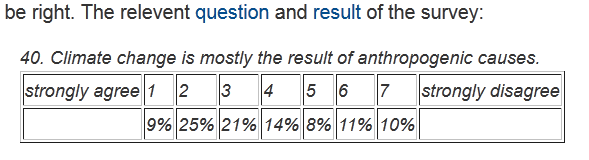
Lewandowsky has stated that an online survey by an opponent was "useless" "without the authors demonstrating the integrity of their data" and that their study "should not have been published without the authors demonstrating the integrity of their data—I doubt that they could". Words that apply even more forcibly to his own study. I guess it all depends on whose ox is being gored.
On Sep 27, 2010, about a month after the Lewandowsky survey was posted at several anti-skeptic blogs, John Cook posted the following at the private SkS forum entitled "Excerpt from Steve [Lewandowsky]'s email". At the time, Hans von Storch and Dennis Bray had just carried out an online survey. Lewandowsky complained that there was "no way to check or verify the integrity of the data" and therefore the data was probably "useless". Lewandowsky said that the study should not have been published "without the authors demonstrating the integrity of their data":
I'm sure Steve won't mind if I excerpt from the email he sent me about von Storch's paper:
Got the paper some time ago and I have corresponded with Bray. He seems like a nice guy but the survey data are apparently compromised by the login and password information having been circulated on a denialist mailing list. I have a copy of that email (via Deltoid).
Bray also violated all internet survey methodological standards by not recording dates, times, and IP numbers of respondents (I know this from him personally). He thus has no way to check or verify the integrity of his data. In other words, the data are possibly (probably?) useless, although the published paper seems to include more data than the previous unpublished report which was entirely compromised as just stated.
Now, all that said, the results are not particularly distressing from our perspective, and he correctly identifies that there is a large segment of the scientific community who think that the IPCC understated the problem.
Overall, though, this study should not have been published without the authors demonstrating the integrity of their data—I doubt that they could.
Lewandowsky himself then commented at the SkS forum on Sep 27 entitled "Background info on survey methodology", favorably citing a critique at Deltoid of methodology in a similar earlier survey, results of which Lewandowsky believed to have been included:
Hi all, see here for background on the survey problems: http://scienceblogs.com/deltoid/2005/05/bray.php
I believe that at least a subset of the data reported in the published paper relies on the data in the unpublished survey critiqued by Deltoid.
By the way, a Swedish journalist, Jens Ergon, has done a better controlled survey of Swedish cllimate scientists and their publications and found the usual 97% agreement on AGW. This was reported on Swedish TV and I have corresponded with him.
Graham Wayne then commented that the "problems of data integrity" put him off writing about the topic:
Well, the problems with the data integrity do throw something of a spanner in the works. If I were to write this up, I don't see how I could be less than candid about the problems, which would in turn sufficiently dilute the value of the research. Climate contrarians will jump on the flaws and hammer them to the exclusion of all else (surprised WUWT didn't do this already), so I'm rather put off writing about it.
Anyone else got a view on the practicality of focusing on this?
The (2005) Deltoid post that Lewandowsky had cited is here, which discussed the following survey result – a result that appears to contradict the "97%" of all climate scientists that is commonly cited:

Lambert commented as follows:
Is global warming skepticism amongst climate scientists as widespread as this survey indicates? To answer this we need to look at how the sampling was conducted:
The 2003 survey was conducted as an on-line survey. The existence of the survey was posted in the Bulletin of the American Meteorological Society, the Climlist server, and was sent to institutional lists in Germany Denmark and the U.K. As an effort to prevent general access to the survey, the survey was password protected. The password was contained in the informative message distributed according to the above.
However, the information about the survey was reposted (mail list membership required to read link) to the climatesceptics mail list by Timo Hameranta on Sep 20 2003: (my emphasis)
the survey (below) is directed to those involved in the natural sciences related to climate change and not, for example, those involved in policy analysis or economic issues.
I suggest that you participate by completing the questionnaire (instructions to participate below).
xxxxxxxxxxxxxxxxxxxxxxxxxxxxxxxxxxxxxxxxxxx
L�hett�j�: CLIMLIST Climatology Distribution List
[mailto:CLIMLIST@...] Puolesta CLIMLIST
L�hetetty: 19. syyskuuta 2003 18:12
Vastaanottaja: CLIMLIST@…
Aihe: Survey of Climate Scientists
CLIMLIST Mailing Number 03-09-24
Origin: "Dr. Dennis Bray"
Due to the nature of the distribution of electronic surveys some recipients of this message might have received the same previously. If that is the case, my apologies. Please do not submit the survey twice, although, once would be much appreciated. The survey is directed to those involved in the natural sciences related to climate change and not, for example, those involved in policy analysis or economic issues. Your discretion in choosing to participate in the survey on this basis would be greatly appreciated, as would your cooperation in making the survey a success. If you know of colleagues not contained on climlist but involved in the climate sciences, it would be appreciated if you could bring this survey to their attention with the suggestion that they too might like to participate by completing the questionnaire. Simply forwarding this message is likely the most convenient method.
… If you do choose to participate, the survey can be reached by opening your web browser and going to the following link:
http://w3g.gkss.de/G/Mitarbeiter/bray.html/
When the page opens click the link to "survey of climate scientists" Here you will be asked for a username and password.
For username enter "respondent" (without quotation marks)
For password enter "ccsurvey" (again without the quotation marks).
The survey is password protected as an effort to limit the respondents to those involved in the climate sciences. There is also the option to print the survey from a PDF file and submit though regular postal services. Electronic submissions do not transmit your email address and consequently anonymity is ensured. Thank you in advance for your cooperation.
Since the survey was anonymous, there is no way to ensure that only climate scientists participated and no way to prevent people from submitting the survey multiple times. Furthermore, the survey was distributed on the climatesceptics list which has over 200 members, almost all of them strongly skeptical about global warming. Since the total number of participants was just 557, this could serious skew the results. I don't believe that the results of this survey are representative of the views of climate scientists.
Lambert then cited a response from Bray at realclimate in which Bray stated:
It would be possible however, should one wish, to submit a duplicate return in the 2003 survey. 2003 surveys were checked for identical response patterns and none existed. Of course this does not mean that a single person could not fill out two surveys using different responses.
Lambert criticized this as follows:
The only thing Bray did to check for multiple responses by the same person was to see if there were any responses that were exact duplicates
As I interpret Lewandowsky's methodology, Lewandowsky's check was whether consecutive responses from the same IP address were identical (but this is only an interpretation of poorly described methodology.)
Lambert summarized his criticism as follows:
While no study is perfect, this study is so imperfect as to be useless. Since it was posted on the climatesceptics list, the sample is not representative. As a social scientist Bray should know this.
It is obvious that all the criticisms leveled by Lewandowsky and Lambert against the von Storch and Bray survey apply even more strongly to his own survey. Applying Lewandowsky's own standards, his own survey is "useless" unless he can demonstrate "data integrity", which he can't.
Instead of demonstrating data integrity, in Lewandowsky's response today (his first non-juvenile response), Lewandowsky argues, in effect, that data integrity doesn't matter – a familiar enough reaction in past paleoclimate disputes.
Lewandowsky, although he was quick to fabricate a jibe at me about a supposed pastrami sandwich, did not respond to or cite my post on this matter, though he did cite Tom Curtis' more limited critique. Nor did Lewandowsky examine the crosscut of data that I had used. Instead, Lewandowsky carried out a different crosscut of the data, arguing that he got similar results with this different crosscut. I placed source code for my analysis online so any critics could readily interpret my conclusions and understand points at issue. Unfortunately Lewandowsky has not dne so, making the process of replication and analysis less efficient than it ought to be. I'll try to take a look at Lewandowsky's most recent post over the next few days.
however, one point is obvious: Lewandowsky's defence is framed in terms of "outliers" as opposed to "data integrity". It seems evident that, using Lewandowsky's own words (about the Bray-con Storch study):
this study should not have been published without the authors demonstrating the integrity of their data—I doubt that they could

Monday, September 10, 2012

Burt Rutan on climate change

Link: http://www.cfact.org/a/2169/Globaloney-exposed-from-outer-space (via shareaholic.com)

...what really drew me into the subject, was when I found that I couldn't obtain the raw data that I was looking for. I was shocked to find that there were actually climate scientists who wouldn't share the raw data, but would only share their conclusions in summary graphs that were used to prove their various theories about planet warming.

Anyone reading this is invited to e-mail Mr. Rutan the raw data.

Saturday, September 08, 2012

ENCODE hype? From now on I'll just reply: #oniontest


ENCODE hype? From now on I'll just reply: #oniontest


via The Panda's Thumb by Nick Matzke on 9/5/12


The science media exploded today with the claim from the ENCODE project that 80% of the genome is "functional". The creationists are already beside themselves with joy. And the problem cannot be blamed on the science media, although I wish they were quicker to exercise independent skepticism – the 80% claim is right there in the abstract of the Nature article.
However, skepticism has arisen spontaneously from all over the scientific blogosphere, facebook, and twitter. You see, most of us scientists know that (a) ENCODE is using an extremely liberal and dubious definition of "function", basically meaning "some detectable chemical activity". People have pointed out that randomly generated DNA sequences would often be "functional" on this definition. (b) All the evidence for relative nonfunctionality which has been known for decades is still there and hasn't really changed – lack of conservation, onion test, etc. But I'm beginning to think that certain parts of molecular biology and bioinformatics are populated with people who are very smart, but who got through school with a lot of detailed technical training but without enough broad training in basic comparative biology.
Anyway, I'd write more, but I'm jammed and Ryan Gregory has said everything I would say, except better: http://www.genomicron.evolverzone.c[…]encode-hype/
See also Larry Moran: http://sandwalk.blogspot.com/2012/0[…]-of-our.html, especially the rather wry comments.
Hashtag: #oniontest

Friday, September 07, 2012

William F. Buckley, Jr. - National Review Online

Link: Ronald Reagan: A Relaxing View


Among other things, the war against Reagan, before he's even elected President.